

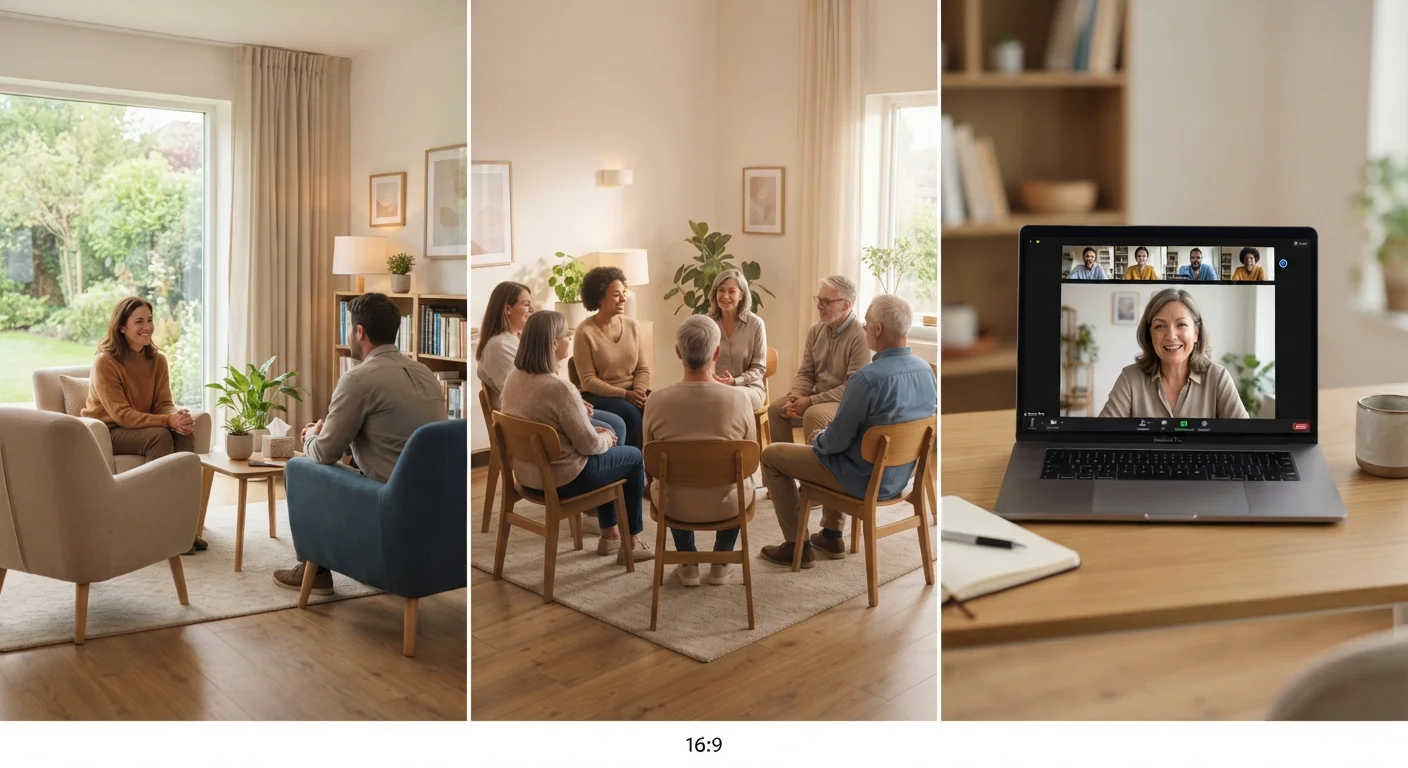
Our Verdict
Each therapy format has a legitimate evidence base and a distinct set of practical trade-offs. Individual sessions suit those who prioritize privacy and tailored treatment. Group therapy can be powerful for building social connection and reducing isolation. Online formats remove barriers for many people who might otherwise not access care at all. The most important step is consulting a qualified mental health professional to find the right fit.
| Best for | Recommended |
|---|---|
| Those seeking personalized, private, in-depth treatment | Individual Therapy |
| Those who benefit from peer support and shared experience | Group Therapy |
| Those with scheduling, mobility, or geographic limitations | Online Therapy |
| Those wanting flexibility alongside structured support | Online Therapy |
What Sets These Three Formats Apart
Therapy is not one-size-fits-all, and the format of treatment matters as much as the therapeutic approach used within it. Individual, group, and online sessions differ in their structure, therapeutic dynamics, cost, and accessibility - and research suggests each can be effective when matched to the right person and goal.
This article offers a factual overview of all three formats to help readers understand what to consider. It is not a substitute for professional mental health assessment. If you are considering therapy, speaking with a licensed clinician is the most reliable path to finding a format that suits your situation.
For a deeper look at specific therapeutic methods, see our overview of CBT and mindfulness-based approaches.
| Individual Therapy | Group Therapy | Online Therapy | |
|---|---|---|---|
| Session Focus | One-on-one, fully personalized | Shared among 6-12 participants | One-on-one or group, remote |
| Privacy Level | Highest - fully confidential | Shared space; group agreements apply | High; depends on home environment |
| Typical Cost Per Session | Generally higher | Generally lower per person | Variable; often comparable to in-person |
| Accessibility | Limited by location and availability | Limited by location and availability | High - removes geographic barriers |
| Peer Connection | Not a feature of the format | Core therapeutic element | Possible in online group formats |
| Evidence Base | Extensive across many conditions | Strong, especially for anxiety, depression | Growing; comparable outcomes for many |
| Scheduling Flexibility | Moderate - fixed appointment times | Moderate - fixed group schedule | High - broader time-slot availability |
Individual Therapy: Personalized and Private
In individual therapy, one client works one-on-one with a licensed mental health professional - such as a psychologist, licensed clinical social worker, or licensed professional counselor. Sessions are typically 45-60 minutes and are tailored entirely to the individual's history, goals, and presenting concerns.
The primary strengths of individual therapy are privacy and depth. The therapeutic relationship itself - sometimes called the working alliance - is one of the most consistently studied predictors of positive outcomes across mental health research. Without the social dynamics of a group, clients can often explore personal material at their own pace.
The main limitations are cost and availability. Individual sessions tend to be the most expensive format, and therapist shortages in many regions can mean long wait times. Insurance coverage varies substantially by plan and provider.
Getting the Most from Individual Sessions
Research consistently shows that the quality of the therapeutic relationship - called the working alliance - is one of the strongest predictors of good outcomes. If you try individual therapy and don't feel a strong sense of trust or collaboration with your therapist after a few sessions, it's reasonable to discuss this openly or consider consulting another provider. A good fit matters.
Group Therapy: Shared Experience as a Therapeutic Tool
Group therapy brings together several clients - typically six to twelve - facilitated by one or more licensed therapists. Groups may be organized around a specific concern (such as grief, social anxiety, or substance recovery) or may be more open in focus.
One of its most documented benefits is universality - the recognition that others share similar struggles, which can reduce shame and isolation. Research published in peer-reviewed clinical journals has found group therapy to be comparably effective to individual therapy for a range of conditions, including depression and anxiety disorders, though individual responses vary considerably.
Group settings also create natural opportunities to practice interpersonal skills in real time, which can be particularly valuable for social anxiety or relationship difficulties. Cost per session is generally lower than individual therapy, making it more accessible for some people. However, the shared environment means less individual airtime, and confidentiality depends on the conduct of all group members - something therapists address through explicit group agreements.
Complementary self-reflection tools can support any therapy format. Our guide on journaling for emotional clarity covers structured writing techniques with an evidence base in mental wellness.
Online Therapy: Access and Flexibility
Online therapy - also called teletherapy or telemental health - delivers individual or group sessions via video, phone, or text-based platforms. The format has expanded significantly in clinical acceptance, particularly following regulatory changes during the COVID-19 pandemic that allowed licensed therapists to treat clients across state lines more broadly (though licensure rules still vary by state and continue to evolve).
A growing body of research supports the effectiveness of video-based therapy for conditions including depression, anxiety, and PTSD, with several systematic reviews finding outcomes comparable to in-person care for many clients. The format substantially reduces barriers related to geography, transportation, disability, and scheduling.
Trade-offs include technology requirements - a reliable internet connection and a private physical space - and the absence of in-person nonverbal cues, which some clinicians consider therapeutically meaningful. Online therapy may not be appropriate for individuals in acute crisis or those whose conditions require closer clinical monitoring; a licensed professional can advise on suitability.
Online Therapy Is Not a Crisis Resource
Online therapy platforms are not equipped to manage psychiatric emergencies. If you or someone you know is experiencing a mental health crisis or thoughts of self-harm, contact the 988 Suicide and Crisis Lifeline (call or text 988 in the U.S.) or go to your nearest emergency room. Always verify that any online therapist is licensed in your state before beginning treatment.
Choosing a Format: What to Weigh
No format is inherently superior. Clinicians often consider factors such as the nature and severity of presenting concerns, a person's comfort with group settings, practical constraints like cost and schedule, and prior treatment history.
Some people move between formats at different life stages - beginning with individual therapy to build foundational skills, then adding group work for peer support, or transitioning to online sessions when circumstances change. A combination approach is not unusual in clinical practice.
Before selecting a format, consider discussing the following with a qualified mental health professional:
- Your primary goals for therapy (symptom relief, skill-building, support, processing specific experiences)
- Your comfort with privacy and group dynamics
- Practical constraints: cost, insurance coverage, location, and scheduling
- Any history that may make one setting more or less appropriate
This article is for general informational and educational purposes only and does not constitute medical or mental health advice. Always consult a qualified, licensed mental health professional for guidance specific to your situation.
~42%
U.S. adults reporting unmet mental health care needs
According to the National Alliance on Mental Illness (NAMI), access barriers - including cost and provider availability - remain a major obstacle to care for millions of Americans.
Comparable
Outcomes: online vs. in-person therapy
Multiple systematic reviews, including work published in journals such as the Journal of Affective Disorders, have found video-based therapy produces outcomes broadly comparable to face-to-face sessions for depression and anxiety in many populations.
The content on this site is for informational purposes only and is not a substitute for professional advice. Always consult a qualified professional for guidance specific to your situation.