

Why Filter Ratings Exist — and Why There Are So Many
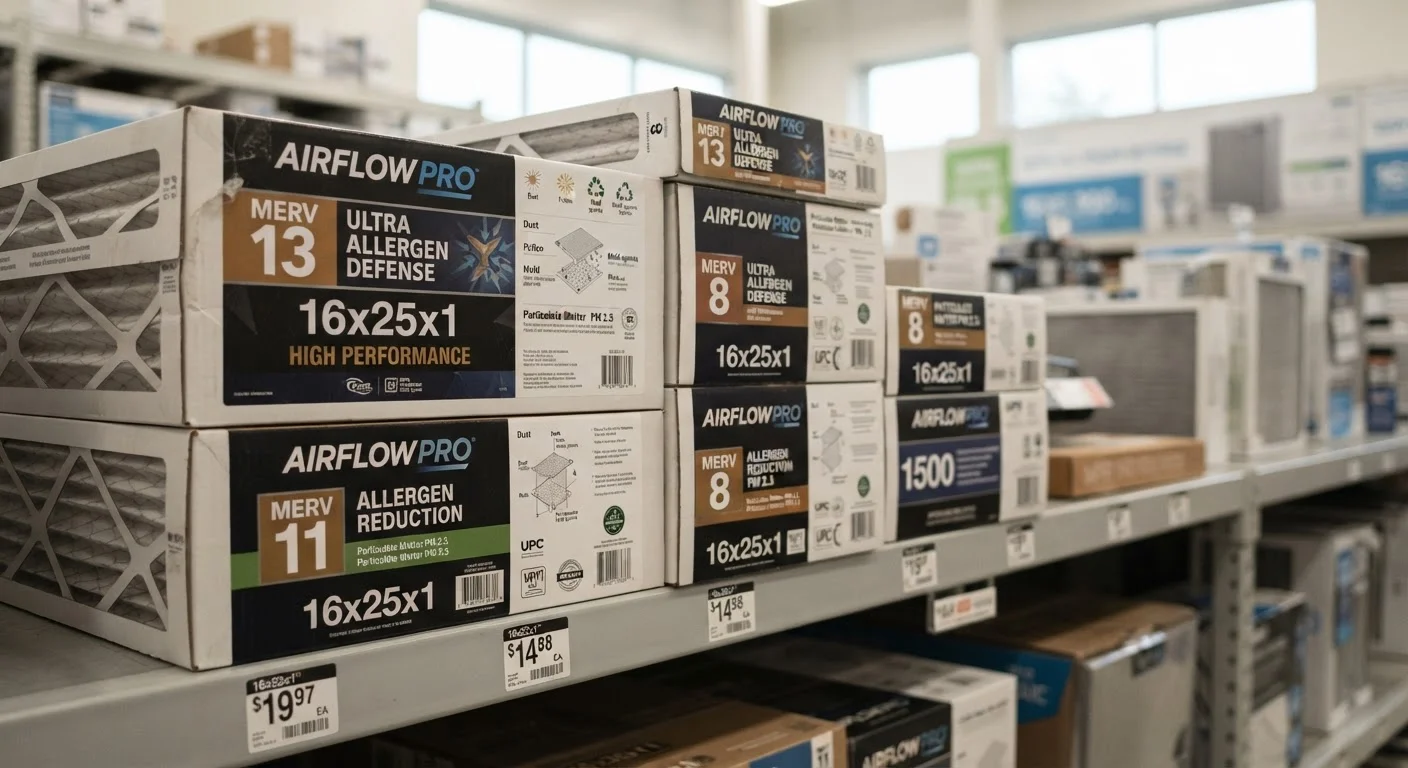
Stand in the filter aisle long enough and you'll spot at least three different number systems on the packaging: MERV, MPR, and FPR. None of them are interchangeable, and each was created by a different organization for a different purpose. Rather than a single universal standard, the market evolved with competing systems — which is exactly why the packaging feels confusing.
The good news: once you understand what each rating is actually measuring, choosing the right filter becomes much more straightforward. Think of it like decoding smartphone specs — the numbers mean something specific once you know the framework.
| Rating Systems in Common Use | 3 (MERV, MPR, FPR) |
| Only Third-Party Standard | MERV (developed by ASHRAE) (ASHRAE Standard 52.2) |
| Typical Residential MERV Range | MERV 5–13 |
| Recommended Replacement Frequency | Every 1–3 months (varies by filter type and household) (U.S. Department of Energy guidance) |
| FPR Scale Range | 1–10 |
| MPR Scale Range | 300–2800 |
MERV, MPR, and FPR: A Plain-Language Breakdown
MERV (Minimum Efficiency Reporting Value) is the most widely recognized system and the only one developed by a neutral standards body — ASHRAE (the American Society of Heating, Refrigerating and Air-Conditioning Engineers). It runs from 1 to 20. Residential filters typically fall between MERV 5 and MERV 13. Higher numbers capture smaller particles, but they also restrict airflow more. Most homes do well in the MERV 8–11 range.
MPR (Microparticle Performance Rating) was created by a single filter manufacturer and measures how well a filter captures particles smaller than 1 micron — things like smoke, bacteria, and some mold spores. MPR values typically range from 300 to 2800. Because it was developed internally, it only appears on that manufacturer's products and cannot be directly compared across brands.
FPR (Filter Performance Rating) is a 1–10 scale developed by a major home improvement retailer for filters sold in their stores. It combines particle capture efficiency and airflow restriction into one number and uses a color-coded label. Like MPR, it is proprietary and brand-specific.
MERV
Minimum Efficiency Reporting Value. A standardized 1–20 scale developed by ASHRAE that measures how effectively a filter captures airborne particles of different sizes. It is the only major filter rating based on a third-party industry standard.
MPR
Microparticle Performance Rating. A proprietary rating created by one filter manufacturer to measure capture of particles smaller than 1 micron. Values typically range from 300 to 2800 and are not comparable across brands.
FPR
Filter Performance Rating. A 1–10 proprietary scale developed by a major retailer for filters sold in their stores. It combines filtration efficiency and airflow resistance into a single color-coded score.
Airflow Restriction
The degree to which a filter slows the movement of air through your HVAC system. Higher-efficiency filters capture more particles but tend to restrict airflow more, which can strain the system if not matched to its specifications.
Micron
A unit of measurement equal to one millionth of a meter. HVAC filter ratings often reference micron sizes to describe the smallest particles a filter can capture. A human hair is roughly 70 microns in diameter.
Understanding indoor air quality more broadly can help you decide which rating tier makes sense for your household — see our guide on why indoor air quality deserves more attention for context.
How to Choose the Right Rating for Your Home
Because MERV is the only system based on a third-party standard, it is the most useful benchmark when comparing filters across brands. Use the rough equivalencies below as a guide:
- MERV 1–4: Fiberglass panel filters. Capture only large debris like lint and dust bunnies. Not suitable for air quality improvement.
- MERV 5–8: Good baseline for most homes. Captures mold spores, pet dander, and larger dust particles.
- MERV 9–12: Better filtration for households with pets, allergy sufferers, or smokers. Captures fine dust and some bacteria.
- MERV 13–16: Near-hospital grade. Can capture very small particles, but may restrict airflow enough to strain older HVAC systems — check your system's documentation before upgrading.
Check Your HVAC System's Specifications First
Not every HVAC system can handle a high-MERV filter. Older or lower-powered systems may suffer reduced efficiency or mechanical strain if the filter creates too much airflow resistance. Your owner's manual or an HVAC technician can tell you the maximum MERV rating your system supports. This is especially important before upgrading to MERV 13 or higher.
One important caution: a higher MERV rating is not always better for your system. Filters that are too restrictive reduce airflow, which forces your HVAC to work harder and can shorten its lifespan. When in doubt, consult your system's owner manual or an HVAC technician before moving up more than two or three MERV levels.
MERV 8–11
Sweet spot for most residential homes
This range balances particle capture efficiency with adequate airflow for standard residential HVAC systems, according to ASHRAE guidance.
1 micron
Threshold targeted by high-efficiency filters
Filters rated MERV 13 and above are designed to capture particles at or below 1 micron, including some bacteria and fine combustion particles.
The content on this site is for informational purposes only and is not a substitute for professional advice. Always consult a qualified professional for guidance specific to your situation.