

Option A
General Online Reviews
The broad, unverified crowd opinion.
Best for: Getting a wide range of perspectives, including edge cases and subjective experiences, before buying.
Option B
Verified Purchase Reviews
The confirmed-buyer signal.
Best for: Readers who want a higher-confidence baseline that the reviewer actually owns and used the product.
Why the Star Average Is Only Part of the Story
A 4.6-star rating sounds reassuring — until you learn it's based on 11 reviews, eight of which arrived within a single week. Star averages compress a lot of complexity into one number, and that compression can mislead shoppers who don't look underneath it.
Both general online reviews and verified purchase reviews contribute to that average on most platforms, but they carry different levels of accountability. Understanding the difference is one of the more practical skills in modern consumer decision-making — and it pairs directly with other habits like spotting a real-value checklist before purchasing.
| Criterion | General Online Reviews | Verified Purchase Reviews |
|---|---|---|
| Who can post | Any registered account | Confirmed buyers only |
| Risk of fake reviews | Higher — lower barrier to post | Lower — requires a real transaction |
| Captures gift recipients | Yes | Typically no |
| Platform definition consistency | N/A | Varies by retailer |
| Usefulness for niche feedback | Broader range of contexts | Limited to direct purchasers |
| Incentivized review risk | High | Still possible via post-purchase prompts |
What 'Verified Purchase' Actually Means — and Doesn't
A verified purchase label means the platform confirmed that the reviewer bought the item through that retailer. It does not mean the review is unbiased. A seller can still ask buyers — sometimes via a follow-up email or a discount coupon — to leave a positive review after purchasing. The transaction is real; the review may still be influenced.
Definitions also vary by platform. Some marketplaces verify that a transaction occurred without confirming the item received matched the one reviewed. Others use thresholds around purchase timing or account age. When in doubt, check the platform's own help documentation for what its verified badge actually covers.
The FTC's Stance on Incentivized Reviews
The U.S. Federal Trade Commission requires that material connections between reviewers and sellers — including free products, discounts, or payments — be clearly disclosed. Undisclosed incentivized reviews violate FTC guidelines regardless of whether the transaction was verified by the platform. If you spot a review that reads like a testimonial but lacks any disclosure, treat it with extra skepticism.
Despite these limitations, verified purchase reviews do raise the baseline of accountability. Fabricating them at scale requires creating fake buyer accounts and completing actual transactions — a higher bar than simply creating a free account and posting.
Reading the Full Review Profile, Not Just the Badge
Experienced shoppers look beyond the badge. Here are the signals that matter most:
- Review velocity: A sudden spike in reviews — especially five-star ones — within a short window is a red flag, whether or not they're verified.
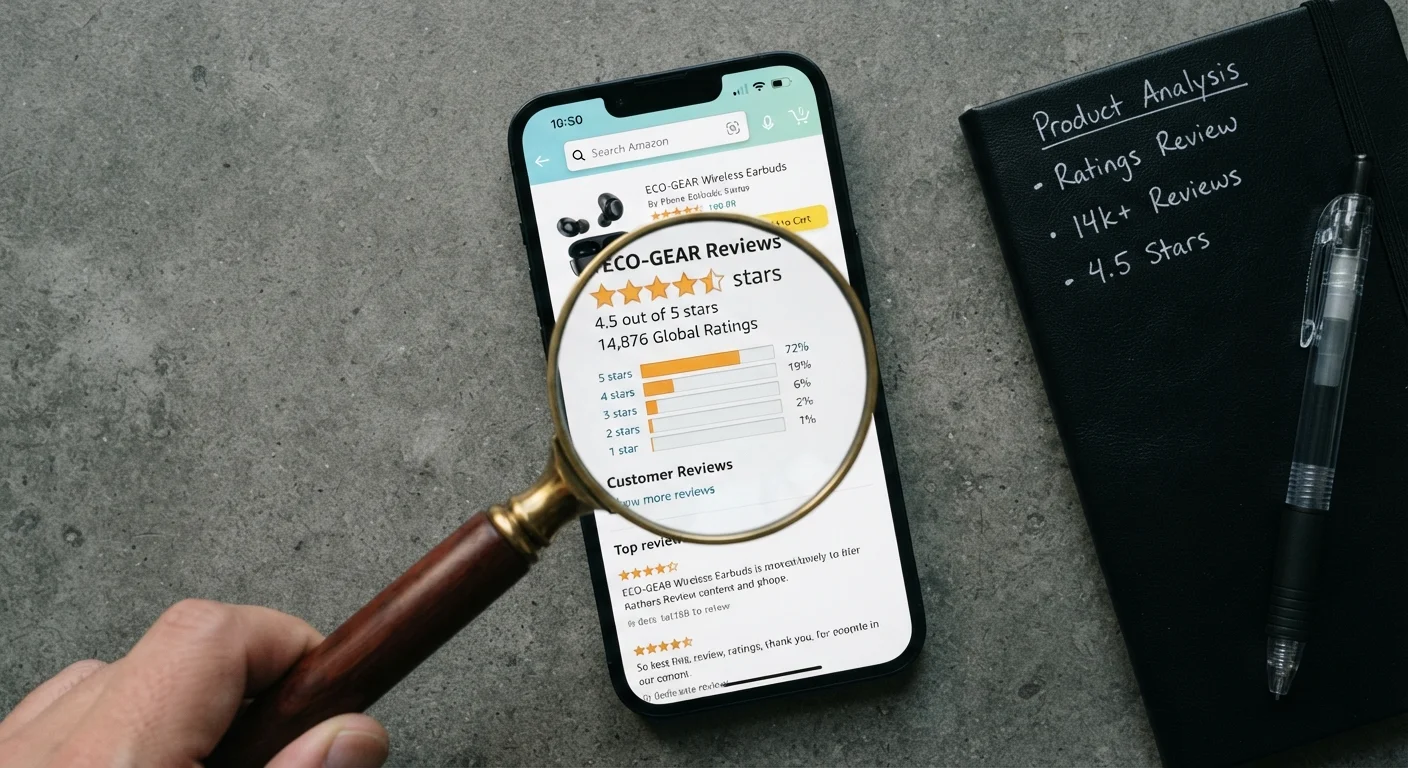
- Rating distribution: A product with 94% five-star and 6% one-star reviews, and almost nothing in between, can indicate suppressed or manipulated feedback. Authentic products usually show a more natural spread.
- Review depth: Detailed reviews that mention specific use cases, product dimensions, or comparisons with alternatives tend to be more informative than single-sentence praise.
- Recency relative to product age: Old reviews may not reflect current manufacturing quality, formula changes, or software updates.
These same habits apply when evaluating quality without a brand name to rely on — the evidence is in the details, not the label.
42%
Fake or misleading online reviews
A 2023 analysis by the Federal Trade Commission found that a substantial share of online reviews across major platforms may be fake, incentivized, or otherwise misleading.
1-star & 2-star
Most informative rating band
Consumer research consistently shows that critical reviews with detailed explanations help shoppers identify genuine product weaknesses more reliably than average star scores.
When Unverified Reviews Carry Legitimate Weight
Unverified doesn't automatically mean unreliable. A person who received a product as a gift, used it in a professional context, or purchased it from a different channel may leave an unverified review that's entirely honest. The absence of a badge is a signal to read more carefully — not a reason to dismiss the feedback outright.
Cross-platform comparison can help. If the same product earns consistent criticism across Amazon, a specialty retailer, and an independent review site — each with different verification systems — the pattern is more credible than any single platform's rating. This is especially useful when pricing signals are also unclear, such as when a product is marketed as heavily discounted but the original price is hard to verify. That context connects to how manufactured discounts distort purchase decisions.
The goal is triangulation: use review type as one input among several, not as a binary trust switch. A purchase decision built on rating averages alone — verified or not — is incomplete. Check the Finding Real Value hub for a fuller framework on separating genuine quality signals from marketing noise.
This article is for general informational and educational purposes only and does not constitute financial, legal, or professional advice. Always conduct your own research before making purchasing decisions.
The content on this site is for informational purposes only and is not a substitute for professional advice. Always consult a qualified professional for guidance specific to your situation.