

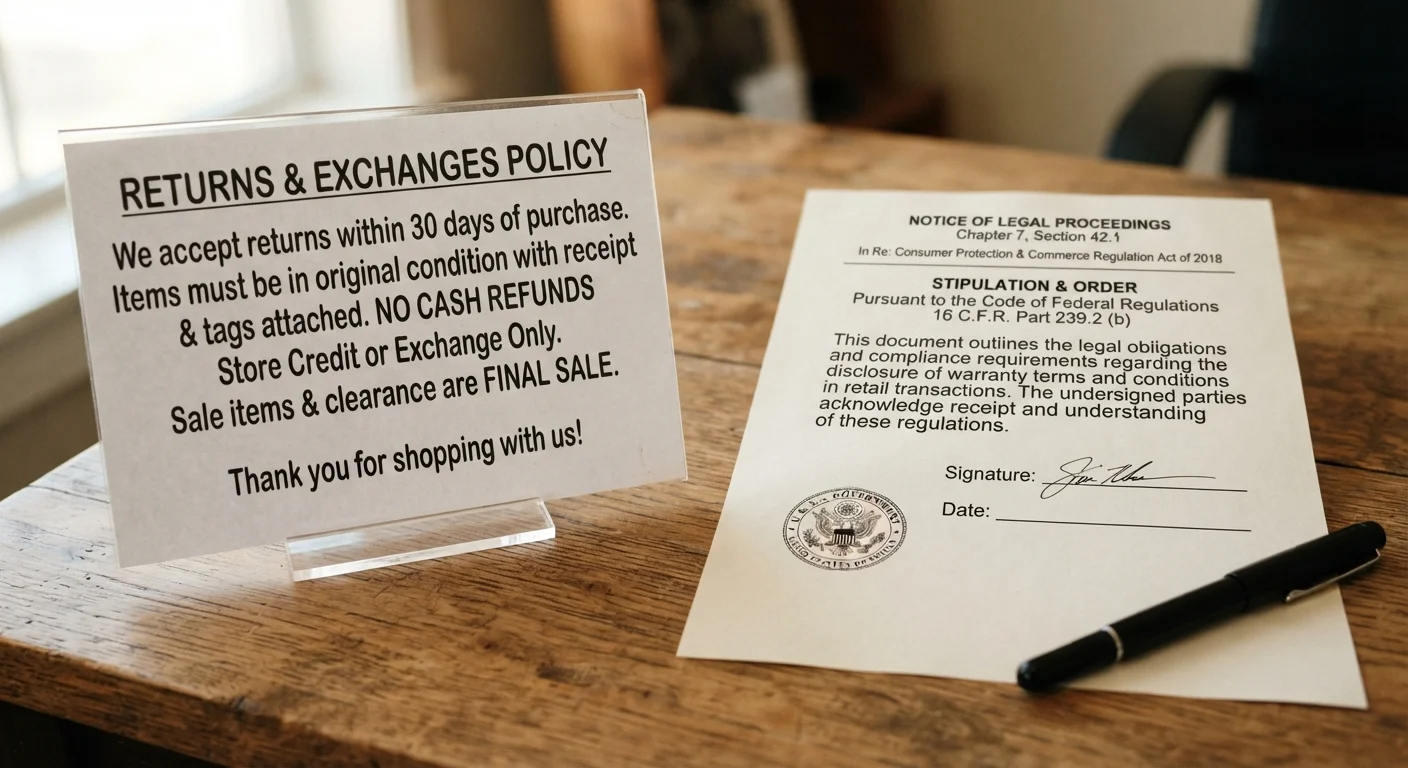
Option A
Store Return Policies
The retailer's voluntary rules — generous or restrictive at their discretion.
Best for: Understanding what a specific retailer will accept back, under what conditions, and within what timeframe.
Option B
Statutory Consumer Rights
Legal protections that apply regardless of what any policy says.
Best for: Asserting your right to a remedy when goods are faulty, misdescribed, or unfit for purpose — no receipt required.
Two Very Different Things That Shoppers Often Conflate
When you walk up to a customer service desk with a broken blender, the employee will almost certainly quote the store's return policy. That policy is a real thing — but it is not the limit of your options. Statutory rights exist on a separate legal track, and understanding the difference is the first step to not leaving money on the table.
A store return policy is a voluntary framework the retailer sets. They can make it generous — 365-day no-questions-asked returns — or restrictive — final sale on all clearance items. It is entirely up to them, within certain disclosure requirements. If you're navigating the fine print around these policies, our guide to retail return policies breaks down restocking fees, receipt requirements, and common gaps.
Statutory consumer rights, by contrast, are legal minimums set by federal and state law. The Magnuson-Moss Warranty Act governs written warranties on consumer products at the federal level. State consumer protection statutes — which vary but exist in every U.S. state — generally require that goods be fit for their ordinary purpose, free from material defects, and match their description. These rights exist whether the store posts a return policy or not.
| Criterion | Store Return Policy | Statutory Rights |
|---|---|---|
| Who sets it | The retailer, voluntarily | Federal and state law |
| Can it be taken away? | Yes — stores can change policies | No — legal rights cannot be waived by a sign |
| Covers change of mind? | Often yes, within the window | Generally no |
| Covers defective goods? | Sometimes, subject to conditions | Yes, as a legal baseline |
| Time limit | Set by the store (e.g., 30–90 days) | Varies by statute and defect type |
| Remedy offered | Refund, exchange, or store credit | Repair, replacement, or refund |
| Receipt required? | Usually yes | Not always — proof of purchase may suffice |
Where Store Policies End and Legal Rights Begin
The critical moment is when a product is defective, misdescribed, or unfit for its intended purpose. At that point, a retailer's posted policy does not cap your remedies. Courts and consumer protection agencies have consistently held that a boilerplate 'all sales final' sign does not extinguish a buyer's right to seek remedy for a faulty product.
50
U.S. states with consumer protection statutes
Every U.S. state has enacted some form of consumer protection law, though scope and remedies vary significantly by jurisdiction.
4 years
Typical UCC implied warranty claim window
Under the Uniform Commercial Code as adopted by most states, buyers generally have up to four years to bring a claim for breach of implied warranty from the date of sale.
~$5,000–$10,000
Typical small claims court limit
Small claims court monetary limits vary by state but typically fall in this range, offering consumers a low-cost legal venue without an attorney.
State lemon laws cover vehicles specifically, and many states have broader implied warranty protections covering everyday consumer goods. The implied warranty of merchantability — a concept embedded in the Uniform Commercial Code, which most states have adopted — means a product must basically work as intended. If it doesn't, you have a legal basis for a remedy even past a return window.
For a plain-language breakdown of these terms, the Consumer Rights Glossary defines key concepts like implied warranty, right of rescission, and 'as-is' sales so you know exactly what each term means for your situation.
Practical Steps When a Store Won't Budge
If a retailer cites its return policy to reject what is actually a valid statutory claim, you have escalation paths that don't require a lawyer.
- Document everything. Keep your receipt, any warranty documentation, photos of the defect, and records of every communication with the retailer.
- Invoke your warranty rights in writing. A written request citing the implied warranty of merchantability creates a paper trail and often prompts a resolution that a verbal complaint does not.
- File a chargeback. If you paid by credit card, your card issuer can dispute the charge for goods that were not as described or were defective. This is separate from the store's own process.
- Complain to your state attorney general. Most state AG offices have consumer protection divisions that handle retailer complaints at no cost to you.
- Small claims court. For amounts typically under $5,000–$10,000 (limits vary by state), small claims court is accessible without an attorney and is a legitimate remedy retailers take seriously.
Our guide to disputing a defective product walks through each of these escalation steps in detail. And before your next major purchase, understanding your post-purchase rights can help you avoid being caught off guard.
Watch Out for Store Credit Pressure
If a retailer offers you store credit as a resolution to a defective product claim, accepting it may complicate or foreclose your ability to pursue a stronger remedy — such as a full cash refund — under statutory rights. There is no obligation to accept store credit when a legal remedy applies. It is worth knowing your options before agreeing to any settlement at the service desk.
This article is for general informational purposes only and does not constitute legal advice. Consumer protection laws vary by state. Consult a qualified attorney or your state attorney general's office for guidance specific to your situation.
The content on this site is for informational purposes only and is not a substitute for professional advice. Always consult a qualified professional for guidance specific to your situation.