

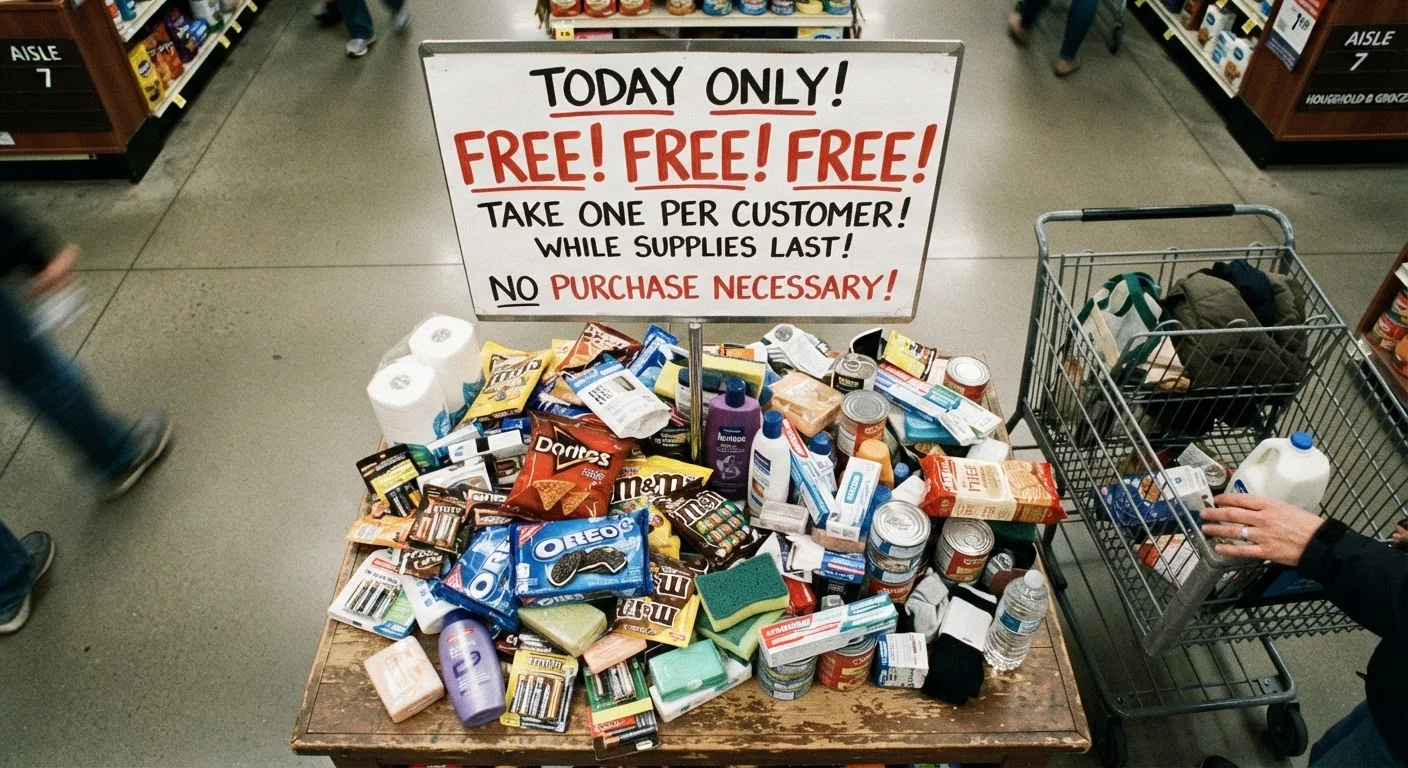
How 'Free' Hijacks Your Decision-Making
Behavioral economists have documented what's sometimes called the 'zero price effect': people respond to a price of zero not just as a very low cost, but as a fundamentally different category of offer. That shift in perception is exactly what retail marketing is built around. When something is labeled free, the brain reduces its scrutiny of the overall transaction — and that's when the real cost slides in unnoticed.
This isn't about shoppers being careless. It's a predictable cognitive response that works on most people most of the time. Retailers invest significant resources in structuring promotions that trigger it. Understanding the mechanics doesn't make you immune, but it does give you a framework to pause and do the math.
Free offers almost always fall into one of five structures, each with its own cost-shifting mechanism. The mistakes below map directly to those structures. For a broader look at how pricing presentation distorts perceived value, see when a 'sale' isn't really a sale.
65%
Shoppers who add items just to qualify for free shipping
A National Retail Federation survey found roughly two-thirds of online shoppers have added unplanned items to a cart solely to meet a free shipping minimum.
48%
Free trial users who forget to cancel before billing
Consumer research by C+R Research found nearly half of respondents had been charged for a subscription they thought they had cancelled or forgotten about entirely.
The Five 'Free' Traps and How to Step Around Them
Each of the following mistakes follows the same template: a 'free' label shifts your focus away from the actual transaction cost. The antidote in every case is identical — isolate the offer from the anchor and calculate what you're actually spending per unit, per use, or per period.
Chasing free shipping thresholds by adding items you wouldn't have otherwise bought.
Why it happens: Paying for shipping feels like a penalty, while reaching a threshold feels like a win. Retailers set those thresholds precisely above average order values to exploit this feeling.
Treating BOGO (buy-one-get-one) as an automatic 50% discount without checking the unit price.
Why it happens: Shoppers anchor on the word 'free' and skip price verification. Retailers sometimes raise the price of the first unit before launching a BOGO promotion.
Accepting a 'free gift with purchase' that requires hitting a minimum spend you wouldn't have reached organically.
Why it happens: The perceived value of the gift feels like a bonus, but it often functions as a spend incentive — not a reward for loyalty.
Signing up for free trials without tracking the cancellation deadline.
Why it happens: The immediate benefit (access, content, service) is tangible; the future charge feels abstract. Retailers rely on inertia and complex cancellation flows to convert trial users.
Assuming 'free returns' eliminates the true cost of a return transaction.
Why it happens: The label 'free returns' implies zero friction, but restocking fees, return-shipping label requirements, and narrow return windows all have real costs in time and sometimes money.
Spending More to 'Unlock' Free Shipping
If your cart is at $43 and free shipping kicks in at $50, you may feel compelled to add another item. Unless that item was already on your list at a price you'd have paid independently, you haven't saved on shipping — you've spent $7 or more to avoid a $6.99 fee. Do the arithmetic before you add to cart.
For a complete picture of what a purchase will actually cost you beyond the sticker, the framework laid out in total cost of ownership applies directly here. Shipping, auto-renewals, and restocking fees are all part of the real price.
Free Trials Frequently Convert to Paid Plans
Many free trial offers require a credit card upfront and auto-renew at full price the moment the trial period ends. The Federal Trade Commission has taken action against companies that made cancellation deliberately difficult. Before starting any free trial, note the exact end date and the cancellation process — in writing, not just in memory.
The same dynamic appears in digital products. If you've ever wondered why apps are free to download, the hidden cost of free apps explains the business models behind no-cost software — including what you trade when money isn't the currency.
The content on this site is for informational purposes only and is not a substitute for professional advice. Always consult a qualified professional for guidance specific to your situation.