

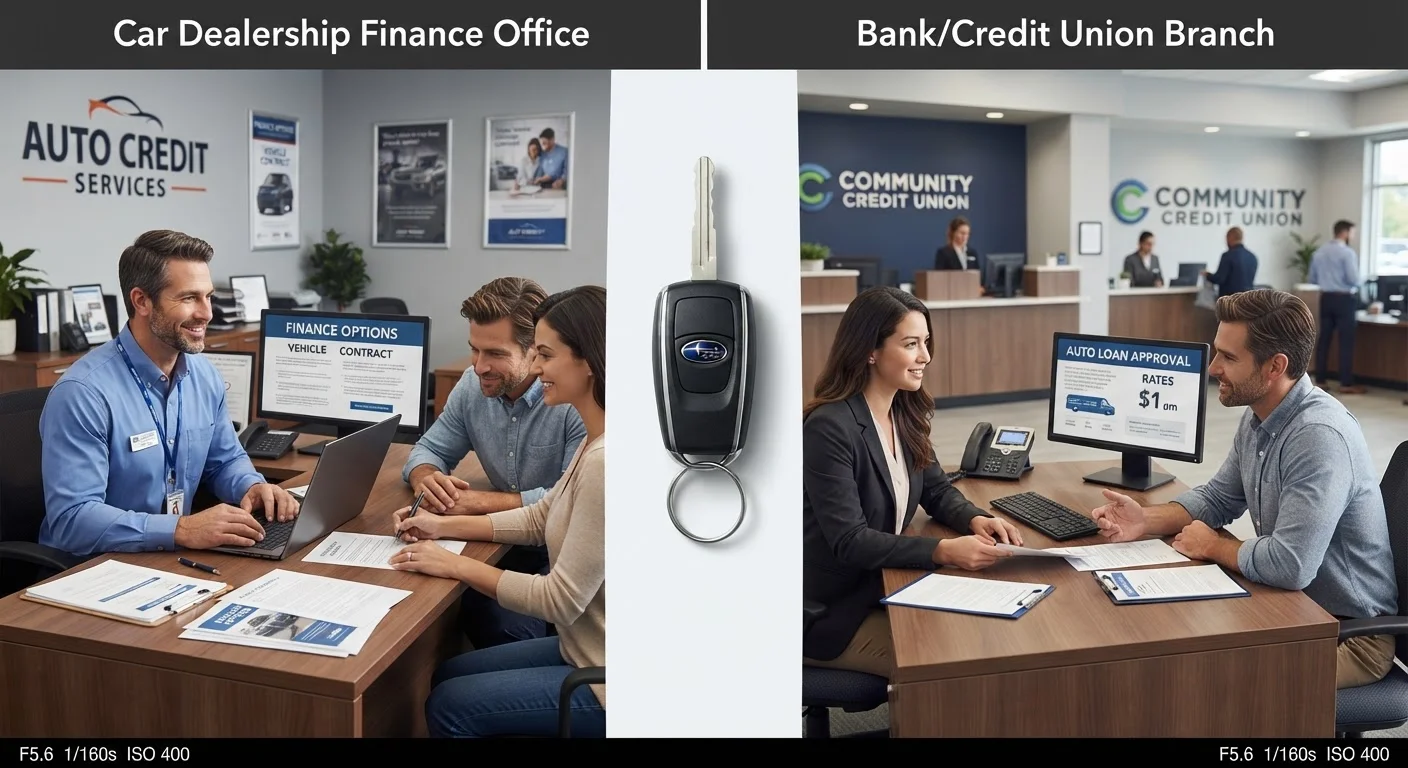
Option A
Dealer Financing
The convenient, one-stop financing option at the point of sale.
Best for: Buyers who want a streamlined purchase process and may qualify for promotional rates on new vehicles.
Option B
Bank or Credit Union Loans
The independent financing route that puts rate-shopping power in your hands.
Best for: Buyers who want to compare rates in advance and enter the dealership with a pre-approved offer.
How Each Financing Path Works
When you finance through a dealership, you're not borrowing directly from the dealer. Instead, the dealer submits your application to one or more of its partner lenders - banks, captive finance arms (the manufacturer's own lending division), or finance companies - and presents you with an offer. The dealer often earns what's called a "dealer reserve," a markup added to the lender's base rate. That spread is the dealer's compensation for arranging the loan.
When you go directly to a bank or credit union, you apply independently and, if approved, receive a loan commitment letter or pre-approval certificate. You then bring that offer to the dealership as a buyer who already has financing lined up. Credit unions, which are member-owned nonprofits, sometimes offer lower rates than commercial banks because they return earnings to members rather than shareholders - though this varies by institution and your credit profile.
Understanding this structural difference is foundational. As our guide on common car-shopping myths explains, the idea that dealers always beat banks on rates isn't reliably true - it depends heavily on the situation.
| Criterion | Dealer Financing | Bank or Credit Union Loans |
|---|---|---|
| Where loan originates | Third-party lender via dealer | Directly from financial institution |
| Rate transparency | Rate may include dealer markup | Posted rates, no intermediary markup |
| Promotional 0% APR | Available on select new vehicles | Not available |
| Application process | Completed at dealership | Done independently before shopping |
| Negotiating position | Financing and price negotiated together | Price negotiated separately as pre-approved buyer |
| Credit flexibility | Access to multiple lender networks | Single institution's criteria apply |
| Best fit vehicle type | New vehicles with manufacturer programs | New or used vehicles |
Rates, Promotions, and the True Cost of Convenience
Dealer financing's biggest selling point is the promotional rate - sometimes advertised as 0% APR for a set term. These offers are real, but they come with conditions: they typically require excellent credit, apply only to specific new-model vehicles, and may be offered in lieu of a cash rebate. If you'd have qualified for a rebate, you'll want to calculate whether accepting the cash and taking a market-rate loan costs less overall.
Outside of promotional windows, dealer-arranged rates are often higher than what a well-qualified borrower could secure independently. The dealer markup can range from a fraction of a percentage point to several points above the lender's buy rate. On a multi-year loan, even one additional percentage point adds meaningful dollars to your total interest paid.
~80%
New car buyers who finance through dealerships
Industry data from sources including J.D. Power has consistently shown the large majority of financed new-vehicle purchases are arranged at the dealership.
1-3%
Typical dealer interest rate markup range
Consumer finance research suggests dealers commonly add between one and three percentage points above a lender's base buy rate, though this varies by lender agreement and state law.
Banks and credit unions post their standard rates publicly, which makes comparison straightforward. Getting pre-approved by two or three lenders before visiting a dealership gives you a concrete benchmark. If the dealer can beat or match it - including through a legitimate promotional offer - you benefit. If not, you use your pre-approval. Either way, you're in control. For a deeper look at how your borrowing history affects what any lender will offer, see how credit scores affect auto loan rates.
Process, Speed, and Flexibility
Dealer financing wins on pure convenience. You select a vehicle, sit down with the finance and insurance (F&I) manager, and drive away the same day with financing arranged. For buyers who want a single-stop experience, this simplicity is a real advantage.
Bank and credit union loans require more legwork upfront: applications, document submission, and waiting for approval decisions - which can take anywhere from minutes (online lenders) to a few business days (some credit unions). However, that upfront work pays dividends at the dealership. Arriving pre-approved means you're negotiating the vehicle's price as a near-cash buyer, rather than mixing the financing conversation into price discussions - a distinction worth understanding before you sign anything. Our breakdown of car purchase contract terms covers the key loan language you'll encounter regardless of which path you choose.
Pre-Approval Doesn't Lock You In
Receiving a pre-approval from a bank or credit union is not a binding commitment to use that lender. It simply gives you a rate benchmark to bring to the negotiating table. If the dealer offers a verifiably better rate - particularly through a manufacturer promotion - you can decline your pre-approval and accept the dealer's terms. Think of it as a floor, not a ceiling.
One practical note: if you're deciding between buying outright versus leasing, the financing structure changes significantly. The buying vs. leasing comparison walks through those trade-offs separately.
The content on this site is for informational purposes only and is not a substitute for professional advice. Always consult a qualified professional for guidance specific to your situation.