

How Lenders Translate Your Score Into a Rate
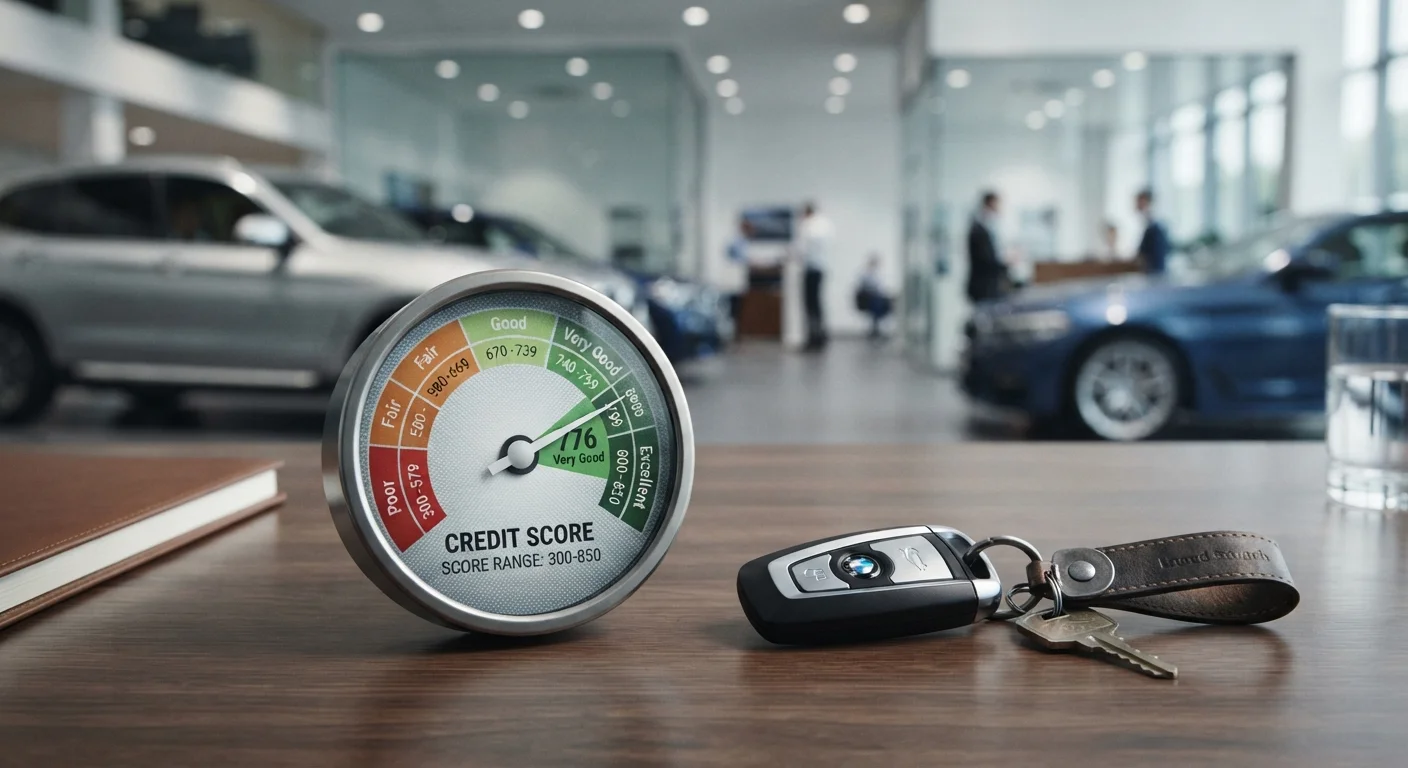
When you apply for an auto loan, the lender doesn't just check whether you qualify - they use your credit score to slot you into an interest rate tier. Think of it like a staircase: each step represents a score range, and the higher you stand, the lower your rate. Lenders call this risk-based pricing, and it's the norm across virtually every bank, credit union, and dealership financing office in the country.
The tiers typically look something like this:
- Super-prime (720+): Lowest available rates, best loan terms
- Prime (660-719): Competitive rates, minor adjustments
- Near-prime (620-659): Moderate rates, some term restrictions
- Subprime (580-619): Elevated rates, stricter conditions
- Deep subprime (below 580): Highest rates, often requiring larger down payments
These thresholds vary by lender and whether you're financing a new or used vehicle - used car loans typically carry higher baseline rates. Understanding where your score falls before you walk into a dealership is genuinely useful preparation. See our comparison of dealer financing vs. bank and credit union loans to understand how different lenders apply these tiers in practice.
$9,000+
Extra interest paid by subprime vs. prime borrowers
Based on illustrative calculations comparing a 5% vs. 16% APR on a $30,000, 60-month auto loan - a common scenario in the US market.
720+
Score threshold most lenders use for best rates
Industry guidance from FICO and major auto lenders consistently places the 'super-prime' tier at approximately 720 and above, though cutoffs vary by lender.
~14-45 days
Rate-shopping window with minimal credit impact
Credit bureaus generally treat multiple auto loan inquiries within this period as a single inquiry, allowing borrowers to compare offers safely.
The Real Dollar Cost of a Lower Score
Abstract rate differences become concrete when you apply them to an actual loan. Consider two borrowers financing the same $30,000 vehicle over 60 months. One has excellent credit and qualifies for a 5% APR; the other has poor credit and receives a 16% APR. The first borrower pays roughly $566 per month and about $3,968 in total interest. The second pays approximately $730 per month and more than $13,800 in total interest - a difference of over $9,800 on the exact same car.
That gap doesn't just affect your monthly budget. It affects the real total cost of car ownership when stacked alongside insurance, maintenance, and fuel. A loan carrying excessive interest can quietly make a modestly priced vehicle far more expensive than a pricier car financed at a low rate.
“The interest rate on your auto loan can easily cost you more than any optional add-on or extended warranty - yet most buyers spend far less time negotiating it. Your credit score is the single biggest variable you control before you ever step onto a lot.”
— Consumer Financial Education Perspective, General guidance drawn from published consumer finance education principles
What You Can Do Before Applying
Your credit score isn't fixed - it responds to specific financial behaviors over time. Even modest improvements in the months before an auto loan application can shift you into a better rate tier. Focus on the factors that carry the most weight:
- Pay down revolving balances. Credit utilization - how much of your available credit card limit you're using - has an outsized effect on your score. Getting utilization below 30% (ideally below 10%) can produce meaningful score gains relatively quickly.
- Check your credit reports for errors. Inaccurate late payments, duplicate accounts, or accounts that aren't yours can suppress your score unfairly. You can request free reports from each major bureau at AnnualCreditReport.com and dispute errors directly with the bureau.
- Avoid opening new credit lines right before applying. Each new account lowers your average account age and generates a hard inquiry, both of which can temporarily reduce your score.
- Keep existing accounts open. Closing old accounts shortens your credit history and reduces available credit, which can nudge utilization upward.
These steps won't transform a 580 into an 750 overnight, but they represent genuine, evidence-based levers. Also be aware that some common assumptions about car financing don't hold up - our article on car shopping beliefs that can cost you money examines several of them in detail.
Get Pre-Approved Before You Shop
Securing a pre-approval from your bank or credit union before visiting a dealership gives you a concrete rate benchmark. It also means you already know your tier - removing the uncertainty that dealers can sometimes exploit when buyers don't know what rate they qualify for. Pre-approval typically results in only a soft or limited hard inquiry depending on the lender.
Reading the Fine Print on Your Loan Offer
Once you have a loan offer in hand, the key figure to focus on is the annual percentage rate (APR), not just the interest rate. APR includes fees and other costs folded into a single annualized figure, making it the most apples-to-apples comparison across lenders. Our plain-language guide to car contract terms explains APR and other key figures you'll encounter when signing.
Also pay attention to the loan term. A longer term - say 72 or 84 months - lowers your monthly payment but increases total interest paid, especially at higher rates. For borrowers in lower credit tiers, a shorter term at the same rate can sometimes reduce total cost meaningfully, though it raises the monthly payment. Weigh both dimensions rather than anchoring solely on what's most affordable each month.
Shopping multiple lenders before settling on financing is one of the highest-leverage steps you can take. Pre-approval from your bank or credit union gives you a concrete baseline rate to bring to the dealership - and that context alone can shift the negotiation in your favor.
This article is for general informational and educational purposes only and does not constitute personalized financial or legal advice. Consult a qualified financial professional for guidance specific to your situation.
Frequently Asked Questions
Most lenders reserve their lowest rates for borrowers with scores of 720 or higher, sometimes called 'prime' or 'super-prime' tiers. That said, exact cutoffs vary by lender, loan term, and whether the vehicle is new or used. Checking with multiple lenders before visiting a dealership gives you a realistic picture of where you stand.
The impact can be significant. On a $30,000 loan over 60 months, the difference between a 5% APR (good credit) and a 15% APR (poor credit) is roughly $150 more per month and over $8,500 extra in total interest. Exact figures depend on loan amount, term, and lender.
A hard inquiry - which happens when a lender pulls your credit - can cause a small, temporary dip of a few points. However, credit bureaus typically treat multiple auto loan inquiries made within a short window (around 14-45 days) as a single inquiry, so rate-shopping multiple lenders has minimal net impact.
Yes, many lenders - including some credit unions and specialized subprime lenders - approve borrowers with scores below 600. However, the interest rates are substantially higher, and loan terms may be more restrictive. Improving your score even modestly before applying can meaningfully reduce what you'll pay.
Not necessarily. Many auto lenders use FICO Auto Scores, which are industry-specific models that weight auto loan repayment history more heavily. Your FICO Auto Score can differ noticeably from your generic FICO score, which is why understanding which score a lender uses matters.
The content on this site is for informational purposes only and is not a substitute for professional advice. Always consult a qualified professional for guidance specific to your situation.