

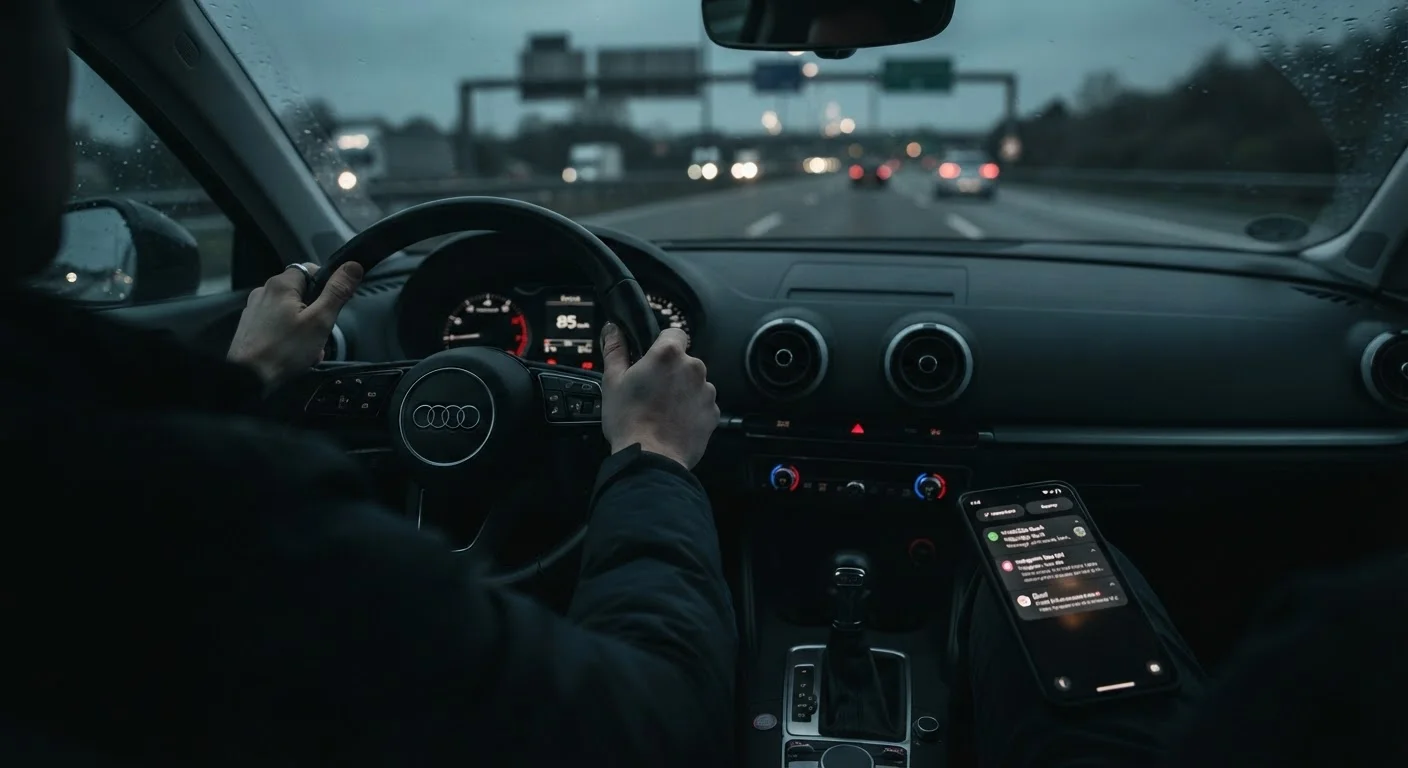
Why Distracted Driving Myths Are Dangerous
Most drivers consider themselves above-average behind the wheel. That self-assessment, well-documented in behavioral research, becomes genuinely dangerous when it shapes how people judge their ability to multitask while driving. Confidence in one's skills has almost no bearing on whether the brain can process two attention-demanding tasks simultaneously - and when the second task involves a two-ton vehicle at highway speed, the consequences of that gap are severe.
Distracted driving claimed an estimated 3,308 lives in the United States in 2022, according to the National Highway Traffic Safety Administration (NHTSA). Those numbers represent real crashes caused, in part, by widespread misunderstandings about how distraction actually works. The myths below appear repeatedly in surveys and post-crash interviews. The crash data tells a different story.
Understanding the science behind distraction can also sharpen awareness of related risks - like the danger of following too closely, where a distracted driver's reaction time gap becomes lethal.
Myth
Hands-free phone calls are safe because you're not physically holding the device.
Fact
Hands-free calls still cause significant cognitive distraction and impair driving performance measurably.
The danger of phone use while driving isn't only in holding the handset - it's in the mental workload of maintaining a conversation. Research from the AAA Foundation for Traffic Safety and academic institutions has consistently shown that using a hands-free device produces a level of cognitive distraction that slows reaction time, narrows the visual field, and causes drivers to miss hazards they would otherwise detect. This phenomenon is sometimes called "inattention blindness" - the eyes are open and pointed at the road, but the brain is processing the phone conversation rather than the driving environment. Bluetooth headsets and dashboard-integrated calling do not eliminate this effect; they only remove the manual component.
Myth
A quick glance at your phone only takes a second - it's not really that risky.
Fact
At 55 mph, a 5-second glance means traveling the length of a football field without watching the road.
NHTSA research found that sending or reading a text message takes an average of 5 seconds of eyes-off-the-road time. At highway speeds, that translates to roughly 100 yards of essentially blind travel. Studies using instrumented vehicles - cars equipped to record real-world driver behavior - have found that glancing away from the forward roadway for more than two seconds significantly increases crash or near-crash risk. The brevity of a glance is psychologically reassuring but physically deceptive: gaps in visual attention at speed leave almost no margin for avoiding sudden hazards like a vehicle braking ahead or a pedestrian stepping into the roadway. This same attentional gap makes distracted driving particularly dangerous in both highway and city environments for different but equally serious reasons.
Myth
Experienced drivers can handle mild distractions - they've developed enough automatic skill.
Fact
Driving experience does not override the brain's fundamental limit on processing two cognitively demanding tasks at once.
Some aspects of driving do become more automatic with experience - gear shifting, basic steering corrections, and familiar route navigation. However, the higher-order demands of driving - scanning intersections, anticipating other drivers' behavior, managing speed in variable traffic - remain cognitively active tasks that compete directly with phone calls, conversations, and mental preoccupation. Neurological research on dual-task performance shows that even highly experienced drivers show measurable performance decreases when a secondary cognitive task is introduced. Experience reduces some error rates but does not create spare cognitive bandwidth sufficient to safely absorb distraction. Overconfidence in one's experience is, itself, a risk factor.
Myth
Eating or drinking while driving is fine as long as you keep both hands on the wheel when needed.
Fact
Eating while driving is classified as a manual, visual, and cognitive distraction - all three distraction types at once.
Transportation safety researchers categorize distractions into three types: manual (hands off the wheel), visual (eyes off the road), and cognitive (mind off the task of driving). Eating behind the wheel typically triggers all three simultaneously: one hand holds the food, eyes shift to manage the food or a spill, and mental attention moves to the eating task. NHTSA data has identified eating and drinking as a notable secondary task associated with crash risk, even though it receives far less public attention than phone use. Spills and dropped items often prompt sudden, uncontrolled reactions - grabbing, looking away - at exactly the wrong moment. The risk is easy to underestimate precisely because eating feels routine and low-effort.
Myth
Voice-to-text is safe because you never have to look at your phone.
Fact
Voice-to-text features carry cognitive distraction ratings similar to or higher than handheld texting in some studies.
Voice-activated messaging systems were introduced in part as a safety-oriented alternative to manual texting. However, research commissioned by the AAA Foundation for Traffic Safety tested multiple voice-to-text systems and found that the mental effort required to compose, review, and correct dictated messages produced significant cognitive load - in several cases higher than composing a text manually. The driver's eyes may be forward, but the brain is occupied with constructing language, monitoring the system's accuracy, and correcting errors. The assumption that voice interaction is inherently low-distraction does not align with how the human brain actually allocates attention during complex language tasks.
Myth
Distracted driving is only a problem when something goes wrong - most distracted trips end fine.
Fact
Arriving safely despite distraction is partly luck; it does not validate the behavior as low-risk.
This is one of the most psychologically entrenched myths about distracted driving. Because dangerous situations on any given road at any given moment are statistically intermittent, a driver who is distracted will often complete a trip without incident - and that outcome reinforces the belief that the behavior is acceptable. This is a form of survivorship bias. Crash data makes clear that the risk is real and cumulative: the probability of a dangerous event occurring during a distracted interval is low on any single trip but compounds meaningfully across thousands of trips. Risk assessment based on personal outcome history is a poor substitute for population-level crash data. Drivers who text regularly are statistically more likely to be involved in a serious collision, even if many individual trips end without incident.
Who Gets Distracted - and What the Numbers Show
A common assumption is that distracted driving is primarily a teenage problem. Young drivers are indeed overrepresented in related crash statistics, but federal data consistently shows drivers across all age groups engage in distraction-related behaviors. Adults in their 20s and 30s are among the heaviest users of handheld devices while driving, and older drivers face their own distraction risks from in-vehicle controls and cognitive slowing.
3,308
Distracted driving fatalities in the US (2022)
According to the National Highway Traffic Safety Administration's 2022 crash data report.
~100 yards
Distance traveled blind during a 5-second phone glance at 55 mph
Referenced by NHTSA in public distracted driving educational materials.
2x+
Increase in crash risk from a 2-second eyes-off-road glance
Findings from naturalistic driving studies using instrumented vehicles tracking real-world driver behavior.
Distraction also intersects with other hazard categories. A driver who is simultaneously fatigued and handling a phone call faces compounded impairment - much like the overlapping risks described in research on drowsy driving and reaction time. Inattention doesn't stack linearly; the brain degrades faster when multiple demands compete.
The practical takeaway isn't that perfect focus is always achievable - it's that drivers who understand their limitations make better choices: silencing phones before pulling out of the driveway, setting navigation before moving, and pulling off safely when a call cannot wait.
No App or Setting Eliminates All Distraction Risk
Do-not-disturb driving modes and notification silencers reduce interruptions but do not make phone use while driving safe. Cognitive distraction persists even when the phone is mounted, voice-activated, or only briefly consulted. The most reliable strategy remains putting the phone out of reach before starting the vehicle. If a call or message genuinely cannot wait, pulling safely off the road is the appropriate response - not a quick glance.
The content on this site is for informational purposes only and is not a substitute for professional advice. Always consult a qualified professional for guidance specific to your situation.