

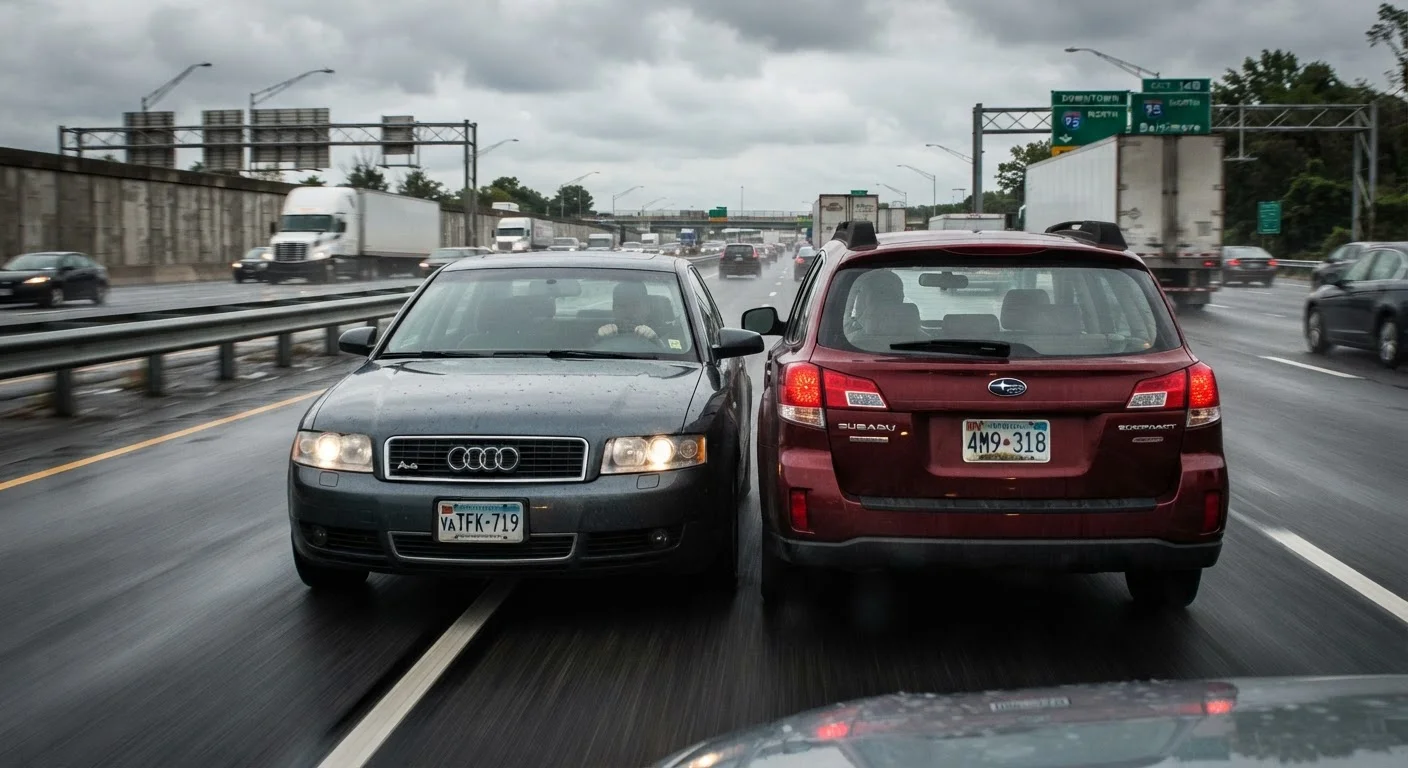
The Numbers Behind Rear-End Crashes
Rear-end collisions are not a minor footnote in U.S. road safety data - they are one of the most frequent crash types on American roads. According to the National Highway Traffic Safety Administration (NHTSA), rear-end crashes represent approximately one-third of all traffic collisions annually, resulting in hundreds of thousands of injuries and thousands of fatalities each year.
Following too closely is consistently identified as a leading contributing factor. Yet many drivers who tailgate do so habitually, without fully appreciating the physics at work. The gap between their bumper and the car ahead may feel like a calculated risk; in reality, it is often no gap at all when reaction time and braking distance are properly accounted for.
~33%
Of all U.S. traffic crashes that are rear-end collisions
According to NHTSA data, rear-end crashes are one of the most common crash types on American roads each year.
1.5 sec
Average human perception-reaction time before braking
Traffic safety research consistently places average driver reaction time between 1.5 and 2.5 seconds depending on alertness and conditions.
240+ ft
Total stopping distance at 60 mph on dry pavement
This figure combines typical reaction distance and braking distance for a passenger vehicle under good conditions, per standard traffic engineering references.
8x
Increase in stopping distance on ice vs. dry road
Transportation safety guidelines note that icy conditions can increase stopping distances by as much as eight times compared to dry pavement.
Why Your Brain Can't Keep Up with Physics
The core danger of tailgating is a mismatch between human reaction time and the speed at which vehicles travel. When a hazard appears - a car braking suddenly, debris in the road, a pedestrian stepping off a curb - your brain must perceive the event, process it, and transmit a signal to your foot before braking even starts. That process typically takes between 1.5 and 2.5 seconds depending on factors like fatigue, distraction, and age.
At 60 mph, a vehicle covers 88 feet every single second. In 1.5 seconds of reaction time alone, that vehicle has already traveled 132 feet - before the brakes touch the rotors. Add actual braking distance on top, and the total stopping distance easily exceeds 240 feet under ideal dry conditions. A tailgating driver who leaves only two car lengths of space has essentially removed any margin for this process to work.
This is why the two-second rule exists - and why three seconds or more is increasingly recommended. For a practical comparison of how speed compounds this problem, see our article on stopping distances and the physics behind them.
“The single most effective thing most drivers can do to reduce their crash risk has nothing to do with their reflexes or skill - it's simply leaving more space in front of them.”
— Traffic Safety Research Consensus, Reflected across NHTSA, AAA Foundation for Traffic Safety, and state transportation agency guidance on following distance
Conditions That Make Tailgating Worse
Most drivers have an intuitive sense that wet roads are more slippery - but few appreciate how dramatically moisture, ice, and reduced visibility multiply stopping distances. On wet pavement, stopping distances can roughly double compared to dry conditions. On ice, the increase can be eightfold or greater. If a tailgating driver on a dry road is already operating with minimal margin, the same behavior in rain or snow becomes catastrophically reckless.
Fog introduces a separate layer of risk. When visibility drops, the hazard you're reacting to may appear at a much shorter distance than normal, compressing the available reaction window even further. Night driving presents its own compounding challenges - for a broader look at how darkness affects crash risk, our guide to night driving hazards and safer habits covers the key adjustments drivers should make.
Adjust Your Gap for Conditions
Use two seconds as a floor, not a target. In rain, fog, or heavy traffic, extend to three or four seconds. When following a large truck or vehicle that limits your view ahead, increase the gap further still - you need to see past the vehicle in front to react to hazards it has already encountered.
Tailgating as Aggressive Driving
Not all tailgating is accidental. Intentional close following - used to pressure a driver to move out of the way or to express frustration - is classified as a form of aggressive driving under most state traffic codes. It is a recognized precursor to road rage incidents, which can escalate from intimidation to dangerous maneuvering or confrontation.
If you find yourself being tailgated, the safest response is to resist the urge to brake-check or retaliate. Changing lanes, gradually easing your speed, or pulling off when safe to let the vehicle pass defuses the situation without introducing new hazards. Our editorial on why road rage escalates and how to stay out of it examines the psychology and practical responses in more depth.
Tailgating also interacts dangerously with blind-spot behavior. When a vehicle follows too closely across multiple lanes, drivers may not perceive surrounding traffic accurately. Pairing proper following distance with strong lane-change awareness - explored in our piece on blind spots and lane-change crashes - forms a foundation of genuinely defensive driving.
Building the Habit of Proper Following Distance
Maintaining a safe gap is one of the simplest, most effective things any driver can do to reduce personal crash risk - and it costs nothing. The two-second rule is easy to apply in real time: choose a fixed landmark (a sign, a bridge edge, a tree), note when the car ahead passes it, and count two full seconds before you reach the same point. If you arrive before two seconds are up, you are too close.
In heavier traffic, adverse weather, or when following large trucks - whose cargo can shift, drop, or obscure your view - increase the gap to three or four seconds. Large commercial vehicles need substantially longer stopping distances than passenger cars, a dynamic covered in detail in our guide to sharing the road with trucks, motorcycles, and cyclists.
Incorporating proper following distance into a broader defensive driving mindset transforms it from an abstract rule into an automatic behavior. For a comprehensive look at how defensive driving techniques reduce overall crash exposure, see our explainer on defensive driving and how it actually works.
The Two-Second Rule Is a Minimum
Driving instructors and traffic safety organizations frequently note that the two-second rule was designed for ideal conditions - dry roads, good visibility, alert driver. It is not a maximum safe distance. Drivers are encouraged to treat it as the absolute floor and increase the gap whenever any variable departs from optimal conditions.
Frequently Asked Questions
The standard guideline is the two-second rule: pick a fixed object on the road and count two seconds after the vehicle ahead passes it before you reach the same point. At highway speeds or in poor conditions, three to four seconds is more appropriate. Many safety experts now advocate for the three-second rule as a baseline.
Tailgating eliminates the buffer you need to react and brake before hitting the car ahead. Human reaction time averages 1.5 seconds, and braking takes additional distance - a gap that tailgating removes entirely. Even minor, unexpected stops by the lead vehicle can make a collision unavoidable.
Yes. Every U.S. state has laws requiring drivers to maintain a 'reasonable and prudent' following distance. Many states specify that drivers must not follow more closely than is safe given speed, traffic, and road conditions. Violations can result in fines and, in crashes, liability.
Stopping distance increases roughly with the square of your speed, not linearly. A car traveling at 60 mph needs significantly more than twice the stopping distance of one going 30 mph. This means the faster you drive, the more critical an adequate following gap becomes.
Stay calm, avoid brake-checking the driver, and if safe, move to a different lane or gradually reduce your speed to encourage them to pass. Reacting with aggression can escalate the situation. Pulling over and letting the driver pass is often the safest resolution.
Significantly so. Wet pavement can double stopping distances compared to dry roads, and ice can increase them by eight times or more. Any following distance that might be borderline acceptable in dry conditions becomes genuinely hazardous in rain, snow, or fog.
The content on this site is for informational purposes only and is not a substitute for professional advice. Always consult a qualified professional for guidance specific to your situation.