

Option A
eSIM
The built-in, software-defined cellular identity.
Best for: Travelers, people who switch carriers often, and users of newer flagship smartphones who value a seamless setup experience.
Option B
Physical SIM Card
The tangible, universally familiar connectivity standard.
Best for: Frequent international travelers who buy local SIMs abroad, users with older devices, or anyone who prefers hardware they can see and handle.
What Each Format Actually Is
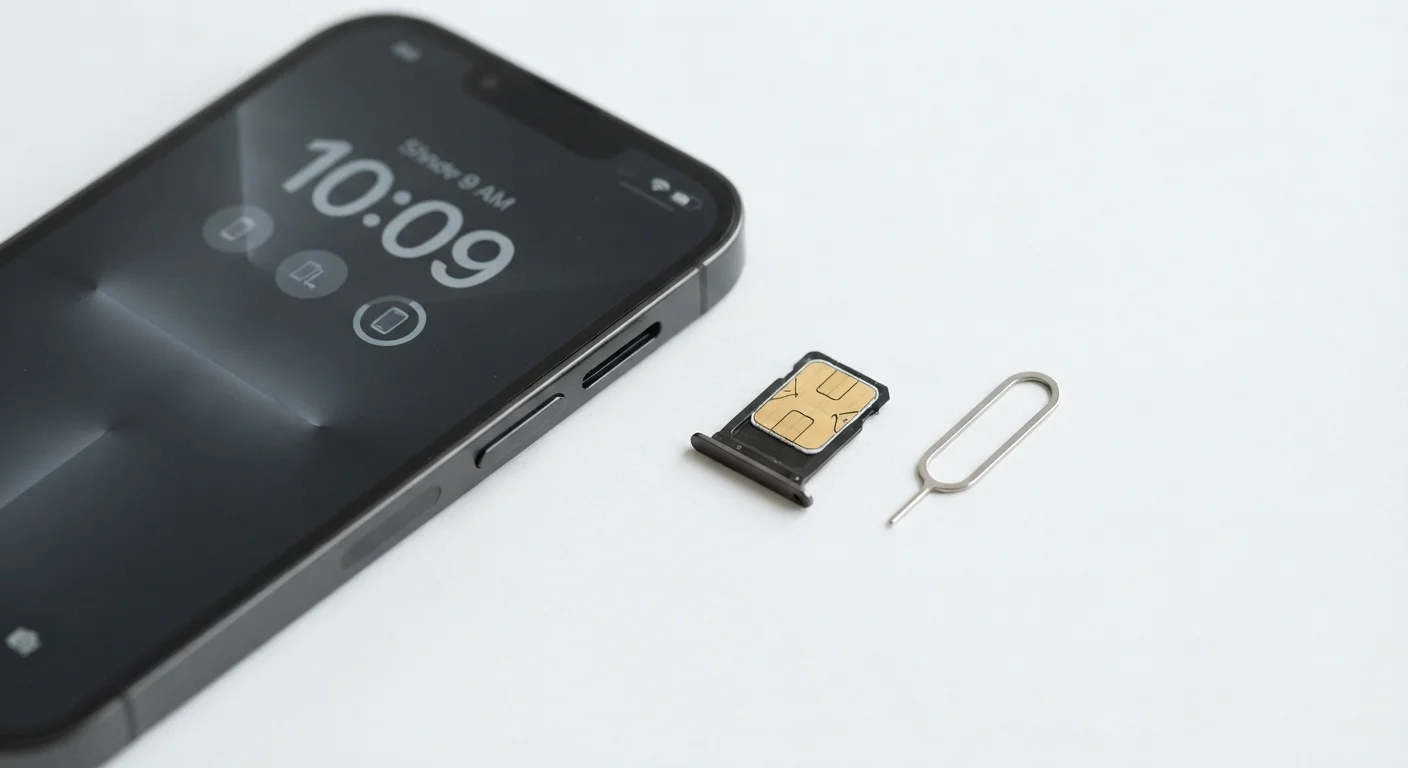
A physical SIM card - short for Subscriber Identity Module - is a small removable chip that stores your carrier credentials. You slide it into a tray on your phone, and it tells the network who you are. SIM cards have shrunk over the years from full-size to mini, micro, and nano formats, but the concept is identical across all of them.
An eSIM (embedded SIM) performs exactly the same function, but the chip is permanently soldered onto your phone's circuit board at the factory. Instead of swapping a physical card, you activate a carrier plan by scanning a QR code or using a carrier app. Your credentials are written to the chip digitally and can be rewritten when you switch providers. To understand how that cellular signal interacts with your phone's other radios, see our breakdown of mobile data, Wi-Fi, and Bluetooth.
| Criterion | eSIM | Physical SIM Card |
|---|---|---|
| Form factor | Soldered chip inside the phone | Removable card inserted into a tray |
| Carrier switching | Digital, often instant via app or QR code | Requires a new physical card |
| Device compatibility | Newer smartphones (post ~2018 flagships) | Nearly all phones globally |
| Dual-number support | Yes, on supported devices | Only on dual-SIM hardware |
| Transferability | Not physically transferable | Easy to move between compatible phones |
| International travel | Add plans digitally before departure | Buy local SIM on arrival |
| Loss/theft risk | Cannot be physically removed | Card can be removed and reused |
Practical Differences That Matter Day to Day
The most immediate difference is setup and switching. Activating an eSIM typically takes minutes from your couch - no store visit, no waiting for a card in the mail. Switching to a new carrier on a physical SIM still requires obtaining a new card, either by mail or at a store.
For dual-number use, many current smartphones support one eSIM and one physical SIM - or multiple eSIM profiles - letting you keep a personal and work line active simultaneously. This is particularly useful for remote workers or small-business owners who previously carried two handsets.
On the security side, a physical SIM can be removed and inserted into another phone, which creates some risk if your device is lost or stolen. An eSIM cannot be physically extracted, which adds a layer of protection against SIM-swapping at the hardware level - though SIM-swapping fraud typically exploits carrier account processes rather than the card itself. For broader mobile security habits, our mobile security primer is a good starting point.
300+
Carriers globally offering eSIM support
According to GSMA data, eSIM-compatible carrier plans have expanded rapidly across North America, Europe, and parts of Asia-Pacific.
2
Active phone numbers on one eSIM-capable device
Most dual-SIM smartphones allow one eSIM profile and one physical SIM - or multiple stored eSIM profiles - to be managed simultaneously.
Which Makes More Sense for You?
The right choice depends heavily on your device, your carrier, and how you use your phone. If you own a flagship smartphone released after 2020, it almost certainly supports eSIM, and several models - particularly some US iPhone variants - have dropped the physical SIM slot entirely, making eSIM the only option.
If you travel internationally and want to avoid roaming charges, eSIM makes it straightforward to add a short-term local data plan without physically swapping cards. That said, physical local SIMs purchased abroad can sometimes be cheaper and more widely available depending on the country, so it's worth researching your destination before departure.
If your phone is a few years old, runs on a budget tier, or you frequently hand devices to family members, physical SIM cards remain completely practical and broadly supported. The ability to simply pop a card from one phone into another is a genuine convenience that eSIM does not replicate. As cellular technology continues to evolve - from 4G LTE to 5G networks - both SIM formats are capable of carrying those faster connections, so network generation alone shouldn't drive your decision.
eSIM Profiles Can Be Stored, Not Just Active
Many phones let you store multiple eSIM profiles - for example, your home carrier and a travel carrier - and switch between them in settings without re-downloading anything. Only one profile per slot is active at a time, but the stored profiles remain ready to reactivate. This makes it easy to re-enable a travel plan on a future trip without going through setup again.
The content on this site is for informational purposes only and is not a substitute for professional advice. Always consult a qualified professional for guidance specific to your situation.