

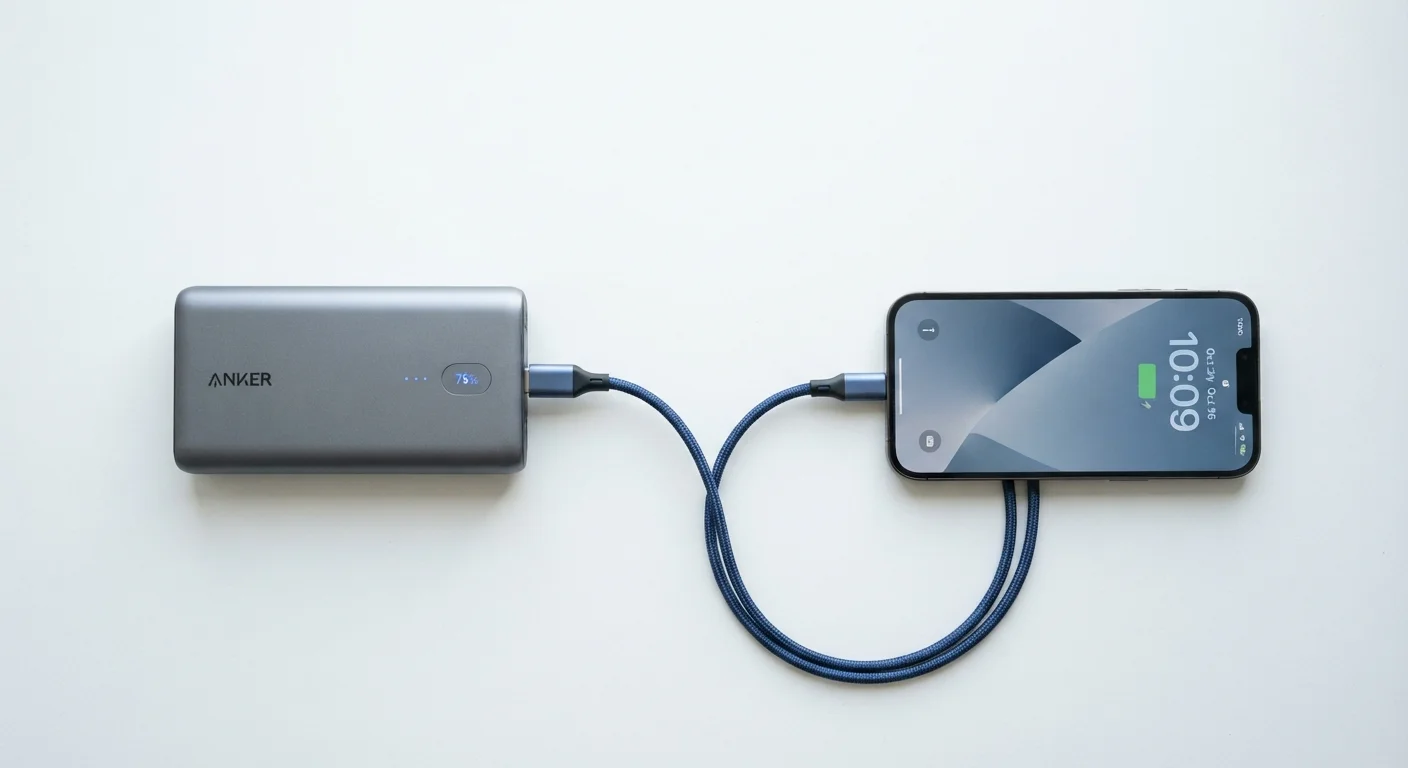
What mAh Actually Measures - and Why the Real Number Is Lower
Milliampere-hours (mAh) is the unit printed most prominently on any power bank box. It measures the total charge a battery can theoretically store. A 20,000 mAh bank holds twice the raw energy of a 10,000 mAh one - in theory.
In practice, you'll never get that full amount delivered to your device. Internal circuitry has to step voltage up from the battery's native 3.7V to the 5V (or higher) your USB port delivers, and that conversion burns off roughly 20-40% of stored energy as heat. A 10,000 mAh power bank realistically delivers closer to 6,000-8,000 mAh to whatever is plugged in.
The practical takeaway: divide the rated mAh by your phone's battery size, then multiply by about 0.65 to estimate real charges. A 10,000 mAh bank charging a phone with a 4,000 mAh battery gives you roughly 1.6 usable charges, not 2.5. For a deeper look at how battery ratings work across devices, see our spec-sheet decoder.
60-80%
Usable capacity vs. rated mAh
Energy conversion losses from battery voltage to USB output typically reduce real-world delivered capacity to 60-80% of the labeled mAh rating.
100 Wh
TSA carry-on power bank limit
The U.S. Transportation Security Administration sets 100 watt-hours as the standard limit for lithium battery power banks in carry-on luggage without special airline approval.
18W+
Minimum wattage for fast charging
Most mainstream fast-charging standards - including USB Power Delivery - begin at 18W, the threshold at which charge times drop noticeably compared to standard 5W or 10W outputs.
Output Wattage: The Number That Controls Charging Speed
Capacity tells you how long the party lasts; wattage tells you how fast drinks get poured. Watts (W) = Volts (V) × Amps (A), and this figure determines how quickly your device actually charges.
A port labeled 5V/2A outputs 10W - fine for earbuds or a slow overnight top-up on a phone. A port labeled 9V/3A outputs 27W and will charge most mid-range smartphones meaningfully faster. Many current power banks offer a single USB-C port at 45W, 65W, or higher that can also charge small laptops.
Two caveats matter here. First, your device has its own maximum input wattage - plugging a 65W bank into a phone that accepts only 18W won't speed things up; the phone regulates the intake. Second, when multiple ports are in use simultaneously, the total wattage is usually shared, so each port gets less. Check the spec sheet for per-port wattage under full load, not just the headline figure.
Match Your Fast-Charge Protocol First
Before buying a power bank, look up the charging protocol your phone supports - USB Power Delivery, or a proprietary standard - and confirm the bank explicitly lists that protocol on its output spec. Without a protocol match, you'll get standard charging speeds regardless of how many watts the bank advertises.
Ports, Protocols, and Pass-Through Explained
The physical port type shapes compatibility. USB-A is the rectangular port most people recognize; it maxes out at around 12W on standard chargers. USB-C supports the USB Power Delivery (USB-PD) protocol, which negotiates higher voltages between devices and enables the fast-charging speeds (18W-100W+) modern phones and laptops need.
Some power banks also support proprietary fast-charge protocols - technologies developed by chip manufacturers that require both the bank and the device to use the same standard to unlock higher speeds. If your phone uses a proprietary protocol, confirm your power bank supports it before assuming you'll get fast-charge speeds. Our article on fast-charging facts and myths breaks down these standards in plain language.
Pass-through charging lets the bank power a connected device while it is itself plugged into a wall. It is useful when outlets are scarce - one outlet charges two things - but it increases internal temperatures. Use it occasionally, and avoid leaving it running in enclosed spaces like a bag pocket.
Watt-Hours vs. Milliampere-Hours
Airlines and safety regulations use watt-hours (Wh), not mAh, because Wh accounts for voltage and gives a true measure of stored energy. To convert: multiply mAh by the battery voltage (usually 3.6V or 3.7V), then divide by 1,000. A 20,000 mAh bank at 3.7V equals 74 Wh - well within the standard 100 Wh airline limit. Some power banks print the Wh value directly on the label, which simplifies the math.
Matching the Right Power Bank to How You Actually Use It
Choosing capacity and output should start with your real-world routine, not the highest spec you can find.
- Day-trippers and commuters: A 5,000-10,000 mAh bank with at least one 18W USB-C port fits in a jacket pocket and handles one or two phone top-ups without adding noticeable weight.
- Weekend travelers: 10,000-20,000 mAh covers a phone, earbuds, and a tablet over a long travel day. Look for at least one 30W+ USB-C port if you want meaningful speed.
- Remote workers or long-haul travelers: 20,000-26,000 mAh with a 45W+ USB-C port can partially recharge small laptops. Note that the TSA restricts carry-on power banks to 100 watt-hours - roughly 27,000 mAh at 3.7V - without airline pre-approval. Always verify current airline and TSA regulations before you fly.
Weight scales with capacity: a 20,000 mAh bank typically weighs 12-16 oz. If you rarely drain your phone fully in a day, a smaller, lighter bank is almost always the smarter choice. Good charging habits also reduce how much you depend on a power bank in the first place - separating battery myths from facts is a useful companion read.
Frequently Asked Questions
For a typical smartphone with a 4,000 mAh battery, a 10,000 mAh bank realistically delivers about 1.5 to 2 full charges after accounting for the 20-40% energy lost to heat and voltage conversion. Larger-battery phones will get fewer charges; smaller devices like earbuds will get many more.
Most mainstream fast-charging standards begin around 18W and scale up to 65W or more. Check your phone's supported charging protocol (such as USB Power Delivery or a proprietary standard) and match it with a power bank that outputs the same wattage and protocol. Your phone will only charge as fast as the slower of the two devices allows.
Power banks must be carried in carry-on baggage - not checked luggage. The standard limit without special approval is 100 watt-hours (Wh). Always verify current regulations with your airline and the TSA or equivalent authority before you travel, as rules can change.
Pass-through charging means you can plug the power bank into a wall outlet while it simultaneously charges a connected device. It is convenient but typically generates more heat, which can slightly reduce long-term battery health. Use it occasionally rather than as a daily habit.
Not necessarily. A high-mAh bank with low output wattage may charge your devices slowly even if it stores a lot of energy. For most users, matching capacity to realistic need and ensuring output wattage matches your devices matters more than chasing the highest mAh number.
The content on this site is for informational purposes only and is not a substitute for professional advice. Always consult a qualified professional for guidance specific to your situation.