

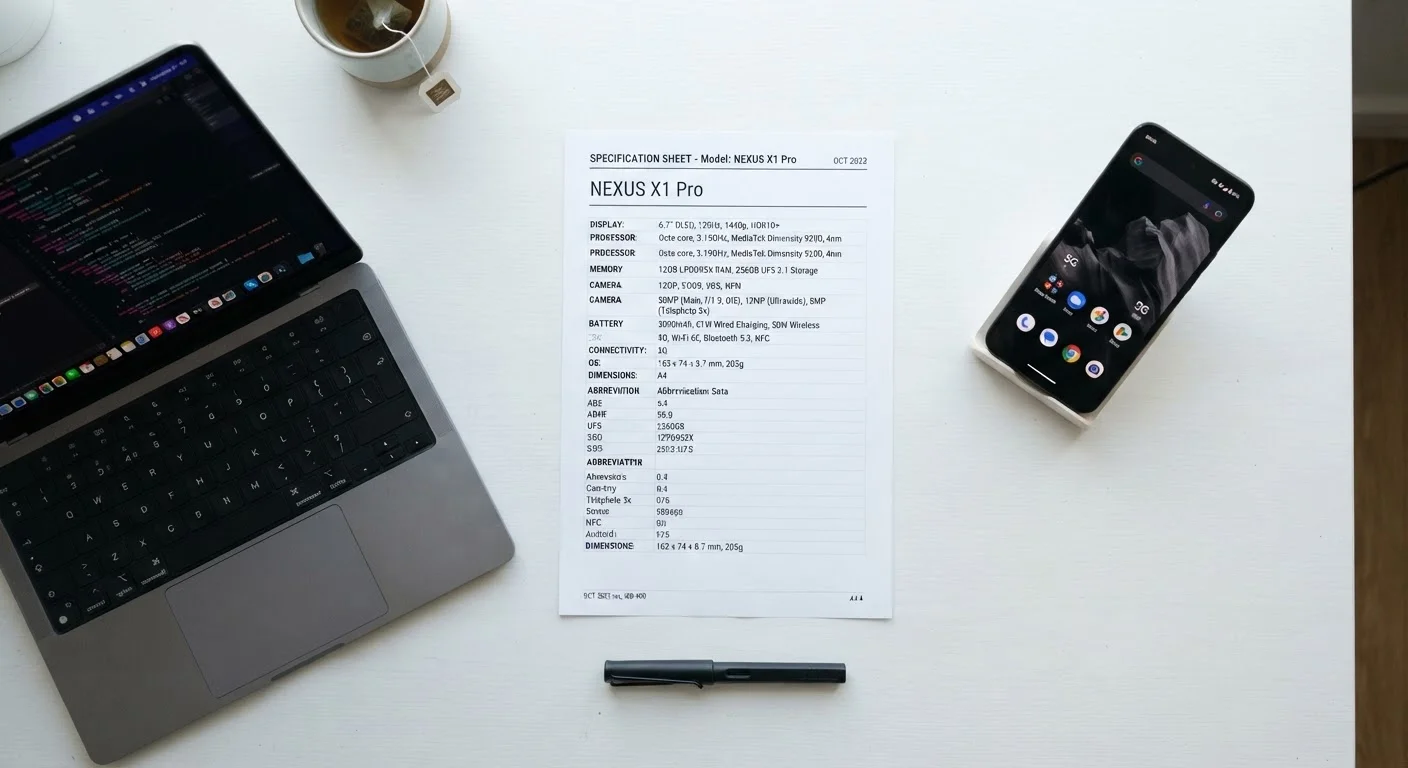
Why Spec Sheets Feel Like a Foreign Language
Whether you're looking at a phone listing, a laptop box, or a smart TV product page, spec sheets throw a wall of abbreviations at you: GHz, RAM, nits, mAh, IP68. These aren't arbitrary - each term captures something concrete about how a device performs in daily life. The problem is that manufacturers write specs for engineers, not households.
This reference guide translates the most common shorthand into plain English. Think of it as a decoder ring you can return to any time you encounter unfamiliar terms. For networking-specific jargon such as bandwidth, latency, or DHCP, see our home networking glossary - and if you want to understand how specs play out specifically on smartphones, our guide to what smartphone specs actually mean goes deeper on phones in particular.
| GHz meaning | Billions of processor cycles per second |
| mAh measures | Battery capacity (fuel tank size) |
| IP68 water resistance | Rated for submersion beyond 1 meter (test conditions) |
| Nits measure | Screen brightness |
| Outdoor readability threshold | Typically 800+ nits |
| Hz in displays | Screen redraws per second |
Processing Power: GHz, Cores, and RAM
GHz (gigahertz) measures how many processing cycles a chip can complete per second - one gigahertz equals one billion cycles. A higher number generally means faster individual task completion, though chip architecture matters just as much as raw clock speed. CPU cores are independent processing units on a chip; more cores allow a device to handle multiple tasks simultaneously without slowdown.
RAM (Random Access Memory) is the short-term workspace a device uses while apps are open. More RAM means more apps can stay active in the background without having to reload. It is separate from storage - RAM is cleared when the device restarts, while storage holds files permanently.
GHz (Gigahertz)
A unit measuring processor clock speed - one GHz equals one billion cycles per second. Higher clock speeds can mean faster processing, but chip design and core count also heavily influence real-world performance.
RAM
Random Access Memory; the active workspace a device uses while running apps. More RAM allows more programs to stay open simultaneously without reloading.
nits
A unit of screen brightness. Higher nit values mean the display can be seen more clearly in bright or outdoor conditions.
mAh
Milliamp-hours; a measurement of battery capacity. A larger mAh number indicates a bigger battery and generally longer runtime, all else being equal.
IP Rating
Ingress Protection rating; a two-digit code indicating a device's resistance to dust (first digit) and water (second digit). Higher numbers signal greater protection.
Refresh Rate (Hz)
How many times per second a display redraws its image. Higher refresh rates (e.g., 120 Hz) produce smoother motion during scrolling, gaming, and video playback.
Resolution
The total number of pixels on a display, expressed as width × height or by shorthand (1080p, 4K). More pixels generally means a sharper, more detailed image.
Watt (W) in charging
The rate at which a charger delivers power to a battery. Higher wattage chargers refill a battery more quickly, provided the device supports that charging speed.
Display Terms: Resolution, Refresh Rate, and Nits
Resolution describes how many pixels make up the display, written as width × height (e.g., 1920×1080) or by shorthand like 1080p, 4K, or QHD. More pixels generally means sharper images, especially on larger screens. Refresh rate, measured in Hz, is how many times per second the screen redraws its image. A 120 Hz display looks noticeably smoother during scrolling and video than a 60 Hz one.
Nits measure screen brightness. Indoor use is comfortable around 400-500 nits; outdoor readability in sunlight typically requires 800 nits or more. This spec matters most for phones and laptops used outside. For a full breakdown of display specs in a TV context, our article on TV specs worth understanding covers HDR formats and panel types in detail.
Battery, Connectivity, and Durability Ratings
mAh (milliamp-hours) indicates battery capacity - essentially the size of the fuel tank. A higher mAh rating means more potential runtime, though actual battery life also depends on the screen, processor efficiency, and software. Watt (W) in charging specs refers to charging speed; a 65W charger refills a battery significantly faster than a 20W charger.
IP ratings (Ingress Protection) use a two-digit code - such as IP67 or IP68 - to indicate resistance to dust and water. The first digit (0-6) rates dust protection; the second (0-9) rates water resistance. IP68 is currently among the highest consumer ratings, meaning the device can withstand submersion beyond one meter for a defined period under test conditions. Real-world conditions vary, and manufacturers' warranties may not cover water damage even on rated devices.
For wireless connectivity, Wi-Fi standards like Wi-Fi 6 (802.11ax) indicate generation and speed capability. Bluetooth version numbers signal range, power efficiency, and audio codec support. Our guide to cellular network generations explains what 4G LTE and 5G mean for real-world speeds.
Specs Reflect Lab Conditions, Not Real-World Use
Manufacturer specifications are measured under controlled test conditions that may not reflect everyday use. Battery life, charging speeds, and water resistance can all vary based on temperature, usage patterns, and device age. Treat spec numbers as useful comparisons between devices rather than guaranteed real-world guarantees. When in doubt, look for independent testing and reviews alongside the official spec sheet.
The content on this site is for informational purposes only and is not a substitute for professional advice. Always consult a qualified professional for guidance specific to your situation.