

The Physics Behind the Quiet
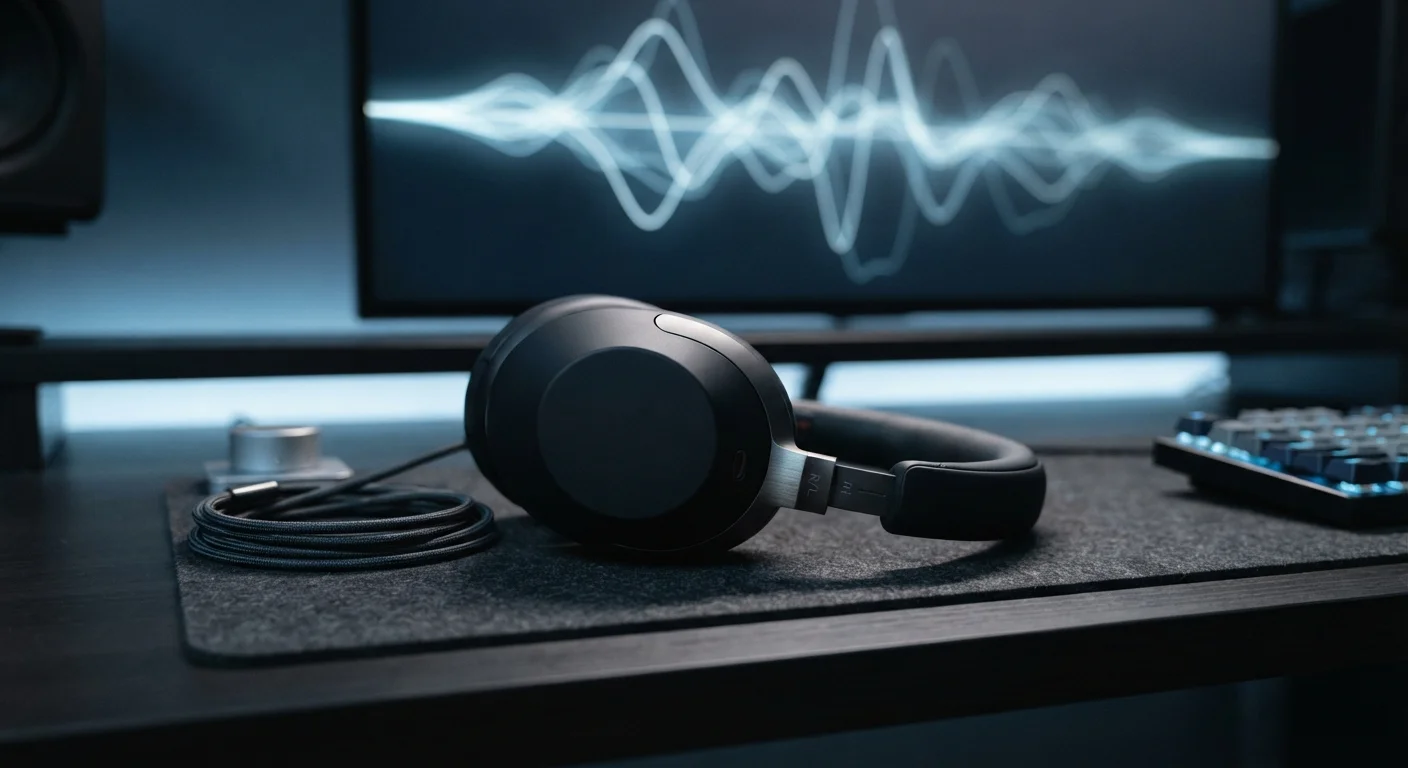
Sound travels as waves of pressure moving through air. When two sound waves with identical frequency and amplitude meet perfectly out of phase - that is, one wave's peak aligns with the other's trough - they cancel each other out. This principle is called destructive interference, and it is the entire foundation of active noise cancellation.
ANC headphones contain one or more small microphones positioned on the outside of the earcup. These microphones continuously sample the surrounding audio environment, capturing incoming noise in real time. An internal processor then generates a new audio signal that is the mathematical inverse of that captured noise - the same shape, but flipped. This inverted signal is played through the headphone speaker alongside your music (or in silence), and when it meets the original noise wave inside the earcup, the two largely cancel each other out.
The entire process happens in milliseconds, continuously adjusting as the surrounding noise changes. That real-time processing loop is why ANC headphones require a charged battery to function.
Transparency Mode: The Opposite Function
Many ANC headphones also include a "transparency" or "ambient" mode. Instead of canceling outside sound, this mode uses the external microphones to pipe environmental audio into your ears, letting you hear your surroundings without removing the headphones. It uses the same microphone hardware - just with the signal processed differently.
What ANC Is Good At - and Where It Struggles
ANC performs best on sounds that are steady, predictable, and low in frequency. Airplane cabin noise, train rumble, air conditioning hum, and highway drone are ideal targets. These sounds repeat in consistent patterns, giving the processor enough time to accurately model and invert them.
High-frequency, sudden, or irregular sounds are harder to cancel. A barking dog, a coworker's voice, or the clatter of a keyboard changes too rapidly for the inversion system to keep pace. By the time the processor has generated an accurate anti-phase signal, the original sound has already changed. This is why even high-end ANC headphones don't make a busy coffee shop feel silent - they reduce the background roar, but voices and sharp sounds cut through.
Match Your ANC to Your Environment
If you primarily use headphones during commutes or flights, prioritize ANC tuned for low-frequency rumble. If your main concern is office focus, a good passive seal from over-ear cushions may contribute as much as the ANC system itself. Think of ANC as one layer of noise management, not the only one.
This is also where passive isolation - the physical seal of the earcup against your head - picks up the slack. The combination of both methods is why closed-back, over-ear headphones tend to offer the most complete noise reduction experience. If you're comparing this with the tradeoffs of going wireless altogether, see our guide to wireless earbuds versus wired headphones for a broader look at how form factor affects performance.
Feedforward, Feedback, and Hybrid Systems
Not all ANC implementations are identical. The placement and number of microphones determine how the system samples incoming noise, and manufacturers have developed three main approaches:
- Feedforward ANC: Microphones sit on the outside of the earcup, sampling noise before it enters. This gives the processor more lead time to generate a canceling signal, making it effective at a wider range of frequencies - but it can't correct for how sound changes inside the earcup.
- Feedback ANC: The microphone sits inside the earcup, closer to your ear. It hears what you actually hear and can make corrections, but has less time to react to incoming noise. This approach works better for lower frequencies.
- Hybrid ANC: Uses microphones in both positions simultaneously. This is generally considered the most capable configuration, as it combines the strengths of both approaches.
20-30 dB
Typical noise reduction from ANC headphones
Consumer ANC headphones generally reduce ambient noise by 20 to 30 decibels under optimal conditions, according to audio engineering literature.
~1 kHz
Upper frequency limit of effective ANC
Most ANC systems are most effective below 1,000 Hz; higher-frequency sounds are harder to cancel due to processing latency constraints.
Understanding which system a pair of headphones uses can help you match the technology to your environment - someone who frequently flies may prioritize feedforward or hybrid ANC tuned for low-frequency engine noise.
What ANC Doesn't Do
It's worth being clear about what active noise cancellation is not. It is not a complete silence generator, and it doesn't "block" sound the way a sealed room does. At its best, ANC can reduce perceived background noise substantially, but some residual sound always remains.
ANC also does not improve audio quality by itself. The cancellation system operates separately from the audio chain. Whether the headphones reproduce music faithfully depends on their speaker drivers and tuning - not their noise-canceling circuitry. Some users also find that engaging ANC introduces a very subtle hiss or tonal coloration to silence; this is an artifact of the processing system itself, not incoming noise.
Finally, ANC is not a substitute for hearing protection in genuinely hazardous noise environments, such as construction sites or loud machinery. For those situations, purpose-built hearing protection rated to appropriate safety standards is the appropriate tool.
Frequently Asked Questions
Yes. ANC is an independent system from audio playback. Many people use it in silence simply to reduce environmental noise, such as during a commute or while working in a noisy office.
Some users perceive the anti-phase signal as a subtle pressure or "fullness" sensation. This is a normal side effect of the brain processing the artificially altered sound environment, not a sign of damage.
ANC is less effective at canceling human speech than steady low-frequency noise, because voices are irregular and unpredictable. Physical earcup design and passive isolation contribute more to blocking conversation than ANC alone.
When the battery runs out, ANC stops functioning. Most headphones will still pass audio through passively, but the active noise reduction is gone entirely until recharged.
No. ANC does not produce harmful sound levels. In fact, it may support hearing health indirectly by reducing the urge to turn up volume to overcome background noise.
Passive isolation is physical sound blocking through materials like foam ear cushions and sealed earcups. ANC is an electronic process that actively counters noise with opposing sound waves. Most over-ear headphones combine both methods.
The content on this site is for informational purposes only and is not a substitute for professional advice. Always consult a qualified professional for guidance specific to your situation.