

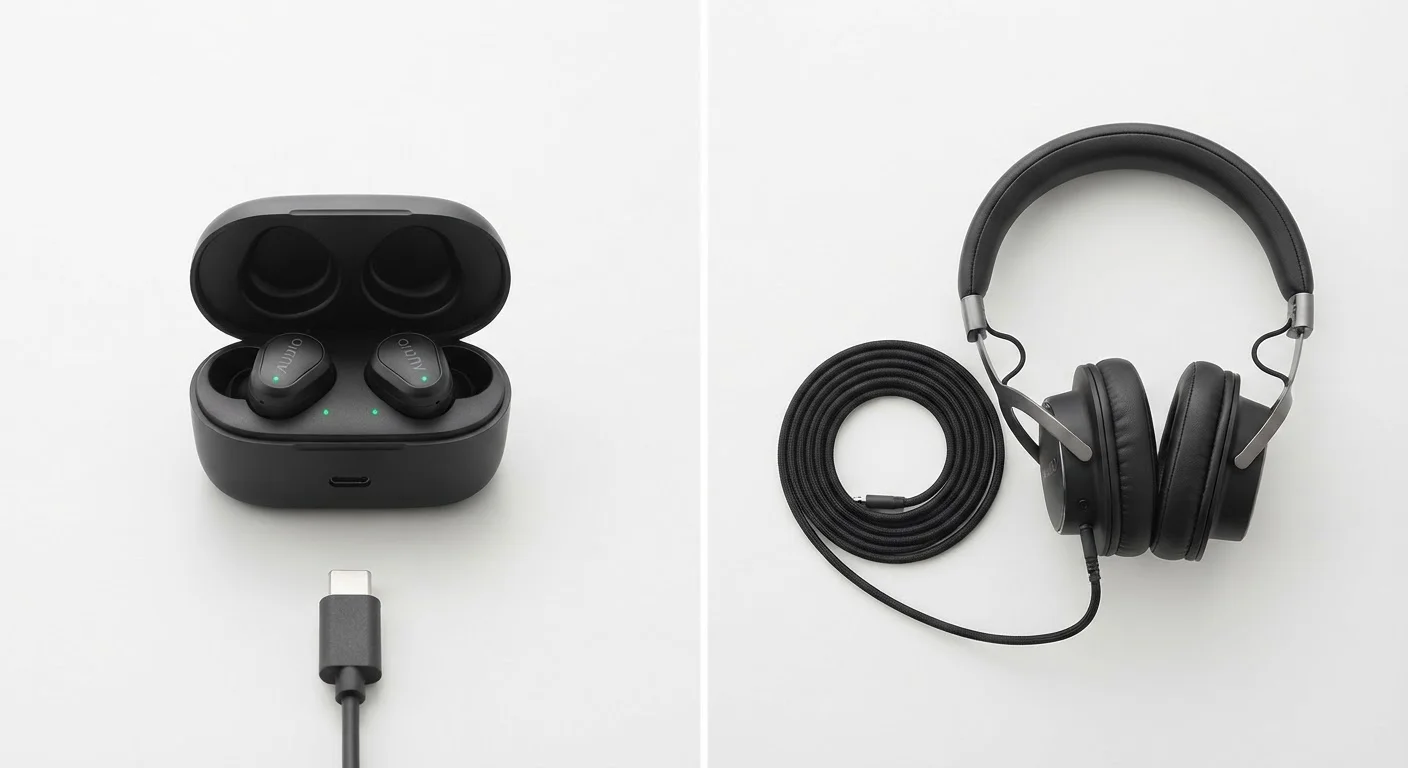
Option A
Wireless Earbuds
The cord-free, go-anywhere listening experience.
Best for: Commuters, exercisers, and anyone who wants hands-free, tangle-free audio on the move.
Option B
Wired Headphones
The dependable, power-free audio workhorse.
Best for: Home listeners, audio enthusiasts, and anyone who values consistent sound without charging.
What Actually Changes When the Cable Disappears
Removing a cable from headphones is not just a cosmetic change - it fundamentally shifts how audio gets from your device to your ears, how long you can listen before needing to stop, and even what devices are compatible. Understanding these shifts helps you choose based on your real habits rather than marketing language.
Wired headphones use a direct analog connection. The electrical audio signal travels from your phone, laptop, or audio player through the cable and into the driver - the component that converts that signal into sound. No conversion step is added, and no battery is required to complete the circuit.
Wireless earbuds work differently. Your device encodes the audio as a Bluetooth signal, transmits it wirelessly, and the earbuds decode and play it back. That encoding and decoding process - handled by what engineers call a codec - introduces at least some compression. The quality of that compression varies by codec and hardware, which is why not all wireless audio sounds the same. For a deeper look at how Bluetooth transmits audio alongside other wireless signals, see how Bluetooth and Wi-Fi coexist on your devices.
Sound Quality: The Compression Question
Audio purists often favor wired headphones for one reason: the signal path is shorter and simpler. There is no wireless encoding step, meaning the driver receives audio as close to the original recording as the hardware allows. This matters most when listening at high volumes or to lossless audio files, where fine detail can be lost during Bluetooth compression.
That said, modern Bluetooth codecs - including aptX, AAC, and LDAC - have narrowed the gap considerably. For most casual listening scenarios - podcasts, streaming music, video calls - the average ear is unlikely to perceive a meaningful quality difference between a well-made pair of wireless earbuds and wired headphones in the same price range.
| Criterion | Wireless Earbuds | Wired Headphones |
|---|---|---|
| Audio transmission | Bluetooth (compressed) | Analog (uncompressed) |
| Battery required | Yes - must charge regularly | No battery needed |
| Typical device lifespan | 2-4 years (battery degradation) | 5-10+ years |
| Interference risk | Possible in crowded RF environments | None - physical connection |
| Headphone jack required | No | Yes (or adapter) |
| Cable management | None | Required |
| Noise cancellation availability | Common in many models | Available but less common |
| Repairability | Limited - sealed battery units | Higher - cables replaceable |
Where differences become audible is at the extreme ends: very high-resolution audio files, or very low-quality Bluetooth hardware. If audio accuracy matters to you, it is worth researching which codec a wireless device supports and whether your phone or source device can match it. Learn how active noise cancellation works and where the technology has limits - it is a feature commonly bundled with wireless earbuds.
Battery Life, Longevity, and the Hidden Cost of Wireless
Every wireless earbud has a battery - and that battery degrades over time. Most lithium-ion cells begin losing noticeable capacity after 300 to 500 full charge cycles, a threshold that regular users can reach within two to three years. After that point, playback time per charge drops, sometimes significantly.
300-500
Charge cycles before noticeable battery degradation
Lithium-ion batteries in consumer electronics, including wireless earbuds, typically begin losing meaningful capacity after this range of full charge cycles.
~2-4 years
Average practical lifespan of wireless earbuds
Battery degradation is the primary factor limiting the useful life of wireless earbuds compared to wired alternatives that have no battery component.
3.5mm
Headphone jack size removed from many smartphones
A growing number of smartphone manufacturers have eliminated the standard 3.5mm analog headphone port, pushing more users toward wireless or adapter-dependent wired options.
Wired headphones have no such limitation. With no battery to degrade, a well-made pair can remain fully functional for a decade or longer - provided the cable and connector are maintained. Some models even allow cable replacement, which further extends usable life. For habits that help any personal audio device last longer, everyday gadget longevity practices covers charging, storage, and cleaning routines worth adopting.
Wireless earbuds also introduce a compatibility dependency: if the charging case is lost or broken, the earbuds themselves may become unusable. This is a practical durability consideration that rarely comes up with wired options.
Convenience, Compatibility, and the Headphone Jack Problem
Convenience is arguably where wireless earbuds win most decisively. No cable to untangle, no physical connector to wear out, and the freedom to move without managing a cord make them the practical choice for gym sessions, runs, or daily commutes.
However, wireless audio introduces its own friction points. Earbuds must be charged, paired to devices, and occasionally reconnected when Bluetooth drops. Interference from crowded wireless environments - like a busy subway or an office with many connected devices - can cause momentary audio dropouts. The wired connection is, by definition, immune to these issues.
Adapters Work - But Add a Step
USB-C to 3.5mm and Lightning to 3.5mm adapters allow wired headphones to connect to phones that have removed the headphone jack. These adapters are widely available and generally reliable. However, audio quality through an adapter depends partly on the digital-to-analog converter (DAC) built into the adapter itself - a factor worth noting if you are listening to high-resolution audio.
Compatibility is a real consideration in either direction. Many current smartphones have removed the 3.5mm headphone jack, which means using wired headphones requires a USB-C or Lightning adapter. These adapters work reliably but add a step and something extra to carry. Wireless earbuds sidestep this issue entirely, connecting via Bluetooth to virtually any modern device. This wired-vs-wireless dynamic also plays out at a larger scale in home networking - the trade-offs between wired and wireless connections follow a similar logic of reliability versus convenience.
The content on this site is for informational purposes only and is not a substitute for professional advice. Always consult a qualified professional for guidance specific to your situation.