

Our Verdict
Neither natural nor mechanical ventilation is universally superior — the right choice depends on where you live and how your home is built. Older, leakier homes in mild climates can lean more heavily on natural ventilation, while tightly constructed or climate-challenged homes need mechanical systems to maintain safe, comfortable indoor air. A layered approach that combines both strategies tends to perform best for most American households.
| Best for | Recommended |
|---|---|
| Mild-climate homeowners in older, naturally drafty homes | Natural Ventilation |
| Tightly sealed, energy-efficient new construction homes | Mechanical Ventilation |
| Homes in hot, humid, or high-pollution regions | Mechanical Ventilation |
| Most existing homes seeking practical, year-round performance | Hybrid (Natural + Mechanical) |
What Each Approach Actually Does
Ventilation — the controlled exchange of indoor and outdoor air — is one of the most fundamental aspects of a healthy home. Without it, moisture, carbon dioxide, cooking fumes, and other pollutants accumulate inside. The question isn't whether to ventilate, but how.
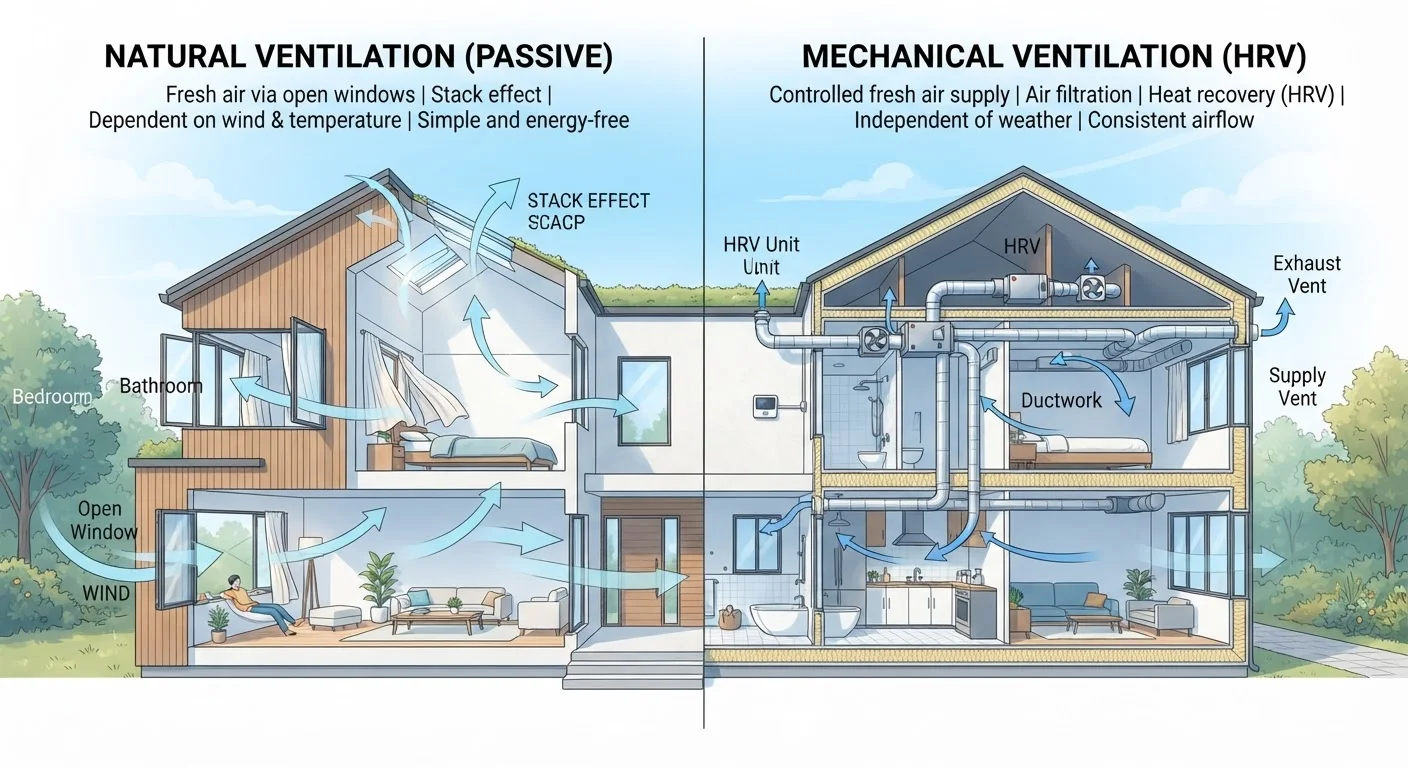
Natural ventilation relies on passive forces: wind pressure and the buoyancy of warm air (called the stack effect) to move air through openings like windows, doors, vents, and gaps in the building envelope. No equipment, no energy cost — just physics.
Mechanical ventilation uses fans, ducts, and sometimes heat exchangers to actively move and filter air. Systems range from simple exhaust fans in bathrooms and kitchens to whole-house setups like Heat Recovery Ventilators (HRVs) or Energy Recovery Ventilators (ERVs), which transfer heat or moisture between incoming and outgoing airstreams to minimize energy loss.
For a broader look at what drives indoor air quality, see our article on why indoor air quality deserves more attention.
| Natural Ventilation | Mechanical Ventilation | |
|---|---|---|
| Upfront Cost | None to minimal | Moderate to high |
| Operating Cost | None | Electricity; filter replacement |
| Reliability | Weather-dependent | Consistent year-round |
| Air Filtration | None | Available (HEPA, carbon options) |
| Best Climate Fit | Mild, temperate regions | Hot, cold, humid, or polluted areas |
| Maintenance Required | Minimal (keep openings clear) | Regular filter changes, fan checks |
| Works in Tight Homes | Limited effectiveness | Yes — designed for sealed homes |
When Natural Ventilation Holds Up — and When It Doesn't
Natural ventilation works best in mild, temperate climates where outdoor air is relatively clean and temperatures are comfortable for much of the year. Cross-ventilation — opening windows on opposite sides of a room or home — can move surprising volumes of air on a breezy day without spending a cent.
The limits become apparent quickly in several scenarios:
- Hot or humid climates: Outdoor air in places like the Gulf Coast or Southeast brings in both heat and moisture, worsening indoor comfort and feeding mold risk.
- Cold climates in winter: Opening windows becomes impractical, and the stack effect alone rarely provides adequate fresh air exchange.
- High outdoor pollution: Wildfire smoke, urban particulates, or high pollen counts make outdoor air a liability, not an asset.
- Tight modern homes: Better-insulated, air-sealed homes built after the early 2000s have far fewer natural air pathways. Opening a window helps, but gaps in the envelope — which older homes relied on for passive fresh air — are largely absent.
The Stack Effect Works for You at Night
On warm evenings when outdoor temperatures drop below indoor temps, open low windows on the shaded side of the home and high windows or vents near the roof. Rising warm air exits at the top, drawing cooler air in below — no fan required. Close everything up before morning heat builds to lock in the cooler air.
What Mechanical Ventilation Adds
Mechanical systems solve the main weakness of natural ventilation: unpredictability. A bathroom exhaust fan reliably removes moisture after a shower regardless of outdoor conditions. A whole-house ERV or HRV exchanges stale indoor air for filtered fresh air continuously, recovering a significant portion of heating or cooling energy in the process.
The tradeoffs are real. Mechanical systems cost money to install and operate, require periodic filter changes and maintenance, and can introduce noise. However, for tightly built homes — increasingly the standard under modern energy codes — mechanical ventilation isn't optional; it's required by building codes like ASHRAE 62.2 to maintain minimum air quality standards.
Smart thermostats and ventilation controllers can now automate these systems based on occupancy, humidity sensors, or outdoor air quality readings. For homeowners exploring that direction, planning a whole-home smart device ecosystem before purchasing anything is a worthwhile first step.
Seasonal changes also affect which system carries more load — something to keep in mind when reviewing your seasonal home maintenance checklist.
90%
Time Americans spend indoors daily
The U.S. Environmental Protection Agency estimates Americans spend approximately 90% of their time indoors, where pollutant concentrations can be 2–5 times higher than outdoors.
0.35 ACH
Minimum air changes per hour recommended
ASHRAE Standard 62.2 recommends a minimum of 0.35 air changes per hour in residential spaces to maintain acceptable indoor air quality.
Building a Practical Ventilation Strategy for Your Home
Most homeowners don't need to choose one approach exclusively. A layered strategy tends to work best:
- Start with spot mechanical ventilation: Ensure every bathroom and the kitchen have functioning exhaust fans vented to the outdoors (not just into the attic). These are the highest-impact, lowest-cost mechanical ventilation investments.
- Use natural ventilation opportunistically: On mild, low-pollution days, open windows to flush air through the home. Pay attention to cross-ventilation — opposing windows and interior doors open creates better airflow than a single open window.
- Assess your home's tightness: If your home was built or significantly renovated after roughly 2000, or if you've added insulation and air sealing, have a building professional evaluate whether a whole-house ventilation system is warranted.
- Match system type to climate: In cold climates, an HRV preserves heat. In hot-humid climates, an ERV helps manage moisture exchange. In mild climates, a simpler supply or exhaust fan system may suffice.
For context on all the systems that work together to keep a house functioning, the guide covering everything that goes into home maintenance is a useful reference.
This article is for general informational purposes only. Consult a licensed HVAC professional or building performance contractor before making significant ventilation changes to your home.
The content on this site is for informational purposes only and is not a substitute for professional advice. Always consult a qualified professional for guidance specific to your situation.