

The Real Problem Isn't Space — It's How It's Used
Small homes force a useful discipline: every square foot has to justify its purpose. But the most common storage mistakes have less to do with the size of a home and more to do with how space is approached — ignoring vertical surfaces, storing things without categorizing them, or holding onto more than a space can comfortably contain.
The strategies below don't require renovation or major investment. They work with the footprint you have by surfacing capacity that's already there. Whether you're in an apartment, a starter home, or a downsized space, these approaches are grounded in practical, tested organization principles.
Start With One Room, Not the Whole House
Trying to organize your entire home at once is a reliable path to burnout. Choose one room — ideally the one causing the most daily friction — and work through these strategies there first. A successful single-room overhaul builds both momentum and a replicable process you can carry room to room.
Six Storage Strategies That Actually Work
Go vertical before going outward
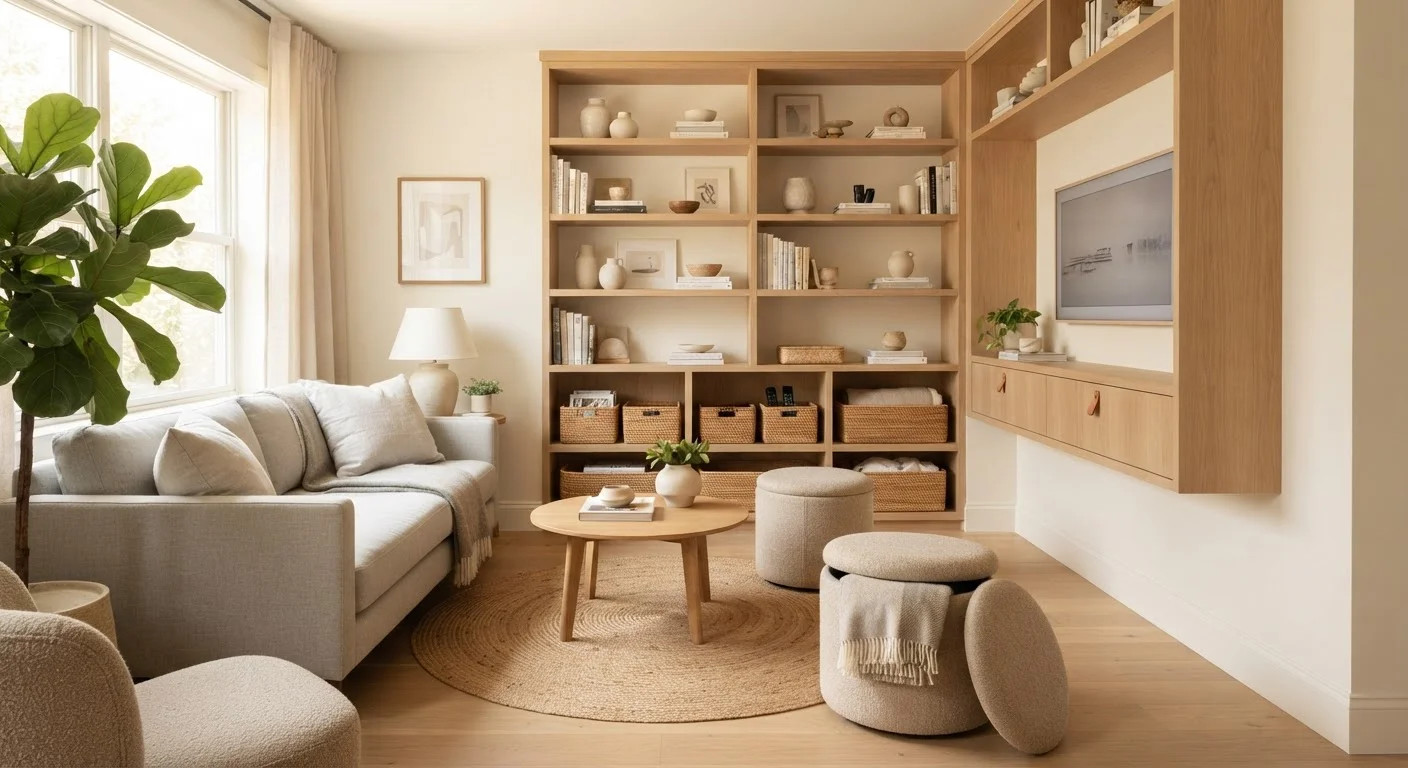
Floor space is finite, but wall space is largely untapped in most small homes. Installing shelving that runs from mid-wall to ceiling — in living rooms, hallways, even above doorframes — can dramatically increase your usable storage without consuming any additional square footage.
Floating shelves work well for books, decorative items, and baskets that contain smaller objects. In kitchens, open wall-mounted shelving can free up cabinet space by relocating everyday dishes or pantry staples to a more accessible surface. The key is treating walls as functional infrastructure, not just decoration.
Walls that go untouched are square footage you're quietly wasting every day.
Choose furniture that pulls double duty
Every piece of furniture in a small home should be earning its keep. Ottomans with interior compartments, bed frames with built-in drawers, coffee tables with lower shelves, and benches with under-seat storage all serve two functions simultaneously — seating or surface plus hidden containment.
When replacing or adding furniture, treat storage capacity as a primary criterion alongside comfort and style. A sofa with a chaise that includes under-cushion drawers, or a dining bench that stores table linens, represents a meaningful gain with no change to your floor plan.
In a small home, furniture that does only one job is a missed opportunity.
Declutter before you organize
No storage system can fix an excess of stuff. The most effective first step is a thorough edit of what you actually own. This doesn't require a dramatic overhaul — start room by room, category by category, and ask whether each item is used regularly, has a clear home, and justifies the space it takes up.
Donating, selling, or responsibly discarding items you no longer use is the fastest way to make existing storage feel adequate. You may find that once you've reduced volume, the storage you already have works fine. For clothing specifically, this process pairs well with thinking about wardrobe curation — see our guide wardrobe pieces that genuinely earn their space.
You cannot organize your way out of owning too much.
Use the back of every door
The inside of cabinet doors, pantry doors, bathroom doors, and closet doors represent storage real estate that most people never activate. Over-door organizers, hooks, magnetic strips, and shallow pocket organizers mount easily and hold a surprising range of items — cleaning supplies, shoes, spices, tools, or toiletries.
In bathrooms especially, an over-door rack can consolidate items that would otherwise crowd countertops or spill onto shelves. In a home office or craft room, the back of a door can become a vertical supply station. These additions are typically renter-friendly since they require no permanent hardware.
Behind every door is a storage surface most people walk past without noticing.
Contain and categorize within drawers and cabinets
Unstructured interior storage — deep kitchen drawers, linen closets, bathroom vanities — tends to become chaotic quickly. Drawer dividers, small bins, and stackable containers cost little and transform these spaces from jumbled catch-alls into organized, accessible systems.
The goal isn't aesthetics for its own sake; it's reducing the time spent hunting for things. When every item has a designated zone within a drawer or cabinet, the system is easier to maintain and easier to return to after daily use. If building new habits around organization feels challenging, the practical guide to home organization is a helpful complement to these strategies.
A drawer with no internal structure is storage you can't actually use efficiently.
Claim hidden zones: under beds, above cabinets, and stair risers
Most homes have storage potential in overlooked zones. The space under a bed can hold flat rolling bins for seasonal clothing, extra bedding, or shoes. The gap above kitchen cabinets — often left empty or used decoratively — can store infrequently accessed items in uniform boxes or baskets. In homes with staircases, hollow stair risers can be converted into pull-out drawers or cubbies by a contractor or handy DIYer.
The principle is consistent: audit your home for dead space. Gaps beside the refrigerator, the area between studs behind drywall in a renovation, even ceiling-mounted garage storage — these all represent capacity that already exists in your footprint and simply hasn't been activated yet.
Dead zones in your home — under beds, above cabinets — are storage waiting to be activated.
Renting? Check Before You Drill
Many of these strategies require no permanent modifications — adhesive hooks, over-door organizers, and freestanding furniture all work without altering walls. If you do want to install shelving or wall-mounted hardware, review your lease and check with your landlord first. Some rentals allow minor installations with written permission, and most require you to restore surfaces before move-out.
Making It Stick: Habits Over Systems
Even the most thoughtfully designed storage system degrades without consistent upkeep. The difference between a home that stays organized and one that cycles back to clutter usually comes down to small daily habits: returning items to their designated place, doing a brief weekly reset, and re-evaluating storage zones a couple of times a year as needs change.
Think of your storage setup as a living system rather than a one-time project. When a zone stops working — when items pile up in a certain spot or a drawer becomes hard to close — that's a signal to reassess the assignment, not just tidy up. Organization that's easy to maintain is the only kind that lasts. For a broader framework on building those habits space by space, see home organization for people who aren't naturally organized.
The content on this site is for informational purposes only and is not a substitute for professional advice. Always consult a qualified professional for guidance specific to your situation.