

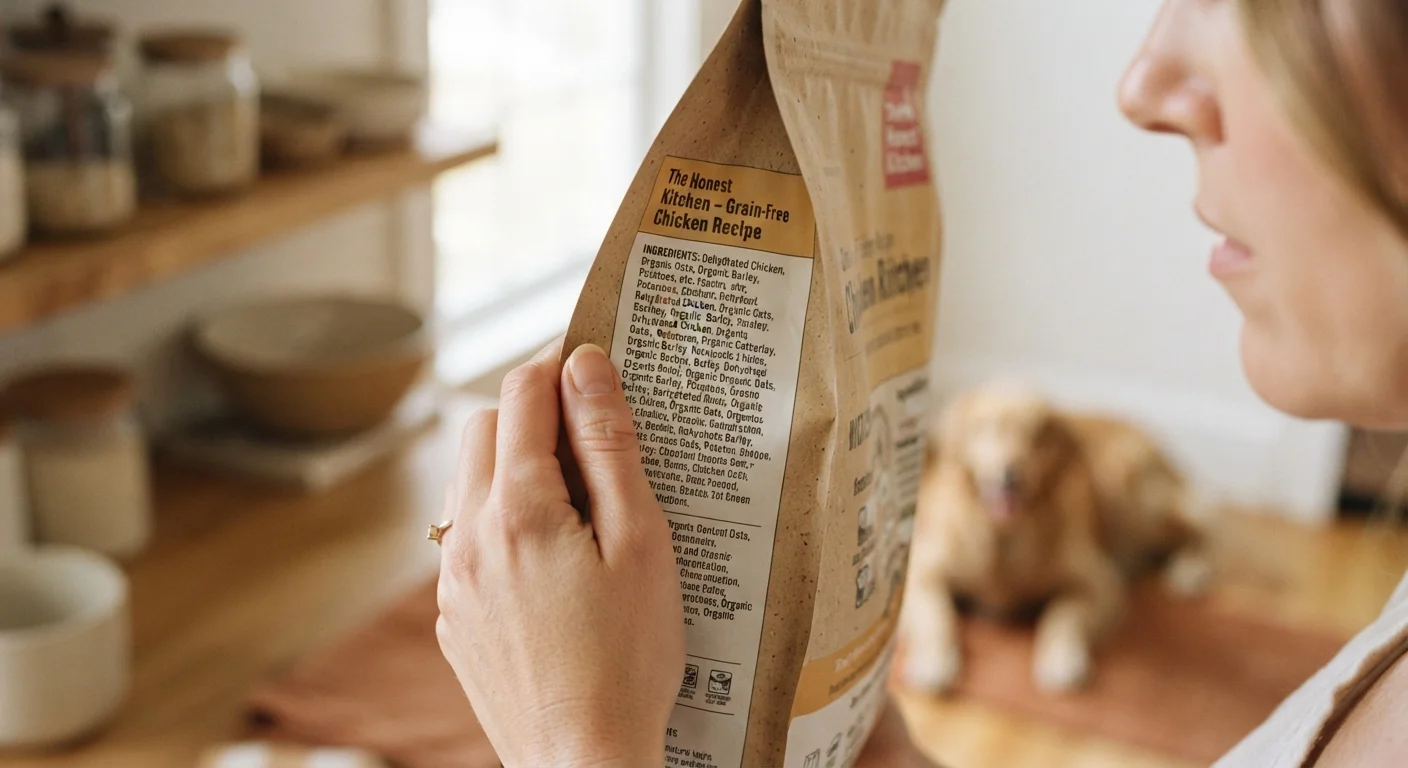
Why Pet Food Labels Are Worth Decoding
Pet food packaging is regulated at both the federal and state level in the United States, primarily through AAFCO (the Association of American Feed Control Officials) model regulations adopted by individual states. That regulatory structure means the label contains genuinely useful, standardized information — if you know where to look. The front of the bag is marketing territory. The back and side panels are where the regulated data lives.
Much like reading a Nutrition Facts label for human food, the skill here is knowing which sections carry regulatory weight and which are promotional. Once you understand the structure, evaluating a new product takes only a few minutes.
What you will need
Pet food package
The label you will work through step by step during this exercise.
AAFCO nutrient profiles reference
The Association of American Feed Control Officials publishes nutrient profiles for dogs and cats; their website provides publicly available educational information.
Veterinarian or veterinary nutritionist
A qualified professional who can interpret label findings in the context of your specific pet's health history.
How to Read a Pet Food Label Step by Step
Work through each section of the label in the order below. Every regulated pet food sold in the US must include all of these elements, so you will find them on any product — dry kibble, wet food, raw frozen, or semi-moist.
Pet Food Labels Are Not Medical Advice
Choosing a pet food based on label reading is a general educational exercise, not a substitute for veterinary guidance. If your pet has a diagnosed health condition, food allergy, or unusual nutritional need, work directly with your veterinarian or a board-certified veterinary nutritionist before changing their diet.
Locate the Product Name and Read It Carefully
US pet food naming rules, enforced by AAFCO and state feed control officials, tie the product name directly to ingredient content. If a single ingredient is named (e.g., "Salmon Cat Food"), that ingredient must make up at least 95% of the total product weight (excluding water). "With Salmon" drops that threshold to just 3%. A "Salmon Flavor" product may contain no salmon at all — only a detectable flavor. Reading the name critically takes five seconds and immediately sets expectations.
Find and Read the AAFCO Nutritional Adequacy Statement
This is the most consequential sentence on the label. It will say something like: "[Product] is formulated to meet the nutritional levels established by the AAFCO Dog Food Nutrient Profiles for all life stages." Look for two things: how adequacy was established (formulation vs. feeding trial) and for whom (all life stages, adult maintenance, growth and reproduction, or a specific age group). A food labeled only for "adult maintenance" is not formulated to support a growing puppy or a pregnant animal.
Scan the Ingredient List Intelligently
Ingredients are listed in descending order by pre-cooking weight, not by nutritional contribution. This matters because raw meat contains a lot of water. A whole chicken listed first may weigh more than a meat meal listed second, but after processing, the meal (which is already dried) may actually deliver more protein per pound. Similarly, a single ingredient can be "split" into sub-forms (e.g., ground corn, corn gluten meal, corn flour) that appear separately — effectively masking how much of that ingredient is present in total. Look for a named protein source near the top, and note how many of the first five ingredients are protein versus carbohydrate or filler. Just like reading a human nutrition label — a skill covered in our guide to Nutrition Facts labels — position on the list is your primary signal.
Interpret the Guaranteed Analysis Panel
This box lists minimum percentages of crude protein and crude fat, and maximum percentages of crude fiber and moisture. These are not exact values — they are guaranteed thresholds. The actual protein content in the food could be higher than stated. When comparing wet and dry foods, you must convert to a dry matter basis to make an apples-to-apples comparison: subtract the moisture percentage from 100, then divide the nutrient percentage by that number. For example, a wet food showing 10% protein and 78% moisture has a dry matter protein of roughly 45% — often higher than a dry kibble's dry matter protein.
Check Feeding Guidelines — and Treat Them as a Starting Point
Feeding guidelines on packaging are general recommendations calculated for an average pet at a given body weight. They do not account for your pet's individual metabolism, activity level, reproductive status, or health conditions. Use them to establish an initial portion, then adjust based on body condition score — your veterinarian can show you how to assess this at home. If you notice your pet gaining or losing weight unexpectedly, consult your vet before making significant changes. For pets showing signs of discomfort that might be diet-related, our article on signs your pet may be in pain can help you identify when a vet visit is warranted.
Evaluate Any Special Claims with Skepticism
"Natural" in pet food has a regulatory definition: ingredients derived solely from plant, animal, or mined sources, without chemical synthesis. "Organic" follows USDA organic standards and requires certification. Beyond those two, most label claims — "premium," "holistic," "grain-free is better" — are not regulated and carry no guaranteed nutritional meaning. Grain-free diets in particular have been a subject of ongoing FDA investigation regarding a potential link to dilated cardiomyopathy in dogs; this research is not yet conclusive, but it underscores why consulting your veterinarian before switching diet types is worthwhile.
Use the AAFCO Statement as Your First Filter
Before reading anything else on the bag, find the AAFCO nutritional adequacy statement. It tells you in plain language whether the food was formulated to meet a nutrient profile or was tested through a feeding trial — and for which life stage. This single sentence does more work than the entire front of the package.
Common Pitfalls and How to Avoid Them
Even informed readers can be tripped up by a few recurring issues on pet food packaging.
Marketing Terms Can Mislead
Words like "premium," "holistic," "human-grade," and "ancestral" have no standardized regulatory definition in US pet food labeling. They signal marketing positioning, not a guaranteed nutritional standard. Focus instead on the regulated sections of the label — the ingredient list, guaranteed analysis, and AAFCO statement.
- Assuming "first ingredient" means most nutritious: Position reflects pre-cook weight, not post-processing nutritional density.
- Comparing wet and dry foods on the same scale: Always convert to dry matter basis before comparing protein or fat percentages across food types.
- Treating the guaranteed analysis as an exact formula: These are minimum or maximum thresholds, not precise nutrient snapshots.
- Overlooking the life stage designation: A food not formulated for your pet's current life stage may leave nutritional gaps or provide excess nutrients inappropriate for their age.
Decoding labels is a skill that transfers — the same careful reading that helps you evaluate pet food can help you navigate other complex product information, whether that's consumer contract fine print or an ingredient list on your own products.
This article provides general educational information about pet food labeling and is not a substitute for professional veterinary advice. Always consult a licensed veterinarian for guidance specific to your pet's health, diet, and nutritional needs.
The content on this site is for informational purposes only and is not a substitute for professional advice. Always consult a qualified professional for guidance specific to your situation.