

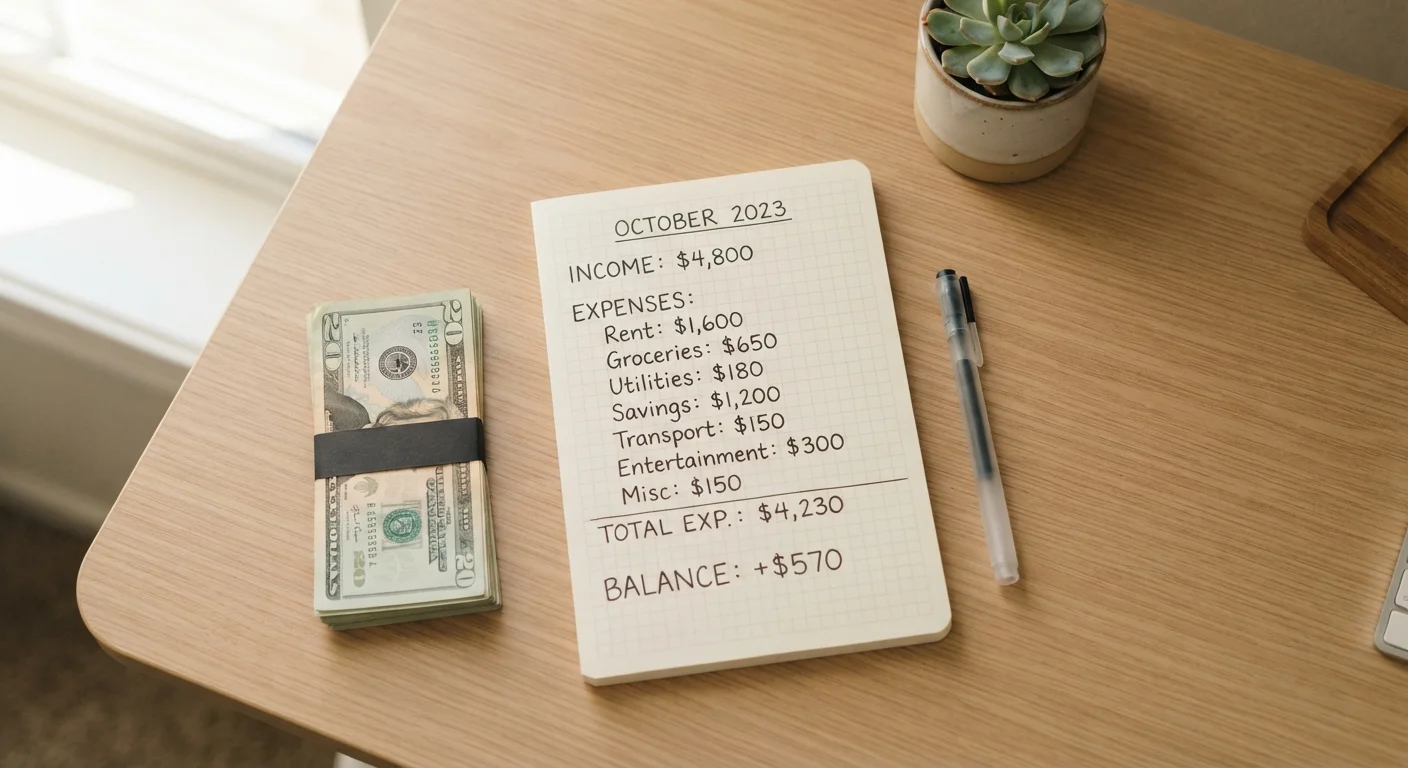
How Zero-Based Budgeting Works
The mechanics are straightforward. At the start of each month, write down your total expected take-home income. Then list every category where money will go: rent or mortgage, groceries, utilities, transportation, subscriptions, savings contributions, debt payments, and any discretionary categories like dining out or entertainment. Assign a specific dollar amount to each category until the total matches your income exactly — leaving a balance of zero.
The word "zero" refers to that final balance, not your bank account. A $200 transfer to a savings account is just as valid a category as a $200 grocery budget. Both get the same deliberate treatment.
If you finish assigning dollars and have money left over, add it to a category — savings, an extra debt payment, or a sinking fund for a future expense. If you run out of income before covering all categories, you must cut somewhere. That forced trade-off is exactly where the method's power lies.
Build a Small Buffer Category
New zero-based budgeters often forget irregular expenses — a car registration, a dentist copay, a birthday gift. Add a modest 'miscellaneous' or 'buffer' category of $25–$50 for your first few months. Once you understand your spending patterns, you can replace it with named sinking funds for specific irregular costs.
Why It Works: The Psychology Behind the Method
Most people operate with a "spend what's left" mindset: pay fixed bills, then use whatever remains without much structure. Zero-based budgeting flips that. By assigning dollars before the month begins, you make spending decisions when you're calm and clearheaded — not in the moment when a purchase feels justified.
Research in behavioral economics consistently shows that pre-commitment — deciding in advance how to act — reduces impulsive financial decisions. When your dining-out category hits zero mid-month, the budget itself becomes the decision-maker rather than your mood.
“A budget is telling your money where to go instead of wondering where it went.”
— Dave Ramsey, Personal finance author and radio host
The method also surfaces hidden spending. Many people discover recurring subscriptions, incremental convenience purchases, or underestimated utility costs only when they're forced to categorize every dollar. That visibility is often the first step toward meaningful change. For a comparison of how this approach stacks up against other popular frameworks, see budgeting methods compared.
Setting Up Your Zero-Based Budget: A Practical Sequence
Follow these steps at the start of each budget period:
- Calculate net income. Use take-home pay — after taxes, benefits deductions, and any automatic transfers. Variable earners should use a conservative estimate.
- List fixed expenses first. These don't change month to month: rent, loan minimums, insurance premiums. Assign exact amounts.
- Estimate variable necessities. Groceries, gas, and utilities fluctuate. Use recent bank statements to find realistic averages, then assign those amounts.
- Fund savings categories. Emergency fund contributions, retirement account transfers, and sinking funds (car maintenance, annual subscriptions) belong here — before discretionary spending.
- Allocate discretionary spending. Entertainment, dining, hobbies, and personal care get whatever remains after the above categories are funded.
- Balance to zero. Adjust category amounts until income minus all allocations equals zero. If categories exceed income, cut discretionary first.
~33%
Americans with a written monthly budget
Surveys by the National Endowment for Financial Education and similar organizations consistently find that fewer than one in three Americans maintains a formal written budget.
$314
Average monthly spending on subscriptions
A 2022 C+R Research study found Americans significantly underestimate their subscription spending, on average guessing roughly $86 per month against an actual average near $219–$314 depending on the segment surveyed.
60%
Adults living paycheck to paycheck
Multiple annual surveys, including those by LendingClub and PYMNTS, have consistently found that roughly 60% of U.S. adults report living paycheck to paycheck regardless of income level.
If you're brand new to budgeting, a plain-language six-step walkthrough can help you build the foundational habits this method requires.
Who Benefits Most — and When It Gets Difficult
Zero-based budgeting suits people who want granular control, have faced unexplained money shortfalls, or are working toward a specific financial goal like paying off debt or saving for a home. It also works well for households managing on a tight margin where every category genuinely matters.
The method is harder to sustain if your income is highly irregular without a reliable floor estimate, if tracking feels burdensome, or if life circumstances change frequently mid-month. In those cases, a broader framework — like the 50/30/20 rule — may be more practical.
Mid-Month Adjustments Are Normal
Zero-based budgets are plans, not contracts. If an unexpected expense arises mid-month, simply move dollars from a lower-priority category to cover it. The key is to consciously reallocate rather than ignore the budget. Tracking these adjustments over time helps you build more accurate budgets in the future.
It's also worth considering how ZBB fits alongside other money habits. Cash envelopes, ZBB, and app-based tracking each have meaningful tradeoffs depending on your lifestyle and discipline style. The broader context of which method suits you is part of a complete personal finance planning approach.
This article provides general financial education and is not personalized financial advice. Consult a licensed financial professional for guidance specific to your situation.
Frequently Asked Questions
No. It means every dollar is assigned a purpose before you spend it. Savings, emergency funds, and investments are all valid budget categories. The point is intentionality, not spending everything down to nothing.
The 50/30/20 rule divides income into three broad buckets: needs, wants, and savings. Zero-based budgeting is more granular — every specific category gets a dollar amount. ZBB requires more upfront planning but gives you tighter control. See <a href="/personal-finance/budgeting-basics/budgeting-methods-compared-zero-based-503020-pay-yourself-first-and-more">how the two methods compare</a> for a full breakdown.
Variable-income earners often use their lowest expected monthly income as the base for planning. Anything earned above that baseline can be allocated in a priority order you define in advance — for example, topping up an emergency fund before adding discretionary spending.
Expect your first budget to take 30–60 minutes. Once you know your categories and typical amounts, subsequent months take 15–20 minutes to adjust. The setup time decreases significantly after the first two or three cycles.
It can be, but it requires discipline and regular review. If you've never budgeted before, start with a simpler framework first. A <a href="/personal-finance/budgeting-basics/your-first-budget-in-six-steps">six-step first budget</a> can help you build foundational habits before adding ZBB's detail.
A simple spreadsheet works well. Several budgeting apps are built specifically around zero-based principles, allowing you to assign income to categories digitally. Pen-and-paper works too — the method depends on your system, not any specific tool.
The content on this site is for informational purposes only and is not a substitute for professional advice. Always consult a qualified professional for guidance specific to your situation.