

Our Verdict
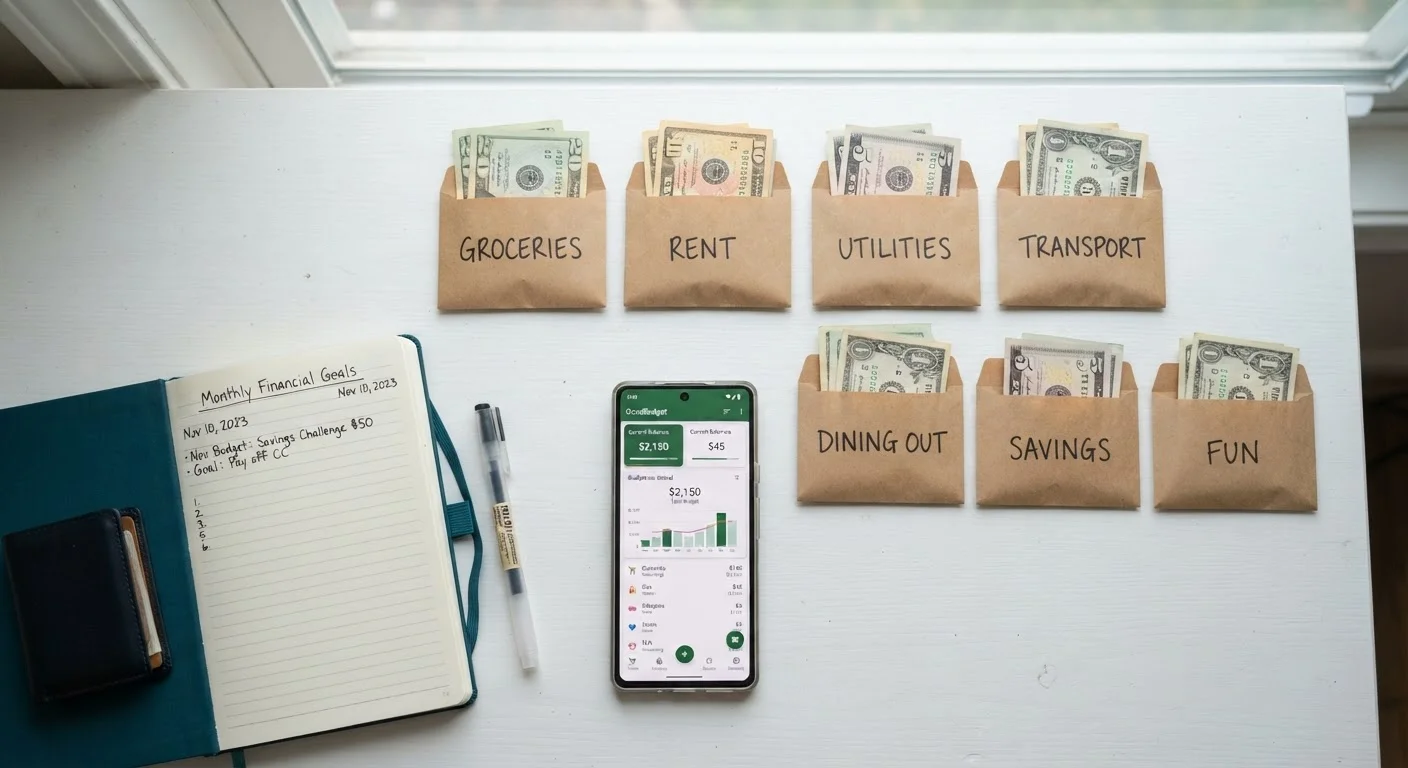
Cash envelope budgeting works best for tactile learners and those prone to overspending in specific categories. Zero-based budgeting rewards detail-oriented planners who want total control over every dollar. Digital tracking is the lowest-friction starting point for most people, but only delivers results when paired with regular review. Choosing the right method ultimately comes down to your spending habits and how hands-on you want to be.
| Best for | Recommended |
|---|---|
| Impulse spenders who need firm category limits | Cash Envelope Budgeting |
| Detail-oriented planners who want full dollar accountability | Zero-Based Budgeting |
| Busy individuals who want low-effort spending awareness | Digital Tracking Apps |
| Those wanting structure with modern convenience | Hybrid Approach |
Why Your Budgeting Method Matters
Choosing how to track your money is not just an administrative decision — it shapes how you relate to spending on a daily basis. A method that requires too much friction gets abandoned. One with too little structure gets ignored. The three approaches most commonly used today — cash envelope budgeting, zero-based budgeting, and digital app tracking — each operate on a different core principle and suit different personality types and financial situations.
Understanding the mechanics and real-world tradeoffs of each method helps you pick one you'll actually stick with. For a broader look at how these fit into overall budget planning, see the complete personal finance planning resource.
| Cash Envelopes | Zero-Based Budgeting | Digital Tracking Apps | |
|---|---|---|---|
| Core mechanism | Physical cash limits per category | Every dollar pre-assigned to a purpose | Automatic transaction categorization |
| Setup time | Low — label envelopes, withdraw cash | High — full monthly allocation required | Low — link accounts, review categories |
| Ongoing effort | Moderate — ATM runs, cash management | High — monthly rebuild, mid-month tweaks | Low — mostly automated with periodic review |
| Works for online spending | No — cash only | Yes — method-agnostic | Yes — tracks card and bank transactions |
| Behavioral impact | High — pain of payment is immediate | High — deliberate allocation builds awareness | Variable — depends on how actively reviewed |
| Best for | Tactile learners, impulse spenders | Detail-oriented planners | Busy individuals, beginners |
| Technology required | None | Spreadsheet helpful | Smartphone and bank account |
Cash Envelope Budgeting: Physical Limits, Real Accountability
The envelope method works by dividing your take-home pay into physical envelopes labeled by spending category — groceries, dining out, gas, entertainment, and so on. Once an envelope is empty, spending in that category stops until the next pay period. No borrowing from other envelopes unless you deliberately choose to.
The psychological force here is real: handing over physical bills feels different from tapping a card. Research in behavioral economics consistently finds that people spend less when using cash versus digital payment methods, because the pain of payment is more immediate and tangible.
Key advantages:
- Naturally limits overspending in problem categories
- No app, subscription, or technology required
- Immediate visual feedback on remaining funds
Common drawbacks:
- Impractical for online purchases, subscriptions, or bill autopay
- Carrying cash can feel inconvenient or unsafe
- Requires weekly or biweekly trips to the ATM
The envelope system pairs especially well with a percentage-based framework. See how it stacks up directly against the 50/30/20 rule in our article comparing these two popular methods.
Start With Just Two or Three Envelopes
You don't need to run your entire budget on cash to benefit from envelope budgeting. Try it for the two or three categories where you consistently overspend — dining out, groceries, or entertainment are common starting points. Once those feel manageable, expand the system as needed. This incremental approach lowers the barrier to entry significantly.
Zero-Based Budgeting: Every Dollar Has a Job
Zero-based budgeting (ZBB) starts from a simple premise: income minus all assigned expenses, savings, and debt payments should equal zero by the end of the month. This doesn't mean spending everything — it means every dollar is intentionally allocated somewhere, including savings goals and emergency fund contributions.
This method demands more planning time upfront. You build your budget from scratch each month, assigning dollars to categories before they're spent. If your income changes month to month, you re-budget to match the new figure.
Key advantages:
- Forces a deliberate decision about every dollar earned
- Naturally incorporates savings and debt payoff as budget categories
- Quickly exposes areas of waste or unconscious spending
Common drawbacks:
- Time-intensive, especially in early months
- Irregular income makes it more complex to execute
- Requires disciplined mid-month adjustments when expenses vary
For a detailed walkthrough of how zero-based budgeting works in practice, see our guide on giving every dollar a job.
Digital Tracking Apps: Visibility Without the Manual Work
App-based budgeting tools sync with your bank accounts and credit cards to categorize transactions automatically, giving you a near-real-time picture of where your money is going. Most platforms generate spending reports, send alerts when you approach category limits, and track progress toward savings goals.
The main appeal is low friction: you don't need to handle cash or build a spreadsheet from scratch each month. But automation has a hidden cost — it's easy to glance at a dashboard and feel informed without actually changing behavior.
Key advantages:
- Automatic transaction import reduces manual data entry
- Accessible on mobile, making spending review easy on the go
- Trend reports reveal patterns over months or years
Common drawbacks:
- Passive visibility doesn't automatically create discipline
- Syncing errors and miscategorized transactions require regular correction
- Privacy considerations when linking financial accounts to third-party apps
If you're drawn to digital tools but curious about what manual tracking offers that apps can't replicate, the comparison in budgeting by hand vs. apps is worth reading.
~30%
Less spent when paying with cash vs. cards
Behavioral research, including work published in the Journal of Consumer Research, consistently finds consumers spend less when using physical cash compared to credit or debit cards.
1 in 3
Americans report having no monthly budget
Surveys by organizations including the National Foundation for Credit Counseling have found that a significant share of U.S. adults do not follow any structured monthly budget.
Choosing What Works for You
The most effective budgeting method is the one you'll actually use consistently. A few questions can help narrow down the right fit:
- Do you overspend in specific categories? Envelope budgeting applies hard stops where you need them most.
- Do you want total control over every dollar? Zero-based budgeting leaves nothing to chance.
- Do you want a low-effort starting point? A digital tracker gets you oriented quickly, even if you refine your method later.
Many people use hybrid approaches — for example, using an app for overall visibility while keeping physical cash for dining and discretionary spending. There's no rule against combining elements. What matters is that your method reflects how you actually live and spend.
For a broader overview of how these and other frameworks compare side by side, the full budgeting methods comparison covers zero-based, 50/30/20, pay-yourself-first, and more. And if you're ready to build consistent habits around whichever method you choose, these spending patterns worth building into any budget offer a practical next step.
This article is for general informational purposes only and does not constitute personalized financial advice. Consult a licensed financial professional for guidance tailored to your individual circumstances.
The content on this site is for informational purposes only and is not a substitute for professional advice. Always consult a qualified professional for guidance specific to your situation.