

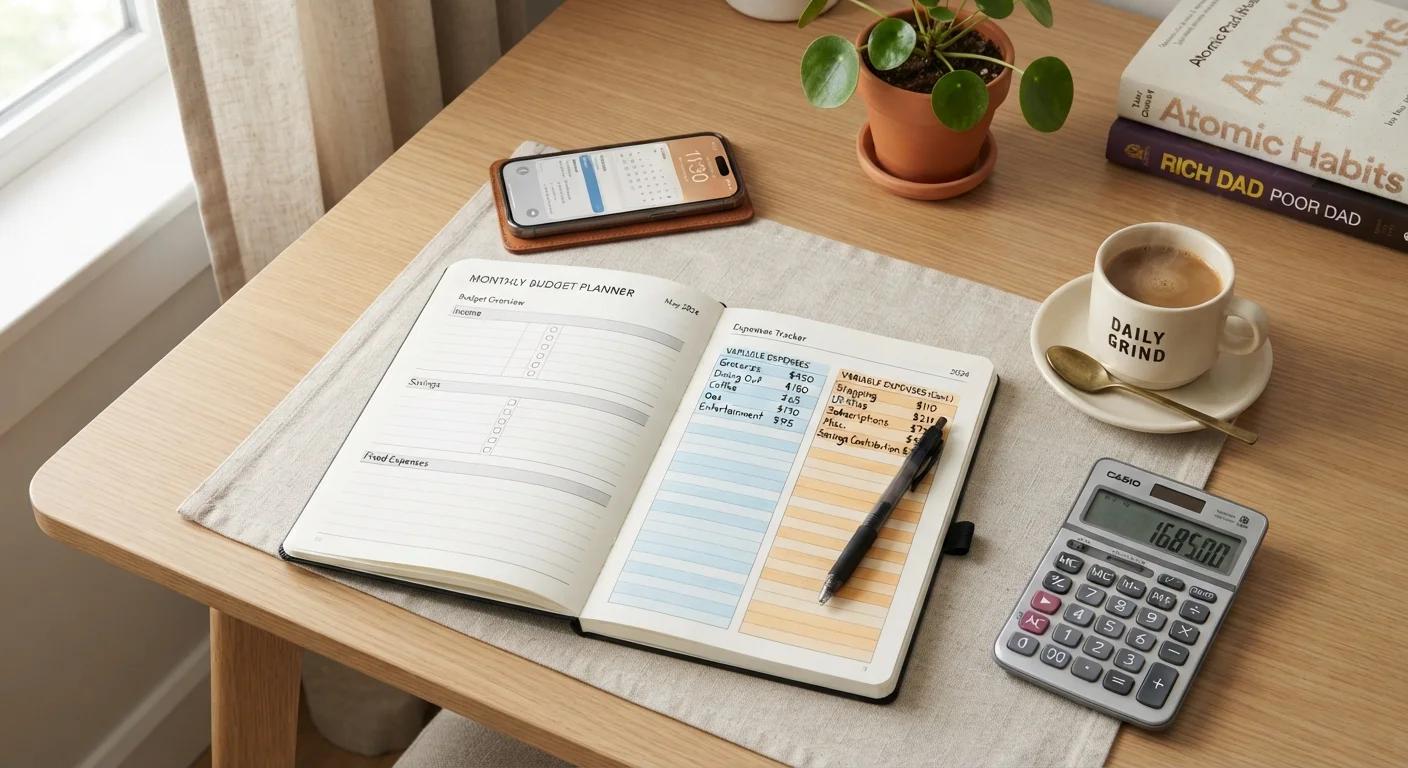
Option A
Fixed Expenses
The predictable, unchanging foundation of your budget.
Best for: Readers who want to establish a reliable baseline of monthly costs they can plan around with certainty.
Option B
Variable Expenses
The flexible costs that shift month to month.
Best for: Readers who want to find the most actionable room to cut, adjust, or redirect spending in their budget.
What Makes an Expense Fixed or Variable?
Every dollar you spend falls into one of two camps. Fixed expenses are costs that remain the same from month to month — your rent or mortgage payment, car loan, insurance premiums, and subscription services at a set rate. You know exactly what they will be before the month begins, which makes planning straightforward.
Variable expenses, by contrast, shift based on your behavior and circumstances. Groceries, gas, dining out, clothing, utilities, and entertainment all fluctuate depending on how much you use or consume. You have meaningful control over these costs, which is both an opportunity and a challenge.
A common mistake is treating all recurring expenses as fixed. A gym membership billed monthly is fixed; the amount you spend on groceries each week is variable — even if you shop weekly out of habit. The distinction matters because the strategies for managing each type are completely different. For a broader foundation on building a budget around these categories, see the Budgeting Basics hub.
| Criterion | Fixed Expenses | Variable Expenses |
|---|---|---|
| Monthly amount | Same every month | Changes based on behavior |
| Predictability | High — easy to plan around | Low to moderate — requires tracking |
| Examples | Rent, loan payments, insurance | Groceries, dining, gas, utilities |
| How to reduce | One-time negotiation or switch | Ongoing behavioral adjustments |
| Budget priority | Planned first as the cost floor | Assigned targets after fixed costs |
| Control level | Low day-to-day control | High day-to-day control |
Managing Fixed Expenses: Low Frequency, High Impact
Because fixed expenses don't change on their own, reducing them requires a deliberate decision — but the payoff is lasting. Negotiating a lower insurance rate, refinancing a loan at a better interest rate, or moving to a less expensive home are all high-effort, one-time actions that permanently lower your monthly floor. These decisions are worth revisiting periodically rather than assuming the rate you started with is the best available.
One practical approach: list every fixed expense and its exact monthly cost. This alone is clarifying. Many households discover forgotten subscriptions or automatic renewals that quietly drain accounts. Once you see the full picture, you can decide which costs are non-negotiable and which are candidates for reduction or elimination.
Semi-Fixed Expenses: The In-Between Category
Some costs don't fit neatly into either bucket. Utility bills, for instance, recur monthly but vary with usage — making them semi-variable. Similarly, a streaming service is fixed until you cancel it, then gone entirely. Treating these costs as variable in your budget gives you the most accurate picture and keeps you from being caught off guard by seasonal swings.
For more ways to structure your overall spending plan, the budgeting methods comparison walks through several frameworks — including the 50/30/20 rule — and how each treats fixed and variable costs differently.
Managing Variable Expenses: Daily Choices, Cumulative Results
Variable expenses are where most budgeting advice lives — because they respond directly to behavior. The core strategy is to set a monthly target for each major variable category (groceries, dining, entertainment, transportation) and track actual spending against it. Even rough tracking surfaces patterns most people don't notice until they see the numbers.
A few approaches that tend to work well:
- Use category envelopes or digital buckets — allocate a set dollar amount to each variable category at the start of the month. When it's gone, it's gone.
- Audit once a quarter — review the previous three months of variable spending to spot drift before it becomes a problem.
- Build in flex — irregular variable costs (car repairs, medical copays, seasonal spending) belong in a small buffer category rather than being ignored until they hit.
Variable spending also shapes travel budgets in important ways. The travel budgeting guide offers a useful framework for estimating trip costs — many of which behave like variable expenses at home.
~33%
Share of income spent on housing (fixed)
The U.S. Bureau of Labor Statistics Consumer Expenditure Survey consistently finds housing represents roughly a third of average household spending — the single largest fixed expense category.
~15%
Share of income spent on food (variable)
According to BLS Consumer Expenditure data, food — including groceries and dining out — accounts for approximately 12–15% of household budgets, making it the most significant variable category for most Americans.
3 in 5
Americans living paycheck to paycheck
Multiple household finance surveys have found that a majority of U.S. adults report limited financial buffer, underlining how important it is to actively manage both fixed and variable costs.
Putting Both Together: A Practical Budget Approach
A reliable budget starts with fixed expenses because they set the non-negotiable floor. Subtract your total fixed costs from your take-home income, and what remains is available for variable spending and savings. This sequencing — fixed first, then variable — prevents the common mistake of overspending on discretionary items and coming up short on essentials.
From there, assign targets to each variable category based on past spending and current goals. If savings is a priority, treat it like a fixed expense: automate a transfer on payday before variable spending can absorb it. This is the core logic behind the pay-yourself-first approach.
If you find this harder than expected, you're in good company. The common budgeting myths article addresses several misconceptions — like the idea that budgets require perfect discipline — that make the process feel more daunting than it is. And if you want to build better spending habits over time, the spending patterns guide offers evidence-backed practices that work alongside any framework.
This article is for general informational purposes only and does not constitute personalized financial advice. Consult a qualified financial professional for guidance tailored to your individual circumstances.
The content on this site is for informational purposes only and is not a substitute for professional advice. Always consult a qualified professional for guidance specific to your situation.