

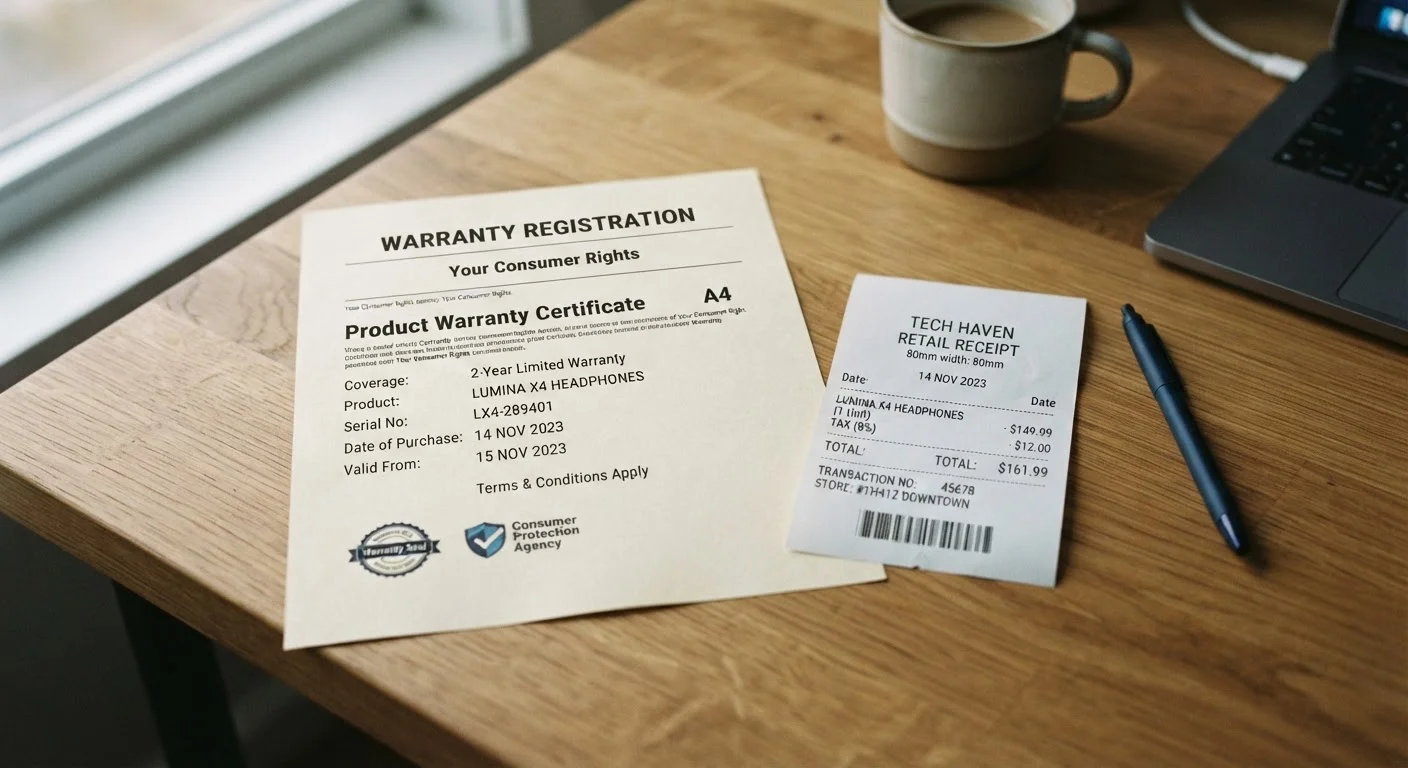
Option A
Express Warranty
The written promise a seller or manufacturer puts on the record.
Best for: Consumers who want clearly defined, documented coverage terms they can point to in a dispute.
Option B
Implied Warranty
The automatic legal baseline every purchase carries by default.
Best for: Consumers whose product fails in a basic way even when no written warranty exists.
What Makes a Warranty 'Express'
An express warranty is any specific, affirmative claim a seller or manufacturer makes about a product's quality, condition, or performance. It doesn't have to be a formal certificate. Under the Uniform Commercial Code (UCC), which most U.S. states have adopted, an express warranty can be created by a written description, a product sample, or even a seller's factual statement made during a sale — provided that statement became part of the reason you bought the product.
In practice, express warranties most often appear as a printed document inside the box, language on product packaging, or terms posted on a manufacturer's website. They typically spell out what's covered, for how long, and what the warrantor will do to remedy a defect (repair, replace, or refund).
What express warranties usually don't cover is equally important: normal wear and tear, accidental damage, unauthorized modifications, and damage from misuse are standard exclusions. Reading those exclusions before you need the warranty is time well spent. Common warranty myths — like the idea that any third-party repair automatically voids coverage — are worth dispelling before a dispute arises.
How Implied Warranties Work Without Any Paperwork
Implied warranties don't require a signature, a registration card, or even a conversation. They arise automatically from state law the moment a sale occurs — as long as the seller is a merchant (a business that regularly sells goods of that type, not a private individual).
The most fundamental is the implied warranty of merchantability: the product must be fit for the ordinary purpose for which such goods are used. A blender must blend. A pair of boots must hold together under normal use. If the item fails at its core function within a reasonable timeframe, you have a legal claim even without a single line of written warranty.
A second type — the implied warranty of fitness for a particular purpose — applies when you told the seller a specific intended use and relied on their recommendation. If the seller suggested a product for that purpose and it failed at it, this implied warranty may apply.
| Criterion | Express Warranty | Implied Warranty |
|---|---|---|
| How it's created | Written, verbal, or by sample/description | Automatically by state law at point of sale |
| Requires documentation | Yes — typically written terms | No — exists without any paperwork |
| Who creates it | Seller or manufacturer | State law (UCC) |
| Can be disclaimed | Seller defines its own limits | Only with conspicuous 'as-is' language; restricted in some states |
| Duration | Stated in the warranty document | Reasonable period; varies by state and product |
| Federal oversight | Governed by Magnuson-Moss Act | Protected under Magnuson-Moss if a written warranty also exists |
| Applies to private sellers | Can apply if explicit promise was made | Generally no — merchant sellers only |
Implied warranties can be disclaimed, but only under specific legal conditions. A seller must use conspicuous written language — typically the words "as-is" or "with all faults" — to strip away implied protections. And in several states, including Massachusetts, Kansas, Maine, Vermont, and West Virginia, sellers cannot disclaim implied warranties on consumer goods at all.
The Federal Layer: Magnuson-Moss and What It Adds
The Magnuson-Moss Warranty Act (15 U.S.C. § 2301 et seq.) is the federal law governing written warranties on consumer products sold in the U.S. It doesn't require manufacturers to offer a written warranty, but if they do, it imposes rules on what they can and can't do.
Magnuson-Moss Does Not Create a Federal Implied Warranty
The Magnuson-Moss Warranty Act protects existing state-law implied warranties — it doesn't create new federal ones. Your actual implied warranty rights depend on the state where you made the purchase, which is why outcomes can differ from state to state. When in doubt, check your state attorney general's consumer protection resources for jurisdiction-specific guidance.
Critically, Magnuson-Moss prohibits a warrantor who provides a written warranty from completely disclaiming implied warranties — they can limit them to the duration of the express warranty, but they cannot eliminate them entirely. This is meaningful protection: if a product comes with any written warranty at all, your implied warranty rights survive.
The Act also creates the "full" vs. "limited" warranty distinction. A full warranty requires free repair or replacement within a reasonable time; a limited warranty may impose conditions. Look for these terms on any warranty document you receive — they signal what remedies you're actually entitled to.
For a broader view of your post-purchase rights, the consumer protection basics that apply after any sale are worth understanding alongside warranty law. And before paying for add-on coverage, consider that extended warranties often duplicate protections you already hold for free.
Using These Rights in Practice
When a product fails, your first step is identifying which warranty applies. If there's written documentation of a specific promise, that's your express warranty claim — locate the warrantor's contact process and follow it to the letter, keeping copies of everything. If no written warranty exists but the product simply doesn't work as it should, your implied warranty of merchantability claim runs against the seller (typically the retailer, under state law).
Document the failure clearly: photos, a description of how the defect appeared, and your proof of purchase. State your claim in writing, even by email — this creates a record. If the seller refuses to honor a valid warranty, you have several escalation paths: your state attorney general's consumer protection office, small claims court (cost-effective for lower-value disputes), or a complaint with the Federal Trade Commission.
50
U.S. states with UCC implied warranty provisions
All 50 U.S. states have adopted some version of the Uniform Commercial Code, establishing baseline implied warranty protections for consumer goods purchases.
5
States that ban implied warranty disclaimers on consumer goods
Massachusetts, Kansas, Maine, Vermont, and West Virginia prohibit sellers from disclaiming implied warranties on consumer products, offering stronger baseline protections.
Understanding the difference between these two warranty types isn't just academic — it determines which lever you pull and who you hold responsible. Extended warranties rarely fill gaps that express and implied warranties leave open, which makes knowing your baseline rights the smartest first move.
This article provides general consumer information and education only. It is not legal advice. For questions about your specific situation, consult a qualified attorney or your state's consumer protection office.
The content on this site is for informational purposes only and is not a substitute for professional advice. Always consult a qualified professional for guidance specific to your situation.