

Why the First Number Wins
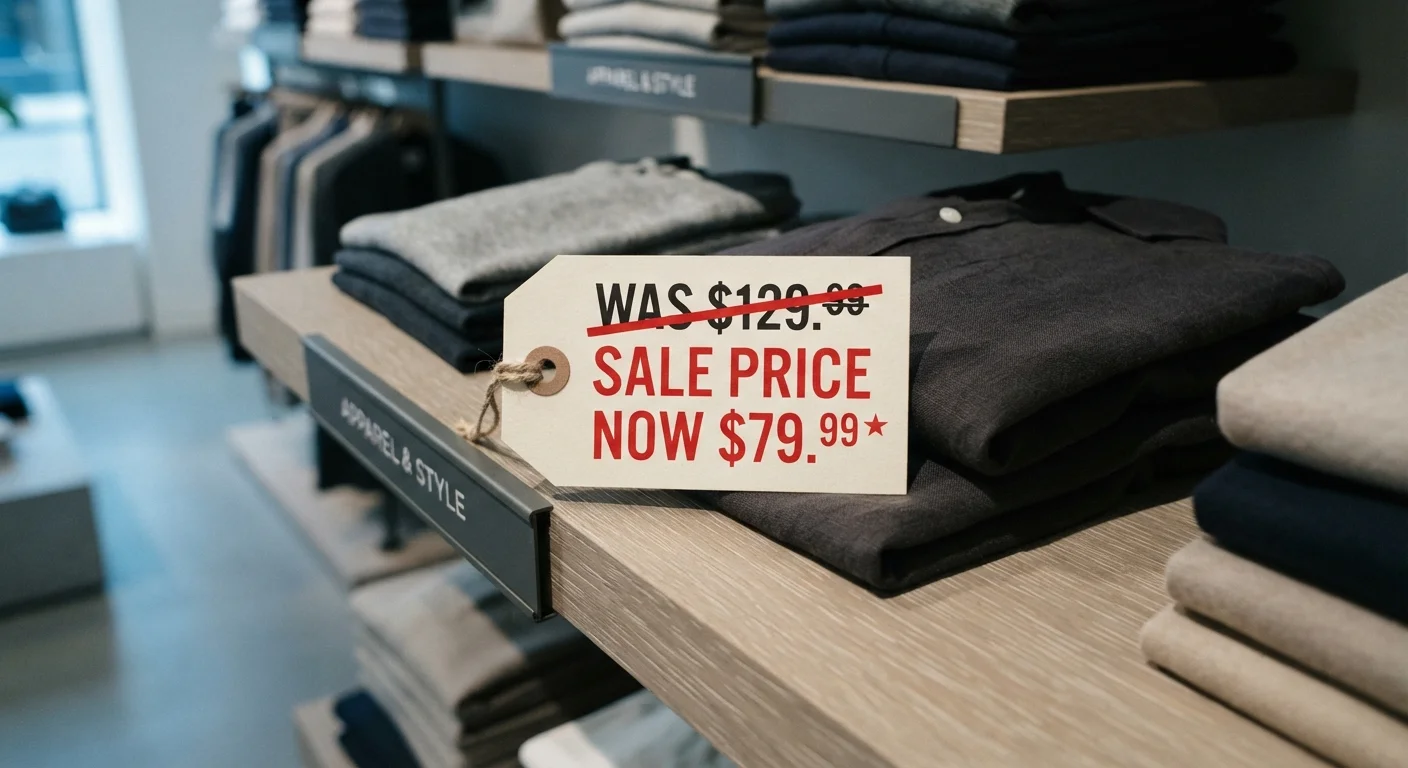
Before you evaluate whether a price is fair, your brain needs a starting point. Whatever number appears first fills that role — automatically, and often permanently. This is price anchoring, and it operates whether you're in a big-box store, scrolling an e-commerce page, or negotiating at a car dealership.
The mechanism is straightforward: the brain treats the initial figure as a plausible reference, then adjusts from there. The problem is that humans are poor at adjusting enough. Studies in behavioral economics consistently show that final judgments remain too close to the anchor, even when people consciously try to correct for it. A $300 jacket marked down to $180 feels like a different proposition than a $180 jacket with no history — even if the actual market value is identical.
This isn't a flaw unique to naive shoppers. It has been demonstrated across trained negotiators, finance professionals, and economists. The anchor's power comes not from credulity but from how memory and comparison fundamentally work. For a broader look at how marketing psychology stacks multiple tactics together, see how anchoring pairs with scarcity tactics.
40%+
Anchoring effect on final price estimates
Behavioral economics research by Ariely, Loewenstein, and Prelec found that initial arbitrary numbers shifted participants' willingness-to-pay estimates by more than 40% in controlled experiments.
73%
Consumers influenced by reference price labels
A study published in the Journal of Consumer Research found that a majority of shoppers reported a product felt like a better value when a higher reference price was displayed alongside the current price.
$1 trillion+
Annual U.S. retail sales influenced by promotional pricing
The National Retail Federation estimates that promotional and sale pricing — anchor-dependent formats — account for a dominant share of total U.S. consumer retail spending each year.
How Retailers Deploy Anchors Intentionally
Retail environments are carefully engineered around this bias. Common anchor tactics include:
- Crossed-out "original" prices: The inflated number is displayed in larger font, often in a muted color to simulate legitimacy. Even if the item was only briefly sold at that price, the number sticks.
- Luxury item placement: Placing a $1,500 item near a $400 item makes the $400 option feel modest. The $1,500 item may never sell; it exists to reframe what expensive means in that category.
- Decoy pricing tiers: A three-tier subscription or product line often includes a middle option that was reverse-engineered to look reasonable compared to the premium tier — not priced based on its actual cost or value.
- Sale event framing: "Up to 70% off" anchors shoppers to the extreme end of the range, even when most items carry far smaller reductions.
Understanding these setups doesn't require cynicism — it requires recognizing that a retailer's pricing display is a persuasion tool, not a neutral information source. This is a foundational concept covered in understanding value before you buy.
“The basic anchoring finding is that when people are asked to make numerical estimates, their estimates are biased toward an initial value. This holds even when the initial value is clearly arbitrary.”
— Daniel Kahneman, Nobel Prize-winning psychologist and author, known for foundational research in behavioral economics
Practical Defenses That Actually Work
Because anchoring operates below the level of conscious deliberation, the most effective defenses work before you encounter the retailer's number.
Set Your Price Ceiling Before You Browse
Before visiting a store or opening a product page, decide the maximum you're willing to pay for the item based on independent research. Write it down. Once you've seen a retailer's anchor price, that number is already competing for space in your working memory — having your own figure committed in advance gives it a fighting chance.
Set your own anchor first. Research what an item typically sells for across independent sources — consumer databases, price-tracking tools, or category price surveys — before you look at any retailer's display. That self-generated figure becomes a competing anchor, and it's one you control.
Evaluate the price in isolation. Ask yourself: would I pay this amount if there were no crossed-out figure beside it? If the answer is no, the anchor is doing the work, not the value.
Audit the "original" price skeptically. U.S. Federal Trade Commission guidelines require that reference prices reflect genuine prior selling prices, but enforcement is uneven. If a product has been perpetually "on sale," the original price may not represent real market history.
Anchoring is also a key driver of impulse decisions — the sudden sense that a deal is too good to pass up. That dynamic is explored in detail in why impulse buying feels rational in the moment. Building a general framework for evaluating every purchase — not just discounted ones — is addressed in a practical shopper's value framework.
When to Trust the Discount — and When Not To
Not every reference price is manufactured. Genuine markdowns happen, and blanket suspicion wastes legitimate savings. The question is how to tell the difference.
Credible discounts tend to share these characteristics: the item was available at the higher price for a sustained period (not a brief window before a planned sale), the reduction reflects documented price history rather than a retailer-assigned MSRP the market never supported, and the lower price is competitive with what other independent sellers charge.
Red flags include "compare at" language (which often refers to a theoretical price, not a historical one), perpetual sales that never end, and dramatic percentage discounts on items with no verifiable price history. The larger the stated discount, the more scrutiny the anchor deserves — not less.
Becoming a more anchor-resistant shopper is part of the broader work of avoiding common purchasing pitfalls. The Avoiding Buyer Mistakes hub covers the full landscape of psychological traps that affect even careful consumers.
Frequently Asked Questions
A common example is a retailer showing an item "originally $200, now $99." The $200 figure is the anchor. Whether $200 was ever a genuine market price is beside the point — it makes $99 feel like a steal. A similar effect happens when a restaurant lists a $65 entrée at the top of a menu to make $28 dishes feel affordable.
Awareness helps, but research shows it doesn't fully neutralize the effect. You still need active steps: look up independent price data, set a maximum price before you shop, and evaluate whether you'd buy the item at the sale price if there were no crossed-out figure next to it.
In the U.S., the FTC has guidelines on deceptive pricing, including reference prices. Retailers generally must have sold the item at the "original" price for a meaningful period of time before advertising it as a discount. However, enforcement is inconsistent, and consumers shouldn't assume every crossed-out price reflects a genuine prior retail price.
Yes — anchoring appears in salary negotiations, real estate listings, car dealerships, and even legal settlements. The first number put on the table tends to disproportionately influence the final agreement, regardless of its basis in fact.
Look up what the item actually sells for across multiple independent sources before you walk into a store or click on a product page. That self-researched price becomes your anchor and competes directly with the retailer's number, giving you a more objective baseline for judgment.
The content on this site is for informational purposes only and is not a substitute for professional advice. Always consult a qualified professional for guidance specific to your situation.