

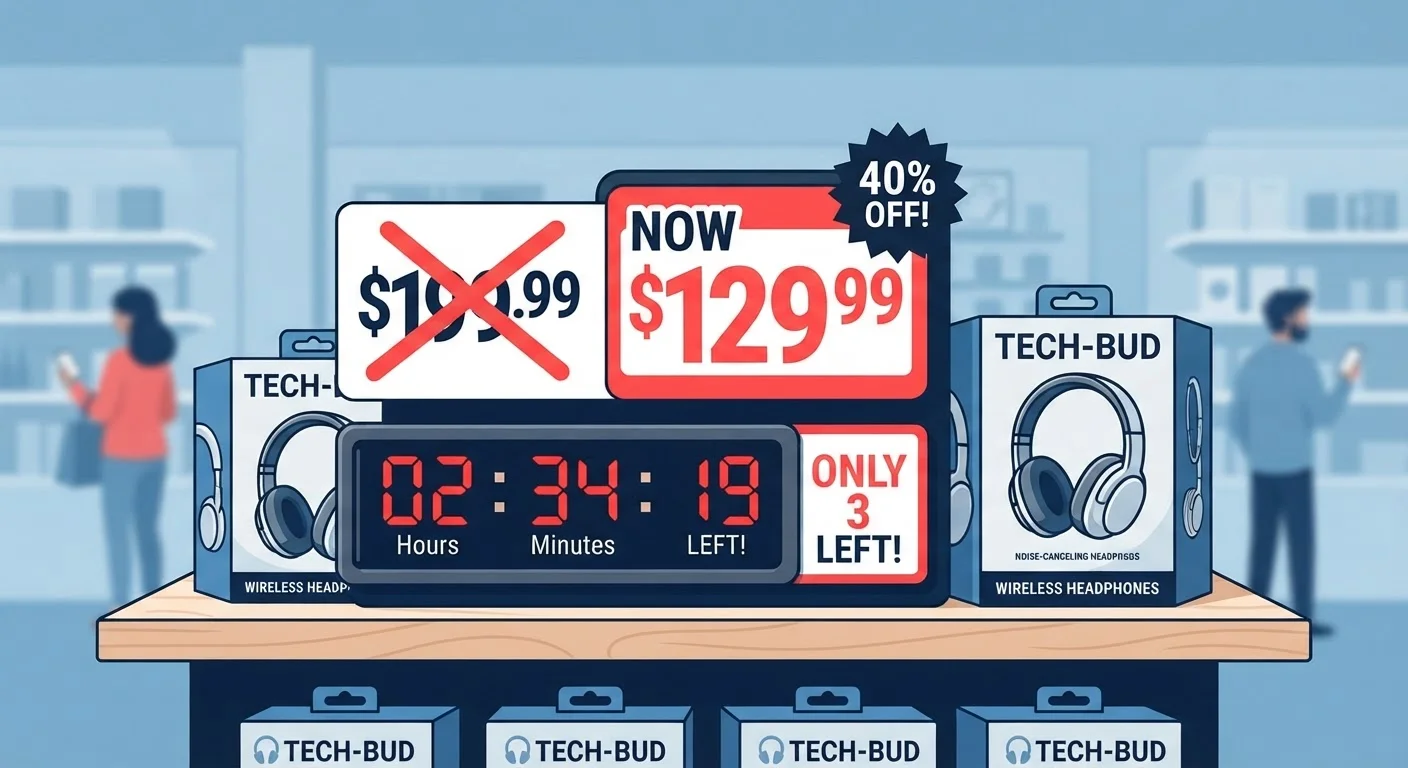
How Anchoring Hijacks Your Sense of Value
Before you evaluate any price, your brain needs a reference point. Retailers know this — and they supply one deliberately. This is price anchoring: presenting a high initial number so that the actual selling price appears reasonable by comparison.
A $200 jacket marked down from $400 feels like a steal. But if you'd walked in without seeing the $400 figure, $200 might have felt steep. The anchor doesn't have to be a genuine prior price — it just has to appear first. Manufacturer's suggested retail prices (MSRPs), crossed-out figures on tags, and prominently displayed 'original' prices all function as anchors, regardless of whether those numbers reflected actual market value.
Academic research in behavioral economics has long documented this effect: the first number people encounter in a pricing context exerts a disproportionate pull on their subsequent judgments. The fix is straightforward in principle, harder in practice — arrive at any purchase with your own independently researched price. That becomes your anchor instead. See how price anchoring shapes every decision after the first number for a deeper look at the mechanics.
“The first number you see in a negotiation or purchase context sets the stage for everything that follows. It doesn't matter whether that number is arbitrary — what matters is that it comes first.”
— Dan Ariely, Behavioral economist and author of 'Predictably Irrational'
Artificial Scarcity: Manufacturing Urgency
'Only 3 left in stock.' 'Selling fast.' '12 people are viewing this right now.' These messages are engineered to trigger a specific psychological response: loss aversion. The fear of missing out can outweigh rational price evaluation — and that's exactly the point.
Artificial scarcity works because humans are wired to assign higher value to things that appear rare. When supply seems limited, the brain shortcuts past deliberate comparison-shopping and into reactive purchasing. Online retailers can display these warnings dynamically, and the numbers don't always correspond to verified inventory levels.
Not Every Scarcity Signal Is False
Genuine limited inventory does exist — clearance items, end-of-season stock, and truly limited-edition products can run out. The issue is that consumers have no reliable way to distinguish authentic scarcity from manufactured urgency in the moment. The safest habit is to treat all urgency signals as psychological cues rather than verified facts, and to verify independently when possible before deciding.
The pattern extends beyond stock counts. Limited-time pricing windows, flash sale countdowns, and 'offer expires at midnight' messages all exploit the same mechanism. If you feel a sudden compulsion to buy immediately, that's a signal to pause — not proceed. Urgency tactics are designed to override your better judgment — recognizing the pressure is the first step to resisting it.
~60%
Shoppers who act on 'low stock' warnings
Research published in the Journal of Marketing found that scarcity messages significantly increased purchase likelihood, with roughly 60% of consumers in tested conditions responding to low-availability cues.
$0.01
Actual difference between $9.99 and $10.00
Despite a one-cent difference, consumer behavior studies consistently show charm-priced items sell in meaningfully higher volumes than round-number equivalents, confirming the left-digit effect is real and durable.
4 in 10
Consumers who regret impulse purchases
A 2022 Bankrate survey found that roughly 4 in 10 American adults reported making an impulse purchase they later regretted, with urgency and perceived scarcity frequently cited as contributing factors.
Charm Pricing and the Left-Digit Effect
The gap between $49.99 and $50.00 is one cent. The perceptual gap is considerably larger. Consumer psychology research consistently finds that shoppers process prices from left to right, anchoring on the leading digit. A price of $49.99 registers closer to $49 than to $50 in fast, intuitive thinking.
Retailers have used this since the 19th century, and it remains pervasive precisely because it works. Charm pricing ($X.99 or $X.95 endings) isn't an accident or a tradition — it's a calculated reduction in perceived cost. The same logic scales: $999 feels meaningfully cheaper than $1,000, even for large purchases like appliances or travel packages.
Round Up Charm Prices Mentally
When you see a price ending in .99 or .95, consciously round it up to the next whole dollar before deciding whether it fits your budget. This one-second habit counteracts the left-digit effect and gives you a more accurate sense of what you're actually spending. It's especially useful for larger purchases where the charm-price gap represents real dollars.
For a full breakdown of how charm pricing interacts with other tactics retailers layer together, see why $9.99 feels nothing like $10. And if you want to understand the broader toolkit, pricing tactics every shopper should know by name offers a plain-language glossary.
Putting It Together: Seeing the System
These three tactics — anchoring, artificial scarcity, and charm pricing — rarely appear in isolation. A typical retail environment layers all of them: a high crossed-out price (anchor), a low-stock warning (scarcity), and a .99 ending (charm) on the same product page. Together they create a context in which a purchase feels urgent, smart, and affordable, independent of whether it actually is any of those things.
The practical defense isn't cynicism — it's process. Before buying, identify what price you would consider fair based on independent research. Then evaluate the actual price against that benchmark, not against the retailer's anchor. Ask whether the urgency signal is verifiable. Round the charm price up mentally to the nearest dollar. None of this takes long, and each step partially neutralizes a different tactic.
When a 'sale' isn't really a sale, the pricing infrastructure around it — anchors, scarcity cues, charm endings — is often what makes it feel like one. Understanding the system doesn't make you immune, but it makes the tactics considerably less automatic. For more on how inflated reference prices distort your sense of savings, see how 'original' prices are set to mislead.
Frequently Asked Questions
Price anchoring is when a retailer displays a high reference price (such as a 'was' price or manufacturer's suggested retail price) before showing the actual selling price. Your brain uses that first number as a benchmark, making the lower price feel like a bargain — even if the original price was inflated or rarely charged.
In most cases, yes — though consumer protection laws vary by state. Retailers can legally display 'low stock' warnings without detailed justification. However, if a scarcity claim is demonstrably false and intended to deceive, it may cross into deceptive trade practices territory. The FTC provides general guidance on misleading advertising.
Research in consumer psychology consistently shows that people read prices left-to-right and anchor heavily on the first digit. A price of $9.99 registers mentally closer to $9 than to $10, even though the difference is just one cent. This is called charm pricing or psychological pricing.
Look up the item's price history using publicly available price-tracking tools before purchasing. Compare the 'sale' price against what the item has actually sold for over the past 90 days. If the 'original' price rarely or never applied, the discount is largely manufactured.
Not always. Some countdown timers reset automatically after expiring or are set to arbitrary deadlines unrelated to actual inventory or sale end dates. Treat them as a psychological cue designed to create urgency, and verify whether the deal is truly time-limited before acting.
The content on this site is for informational purposes only and is not a substitute for professional advice. Always consult a qualified professional for guidance specific to your situation.