

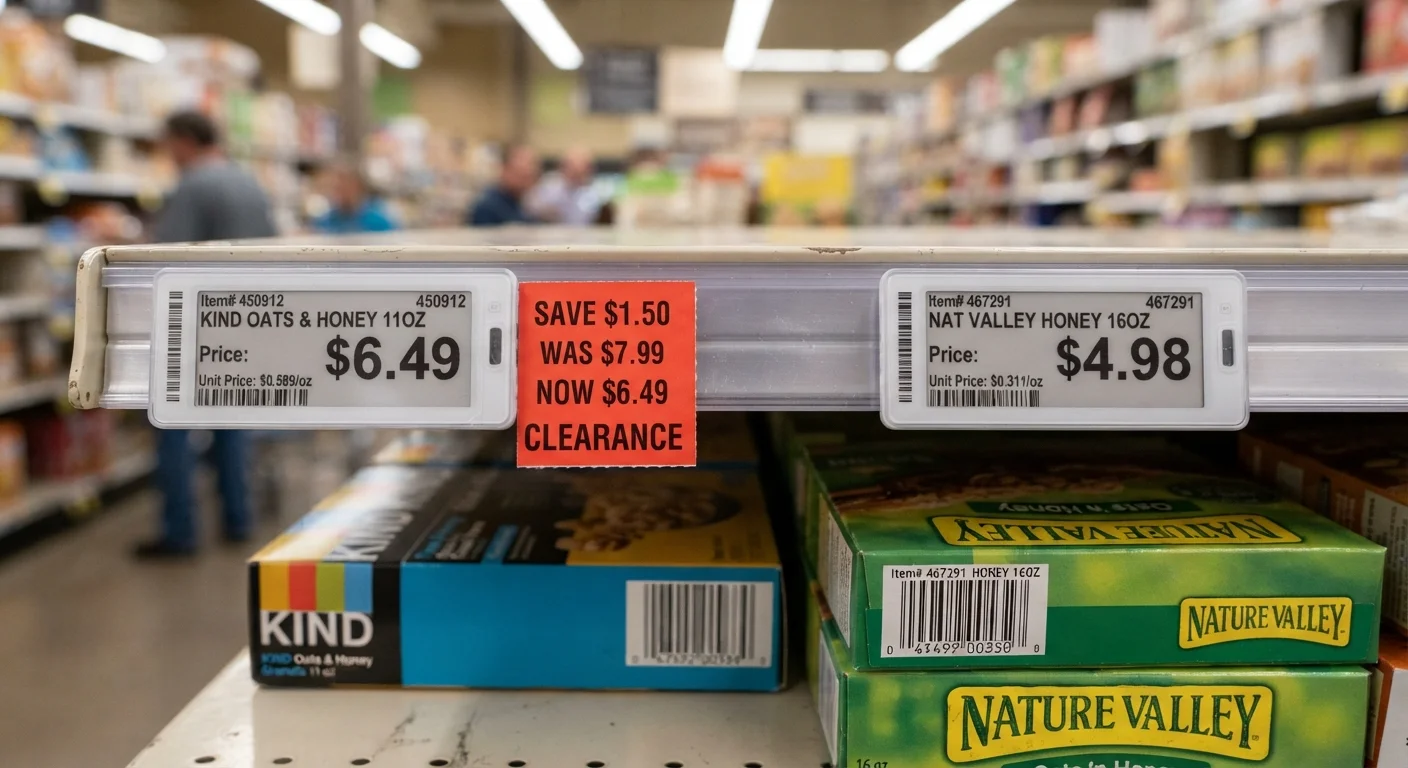
Option A
Sticker Price
The number that grabs your attention first.
Best for: Quickly scanning total out-of-pocket cost when comparing identical items of the same size.
Option B
Unit Price
The number that actually tells you what you're paying.
Best for: Comparing value across different package sizes, brands, and bundle deals.
What Each Number Actually Means
Sticker price is the total dollar amount displayed on a product's tag — the figure you see largest and first. It answers one question: how much money leaves your wallet for that item.
Unit price is the cost expressed per standardized measure — per ounce, per fluid ounce, per count, per square foot, or whatever unit applies to that product category. In stores that display it, unit price usually appears in smaller print on the shelf tag below the sticker price.
The gap between these two numbers is where retailers quietly shape your perception of value. A $12 bottle of detergent looks pricier than a $9 bottle until you check that the $12 version contains 50% more product — making its unit price lower. Sticker price is a budget number. Unit price is a value number. Treating them as interchangeable is one of the most common and costly shopping habits consumers fall into.
For a broader look at how pricing signals are engineered to influence decisions, see how retailers use pricing psychology to shape what feels like a deal.
Head-to-Head: How They Compare
The table below contrasts exactly what each metric tells you — and where each one falls short.
| Criterion | Sticker Price | Unit Price |
|---|---|---|
| What it measures | Total cost of one package | Cost per ounce, count, or unit |
| Useful for budgeting | Yes — direct checkout cost | Indirectly — shows relative value |
| Useful for comparing sizes | No — sizes may differ | Yes — standardizes the comparison |
| Displayed by default | Always shown | Varies by retailer and state law |
| Affected by package size | Yes — larger packs cost more nominally | No — normalizes across sizes |
| Reveals bulk deal quality | No | Yes — confirms or disproves savings |
| Easy to manipulate perceptually | Yes — charm pricing, anchoring | Less so — math-based metric |
The single biggest takeaway: sticker price is necessary but not sufficient. It tells you whether you can afford something; it does not tell you whether you're getting fair value relative to alternatives on the same shelf.
When the "Bigger Is Cheaper" Assumption Breaks Down
Conventional wisdom says buying in bulk saves money. Unit price math says: sometimes. There are three common situations where bulk packaging actually carries a higher unit price than smaller sizes:
- Premium packaging formats. Resealable pouches, individual serving packs, and specialty containers add manufacturing cost that shows up in unit price.
- Limited shelf-space promotions. Retailers occasionally price a mid-size "value" pack at a slight premium to steer shoppers toward either the small (high-margin) or jumbo (slow-moving inventory) option.
- Perishables you won't finish. A lower unit price on a 5-pound bag of salad greens is not a saving if three pounds end up composted. Real unit cost includes waste.
This same logic applies to bundles. Paying for three items packaged together only beats buying one at a time if you actually use all three — and if the bundle's unit price beats the per-item price when purchased separately. Bundle pricing and other common retail tactics are worth understanding before you assume a multi-pack is a win.
~$1,500
Estimated annual food waste cost per U.S. household
According to USDA Economic Research Service estimates, the average American household wastes a significant share of purchased food, which erodes any unit-price advantage from oversized packaging.
30+
U.S. states with unit pricing regulations
The National Conference of State Legislatures has tracked state-level unit pricing laws, though requirements, product categories covered, and enforcement vary considerably by jurisdiction.
How to Calculate Unit Price When the Shelf Tag Doesn't Show It
Not every retailer is required to display unit pricing. U.S. federal law does not mandate it nationally; requirements vary by state, and online retailers are inconsistent. When the tag leaves you guessing, the calculation is straightforward:
Unit Price = Sticker Price ÷ Quantity
Check the product label for net weight, volume, or count. Divide the shelf price by that number. Compare the result across competing products using the same unit — don't compare price per ounce against price per gram without converting first.
Most smartphone calculators handle this in seconds. Some grocery chain apps display unit price in search results even when in-store tags omit it, making aisle-by-aisle comparison faster than it used to be.
Also keep in mind that a promoted "sale" price doesn't automatically improve unit price. A sticker price slashed 20% on an already small package may still land above the unit price of the regular-priced large version. Not every sale represents genuine savings — unit price is one of the clearest ways to verify the claim.
Unit Pricing Laws Vary by State
More than 30 U.S. states have some form of unit pricing regulation, but coverage differs widely — some laws apply only to food retailers above a certain size, others exempt certain product categories. If your local store doesn't show unit prices, you have every right to ask a staff member or use the store's app. Calculating it yourself takes under 10 seconds and is often more reliable than trusting a tag that may not have been updated after a price change.
Understanding unit price is one piece of the larger picture. For costs that appear after purchase — shipping, maintenance, and subscription fees — see total cost of ownership.
The content on this site is for informational purposes only and is not a substitute for professional advice. Always consult a qualified professional for guidance specific to your situation.