

Why Naming the Tactic Changes Everything
Retailers spend enormous resources designing pricing strategies that nudge shoppers toward spending more, faster, and with less scrutiny. The tactics have names — industry-standard terms used in textbooks, boardrooms, and marketing briefs. When shoppers learn those names, they gain a measurable advantage: the ability to recognize the move before reacting to it.
This reference article defines the most common pricing tactics in plain language. It is not an exhaustive academic treatment — it is a working glossary for everyday purchases. For a deeper look at how psychological mechanisms like anchoring and scarcity amplify these tactics, see how anchoring and artificial scarcity work.
| Number of named pricing strategies | Dozens in academic literature; roughly 10–15 encountered in everyday retail |
| Industries most affected by dynamic pricing | Airlines, hotels, ride-share, e-commerce |
| Typical partitioned-fee range | 15–30% added to headline price at checkout (General consumer finance reporting; varies by sector) |
| Best consumer counter-tactic | Compare unit prices and full landed cost before committing |
The Tactics, Defined
The following definitions cover the pricing strategies shoppers are most likely to encounter across grocery, apparel, electronics, and online retail. Understanding even a handful of these can shift how you read a price tag.
Anchor Pricing
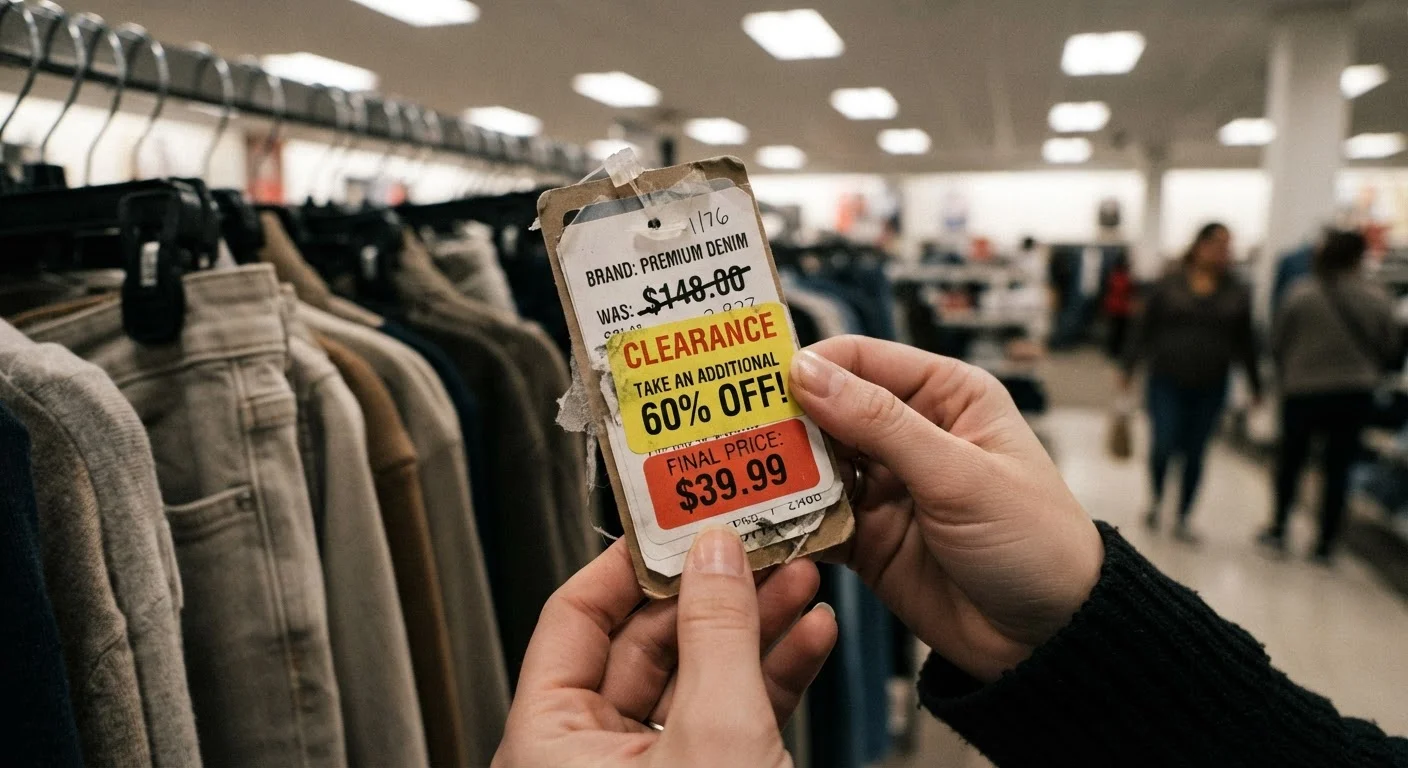
A retailer displays a high 'original' or 'compare at' price alongside the current price to make the current price feel like a bargain. The anchor number sets a mental reference point that influences perceived value, even when the original price was never widely charged.
Bundle Pricing
Multiple products or services are sold together at a single combined price, typically below the sum of individual prices. Bundles can be genuine value, but they also encourage purchasing items you may not need to obtain the one you do.
Loss-Leader Pricing
A product is priced below its cost to attract shoppers into a store or onto a site, with the expectation that they will purchase additional, higher-margin items. The 'loss' on one item is meant to be recovered across the overall basket.
Charm Pricing
Prices are set just below a round number — $9.99 instead of $10, $49.95 instead of $50 — exploiting the tendency for people to process the left-most digit first and perceive the price as significantly lower than it actually is.
Dynamic Pricing
Prices change in real time based on demand, time of day, inventory levels, or even a user's browsing behavior. Common in airlines, hotels, and e-commerce, this means the same item can carry different prices for different shoppers moments apart.
Partitioned Pricing
A low headline price is quoted upfront, while mandatory fees (shipping, service charges, resort fees) are revealed later in the checkout process. The tactic exploits shoppers' tendency to anchor on the initial figure and discount add-ons.
Decoy Pricing
A third, intentionally unattractive option is added to a two-choice set to make one of the original options look significantly more appealing by comparison. The decoy is not meant to sell — it is meant to steer.
Everyday Low Pricing (EDLP)
A retailer commits to consistently low prices without frequent promotional sales, framing the strategy as transparent and shopper-friendly. While not inherently manipulative, EDLP can reduce price-comparison behavior by making sale-event pressure irrelevant.
Price Skimming
A new product launches at a high price targeting early adopters willing to pay a premium, then the price is gradually reduced over time to capture more price-sensitive segments. Common in consumer electronics.
Penetration Pricing
A product or service launches at an artificially low price to build market share quickly, with the intent to raise prices once a customer base is established. Introductory subscription rates are a classic example.
Odd-Even Pricing
A broader version of charm pricing: odd prices (ending in 1, 5, or 9) signal a deal or value orientation, while round or even prices signal quality or premium positioning. Retailers choose endings deliberately to shape perception.
Price Lining
A retailer offers products in a category at a small number of distinct price points (e.g., good, better, best) rather than a continuous range. This simplifies choice but also concentrates shoppers toward the middle tier — typically the highest-margin option.
Bundle pricing and loss-leader pricing often work together: a retailer may price one item below cost to draw you in, then use bundling to recapture margin. Recognizing both tactics simultaneously is more protective than spotting either alone. For a practical method of evaluating whether a bundle genuinely saves money, unit price comparisons are the most reliable tool.
Not Every Tactic Is Deceptive
Many pricing strategies — including EDLP and straightforward bundle discounts — can reflect genuine value and transparent positioning. The goal of knowing these tactics is not to assume bad faith, but to make a deliberate, informed decision rather than an automatic one. Pricing psychology works most powerfully when shoppers are unaware of it; awareness is its primary antidote.
Dynamic pricing and surge pricing deserve special attention online. Prices for flights, hotel rooms, ride-share services, and even some consumer electronics can change multiple times per day based on demand algorithms. Clearing browser cookies or using a private browsing window before checking prices is a commonly cited workaround, though its effectiveness varies by retailer and platform. The core defense is awareness: knowing a price can shift means treating any single quote as a snapshot, not a fixed offer.
Partitioned pricing — where a low headline price is followed by mandatory fees at checkout — is one of the most consequential tactics for consumer decision-making. Shipping costs, service fees, and processing charges can add 15–30% to an advertised price. The fine print that costs shoppers the most often lives in the fee structure, not the headline figure.
Finally, everyday low pricing (EDLP) is a strategy that positions a retailer as consistently affordable without frequent sales. It is not inherently deceptive, but it can make comparison shopping feel less urgent — which is precisely its intent. Shoppers who compare unit prices across retailers, regardless of the pricing strategy in play, tend to make better-informed decisions. See our practical shopper's framework for a structured approach to that comparison process.
The content on this site is for informational purposes only and is not a substitute for professional advice. Always consult a qualified professional for guidance specific to your situation.