

Why the Cheapest Option Isn't Always the Economical One
Most shoppers evaluate a purchase by comparing sticker prices. But the purchase price is just one input in a much larger equation. Total cost of ownership — what an item actually costs over its useful life — often tells a completely different story than the price tag alone.
This isn't an argument to always spend more. It's an argument to think more precisely. Understanding where cheap goods genuinely save money versus where they quietly drain it is one of the most practical financial skills a consumer can develop. For a grounded foundation, see understanding value before you buy.
Evaluating price without accounting for replacement frequency.
Why it happens: Shoppers naturally anchor to the immediate out-of-pocket cost and underweight how soon they'll need to repurchase.
Ignoring performance inefficiencies that create hidden costs.
Why it happens: Poor performance is harder to price than a receipt, so shoppers discount it. A slow appliance that wastes electricity, or a cheap filter that strains a system, rarely shows up in the purchase decision.
Treating all product categories the same way when making value judgments.
Why it happens: Applying a single rule — 'always buy cheap' or 'always buy quality' — is cognitively easier than evaluating each purchase on its own terms.
Anchoring on the discount rather than the actual value delivered.
Why it happens: A heavily marked-down price triggers a sense of 'winning,' which can override rational evaluation of whether the item is worth owning at any price. See also: how 'free' distorts purchase logic.
Holding onto underperforming cheap purchases longer than warranted to justify the spend.
Why it happens: Once money is spent, people feel compelled to extract value from a purchase even when cutting losses and replacing it would be more economical. This is the sunk cost fallacy in retail form — explored further in sunk cost and the shopping cart.
How to Apply Total Cost Thinking in Practice
The goal isn't to talk yourself into spending more — it's to spend accurately. A few straightforward habits make a real difference.
3×
Typical replacement rate for budget vs. durable goods
Consumer research consistently finds that lower-cost versions of frequently used items are replaced roughly three times more often than mid-range alternatives over a two-year window.
~20%
Energy cost premium from low-efficiency appliances
The U.S. Department of Energy notes that appliances lacking efficiency certifications can cost consumers meaningfully more in electricity over a product's operational lifespan.
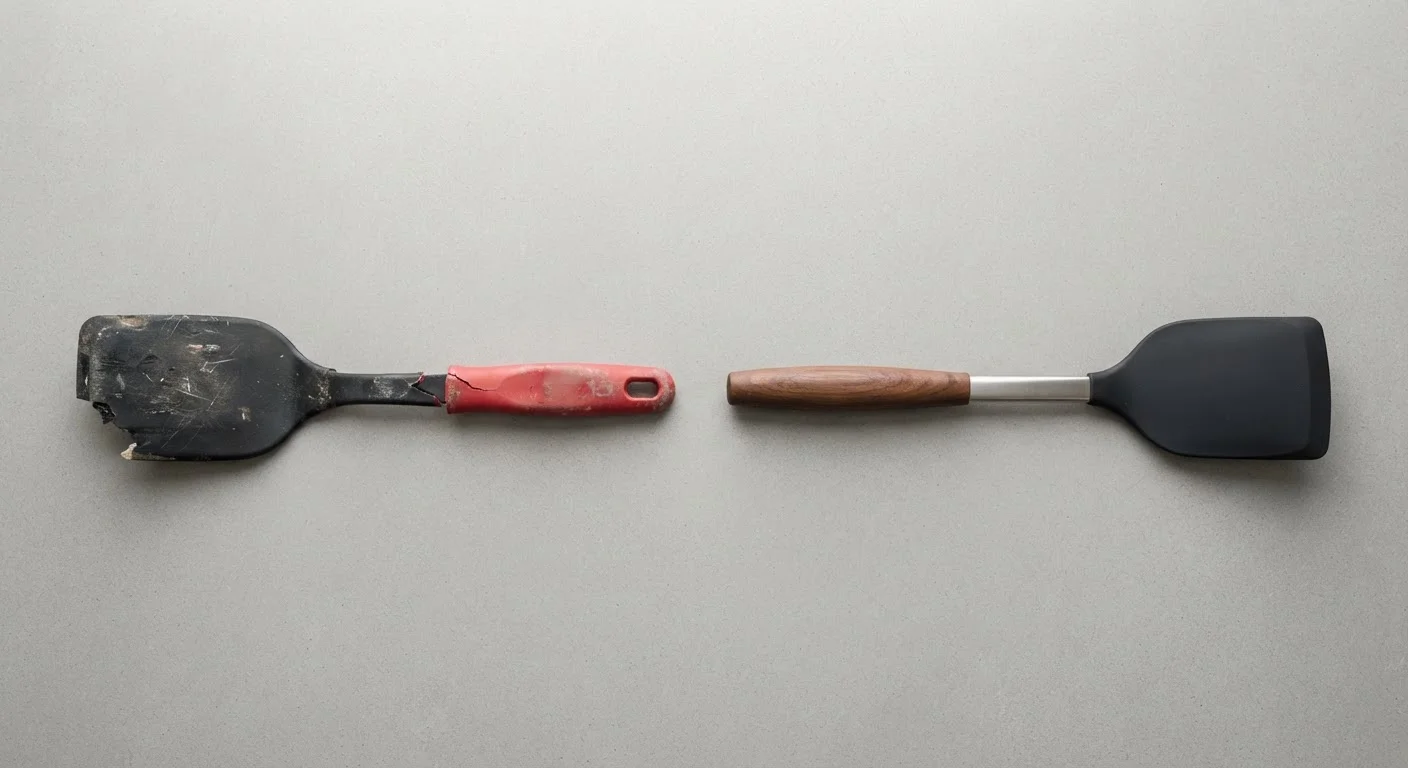
Calculate cost-per-use. Divide the purchase price by the number of realistic uses. A $12 kitchen tool you discard after three uses costs $4 per use. A $40 version used 200 times costs $0.20. That math applies to footwear, appliances, tools, and apparel alike.
Identify the failure point. Before buying cheap, ask: what breaks first, and what happens when it does? A low-cost phone charger that damages a device battery creates costs far exceeding the charger's price. A bargain paint that requires three coats doubles labor time.
Know which categories reward investment. High-frequency use items, safety-relevant goods, and items where failure has cascading consequences are generally worth spending more on. Occasional-use, low-stakes, or easily replaceable items are legitimate candidates for budget options. Price and quality don't always align — expensive doesn't reliably mean durable, especially in apparel.
Sunk Cost Can Trap You With a Bad Purchase
Once a cheap item disappoints, many shoppers hold onto it longer than they should — trying to recoup a loss that's already unrecoverable. Using a poor-quality tool, appliance, or consumable past its useful life often generates secondary costs (wasted materials, damaged surfaces, extra labor) that exceed what a timely replacement would have cost. Cutting losses promptly is usually the more economical move.
Retailers are skilled at making the cheap option feel like the rational choice. Charm pricing and anchoring effects are specifically designed to short-circuit total-cost thinking. Recognizing those tactics — covered in depth in our retail pricing psychology guide — is half the battle. The other half is resisting the pull of a number that looks small in isolation.
This article is for general informational and educational purposes only. It does not constitute financial or purchasing advice tailored to your individual circumstances.
The content on this site is for informational purposes only and is not a substitute for professional advice. Always consult a qualified professional for guidance specific to your situation.