

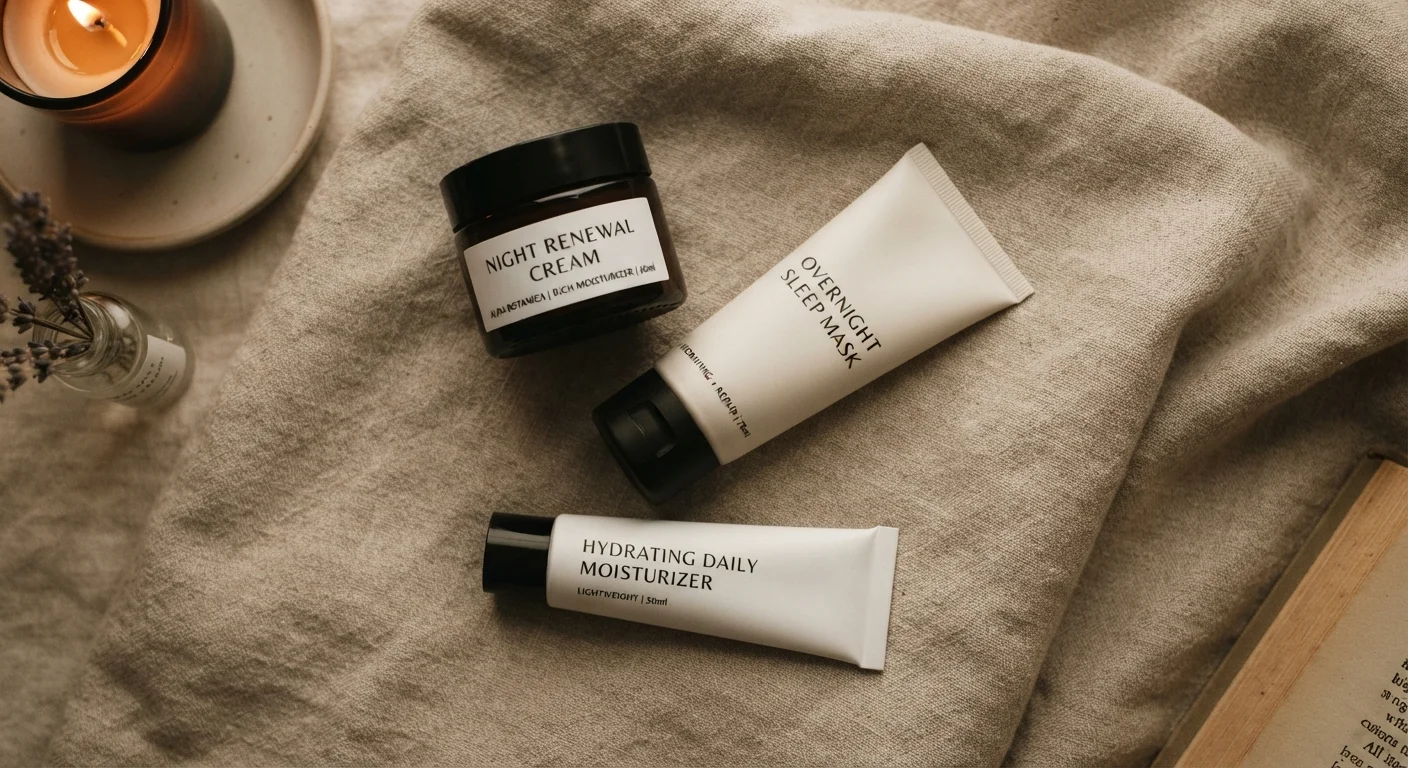
Our Verdict
The distinctions between night cream, sleep mask, and plain moisturizer are more marketing-driven than science-driven. All three can hydrate and support the skin barrier — what separates them is texture, occlusion level, and active ingredient concentration. Choosing based on your skin's actual needs and the ingredient list will serve you better than choosing by category name.
| Best for | Recommended |
|---|---|
| Those with dry or mature skin who want richer overnight hydration | Night Cream |
| Those who already layer serums and want a sealing final step once or twice a week | Sleep Mask |
| Those with normal, oily, or combination skin looking for a reliable, no-fuss option | Plain Moisturizer |
Why the Nighttime Skincare Aisle Is Confusing by Design
Walk down any skincare aisle and you'll find products labeled "night cream," "overnight mask," "sleep mask," "restorative balm," and "nightly moisturizer" — all sitting within arm's reach of each other, often priced very differently. The category names suggest meaningful distinctions, but they aren't regulated terms. Any brand can call a moisturizer a sleep mask or a sleep mask a night cream without meeting a defined standard.
That doesn't mean all three are identical — there are real formulation tendencies that track loosely with each label. But understanding what those tendencies actually are helps you cut through the noise and make a decision based on what your skin needs, not what a product's name implies. If you want to go deeper on decoding what's actually in any of these products, reading an ingredient list is a skill worth developing.
What Each Category Typically Offers
Plain moisturizers form the baseline. They work through a combination of humectants (ingredients like glycerin or hyaluronic acid that draw water to the skin), emollients (oils and fatty acids that soften and smooth), and occlusives (heavier ingredients like petrolatum or shea butter that slow water loss). Most are designed to be lightweight enough for daytime use and are formulated without SPF for nighttime application. There's nothing inherently "less" about them for overnight use.
Night creams tend to be richer versions of moisturizers — higher concentrations of emollients and occlusives, sometimes with added actives like retinol, peptides, or niacinamide. The "night" designation sometimes reflects that heavier textures don't layer well under makeup, or that certain actives (retinol, for example) are best used away from sunlight. But a night cream is still fundamentally a moisturizer.
Sleep masks — also called overnight masks — are typically the most occlusive of the three. They're designed to be the final layer of a skincare routine, sealing everything applied beneath them. Many contain film-forming or gel-like ingredients that give a slightly tacky finish and create a barrier effect. They're not cleansing or exfoliating; their primary role is preventing transepidermal water loss (TEWL) while you sleep.
| Plain Moisturizer | Night Cream | Sleep Mask | |
|---|---|---|---|
| Primary function | Hydrate and support barrier | Hydrate with richer emollients | Occlude and seal prior layers |
| Typical texture | Light to medium lotion or cream | Rich cream or balm | Gel, cream-gel, or thick film |
| Best used as | Daily AM and PM moisturizer | Final PM step for dry or mature skin | Weekly or occasional PM final step |
| Occlusion level | Low to moderate | Moderate to high | High |
| May include active ingredients | Sometimes | Often (retinol, peptides) | Rarely — focus is occlusion |
| Suitable for oily skin | Yes, choose oil-free formulas | Often too heavy | Usually too occlusive |
It's also worth noting that fragrance and preservative choices differ across these product types. If you have reactive skin, understanding label language — including the difference between "fragrance-free" and "unscented" — matters here too. See what those label terms actually mean before assuming a product is safe for sensitive skin.
Does Nighttime Really Change What Your Skin Needs?
There's a biological basis for the idea that skin behaves differently at night. Skin cell turnover and repair processes are generally more active during sleep, and transepidermal water loss tends to be higher overnight. This has led to the claim that nighttime products need to be specially formulated to take advantage of this window.
The reality is more modest. While skin does undergo repair processes during sleep, the core needs — hydration, barrier support, and in some cases targeted actives — don't require an entirely separate product category to meet them. A moisturizer that addresses your skin's actual concerns (dryness, barrier damage, uneven texture) will do the same job whether it's labeled "night cream" or not.
Layer Before You Seal
If you use a sleep mask, apply it last — after serums, treatments, and your regular moisturizer. Sleep masks work by trapping what's underneath, not by delivering actives on their own. Using one directly on bare skin skips the hydration step it's meant to lock in.
Where timing genuinely matters is with specific actives. Retinoids, for example, degrade in sunlight and should be used at night; AHAs increase photosensitivity and are similarly better suited to a nighttime routine. But those are ingredient-driven decisions, not category-driven ones. For guidance on pairing actives safely, layering active ingredients walks through the key compatibility rules.
When the Distinction Actually Matters
For most people with normal to oily skin, a plain moisturizer used consistently at night is entirely sufficient. The added occlusion of a sleep mask may actually feel uncomfortable or trigger breakouts for those prone to congestion. And the richness of many night creams can be more than oilier skin types need.
Sleep masks earn their place for dry or compromised skin barriers, or as an occasional intensive treatment after harsh weather or travel. They also work well as a weekly addition over serums when extra hydration is the goal — not as a nightly replacement for a full routine.
Night creams make the most sense if your skin is consistently dry or mature and a standard moisturizer consistently feels insufficient by morning. The richer emollient base can meaningfully reduce overnight water loss. If you're finding any moisturizer isn't delivering results, the issue may be application timing or layering order rather than the product itself — why a moisturizer stops working covers those common missteps.
This article is for general informational purposes only and does not constitute medical or dermatological advice. Consult a qualified skincare professional or dermatologist for concerns about your specific skin type or condition.
The content on this site is for informational purposes only and is not a substitute for professional advice. Always consult a qualified professional for guidance specific to your situation.