

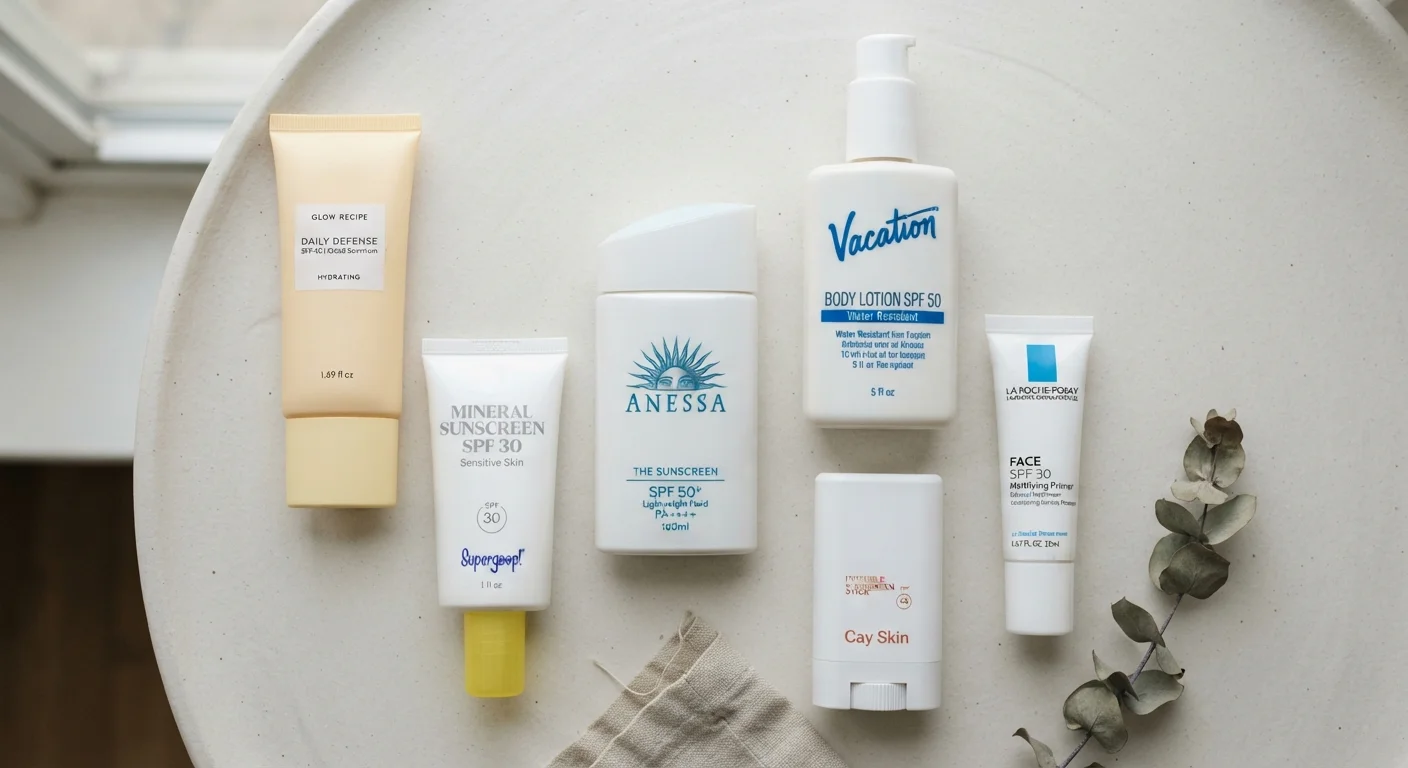
Why Sunscreen Labels Feel Confusing
Flip over any sunscreen and you'll find a mix of numbers, acronyms, and marketing language that can make a straightforward purchase feel oddly technical. Terms like SPF 50, PA++++, and broad spectrum each carry specific, regulated meanings — but they don't always appear together or get explained on the label itself.
This glossary cuts through that noise. Whether you're comparing formulas or just trying to understand what you already own, these definitions give you a reliable baseline. For a deeper look at how other beauty product labels work, see our guide on reading a skincare ingredient list.
SPF (Sun Protection Factor)
A number indicating how much UVB radiation a sunscreen filters relative to unprotected skin. SPF 30 filters roughly 97% of UVB rays; SPF 50 filters about 98%. Higher numbers offer marginally more protection, not exponentially more.
UVB
Ultraviolet B radiation — the wavelengths primarily responsible for sunburn and a significant contributor to skin cancer risk. SPF ratings measure protection specifically against UVB.
UVA
Ultraviolet A radiation — longer wavelengths that penetrate deeper into skin and are associated with premature aging and DNA damage. UVA rays are present year-round, even through glass, and do not cause immediate sunburn.
Broad Spectrum
A U.S. FDA-regulated label claim indicating that a sunscreen provides protection against both UVB and UVA radiation, meeting a minimum UVA-to-UVB protection ratio in standardized testing.
PA Rating
A UVA protection grading system developed in Japan, now widely used across Asia and on many globally sold products. Ratings run from PA+ (low UVA protection) to PA++++ (highest UVA protection). Each additional plus sign represents a meaningful increase in protection.
Chemical (Organic) Filter
A sunscreen active ingredient that absorbs UV radiation and converts it to heat. Examples include avobenzone and oxybenzone. The word 'chemical' here is a chemistry classification, not a negative descriptor.
Mineral (Physical) Filter
A sunscreen active ingredient — zinc oxide or titanium dioxide — that sits on the skin surface and reflects or scatters UV radiation. Mineral filters are the only sunscreen actives currently classified as 'generally recognized as safe and effective' by the FDA pending further study.
Water Resistance
An FDA-regulated claim indicating a sunscreen maintains its SPF level after 40 or 80 minutes of water exposure (as specified on the label). No sunscreen is fully waterproof; reapplication after swimming or heavy sweating is always necessary.
Key Ratings at a Glance
Before diving into definitions, here are the headline facts about how each sunscreen rating system works in practice.
| SPF 30 UVB filtration | ~97% (U.S. FDA sunscreen monograph) |
| SPF 50 UVB filtration | ~98% (U.S. FDA sunscreen monograph) |
| PA++++ minimum PPD value | 16 or higher (Japan Cosmetic Industry Association (JCIA) standard) |
| Water resistance options under FDA rules | 40 minutes or 80 minutes (FDA 2011 sunscreen labeling rule) |
| Mineral filter actives recognized by FDA | Zinc oxide, titanium dioxide (FDA proposed sunscreen order, 2019) |
One thing worth noting: these rating systems were developed independently by different regulatory bodies, which is why they don't map neatly onto one another. A sunscreen labeled SPF 30 in the U.S. is tested under different methodology than the same number on a product sold in Japan or the EU.
PA Ratings Are Not Required in the U.S.
The PA system is a Japanese industry standard, not an FDA requirement, so many U.S.-formulated sunscreens omit it even if they offer strong UVA protection. A product without a PA rating may still be effective — check for the 'broad spectrum' claim as the U.S. equivalent of minimum UVA coverage. Products sold internationally or through global beauty retailers are more likely to display both systems.
If you're interested in why daily use matters and where people commonly go wrong, sunscreen every day covers the practical side in detail.
How to Read These Numbers Together
No single rating tells the full story. SPF measures UVB protection only. PA ratings measure UVA protection. Broad spectrum is a binary label — either a product meets the threshold or it doesn't. Ideally, a sunscreen carries all three: a meaningful SPF number, a PA rating of at least +++, and a broad spectrum designation.
Sun protection also connects to concerns like hyperpigmentation and dark spots, since UVA exposure is a primary driver of uneven skin tone. And if you have sensitive skin, the fragrance-free vs. unscented distinction matters when choosing a formula you'll wear comfortably every day.
~97%
UVB rays blocked by SPF 30
According to the U.S. FDA, SPF 30 filters approximately 97% of UVB radiation under standardized testing conditions.
2 mg/cm²
Amount needed to match labeled SPF
Dermatology literature consistently notes that most people apply far less than the tested dose, which significantly reduces real-world protection.
This article is for general informational purposes only. For personalized skincare guidance, consult a board-certified dermatologist.
The content on this site is for informational purposes only and is not a substitute for professional advice. Always consult a qualified professional for guidance specific to your situation.