

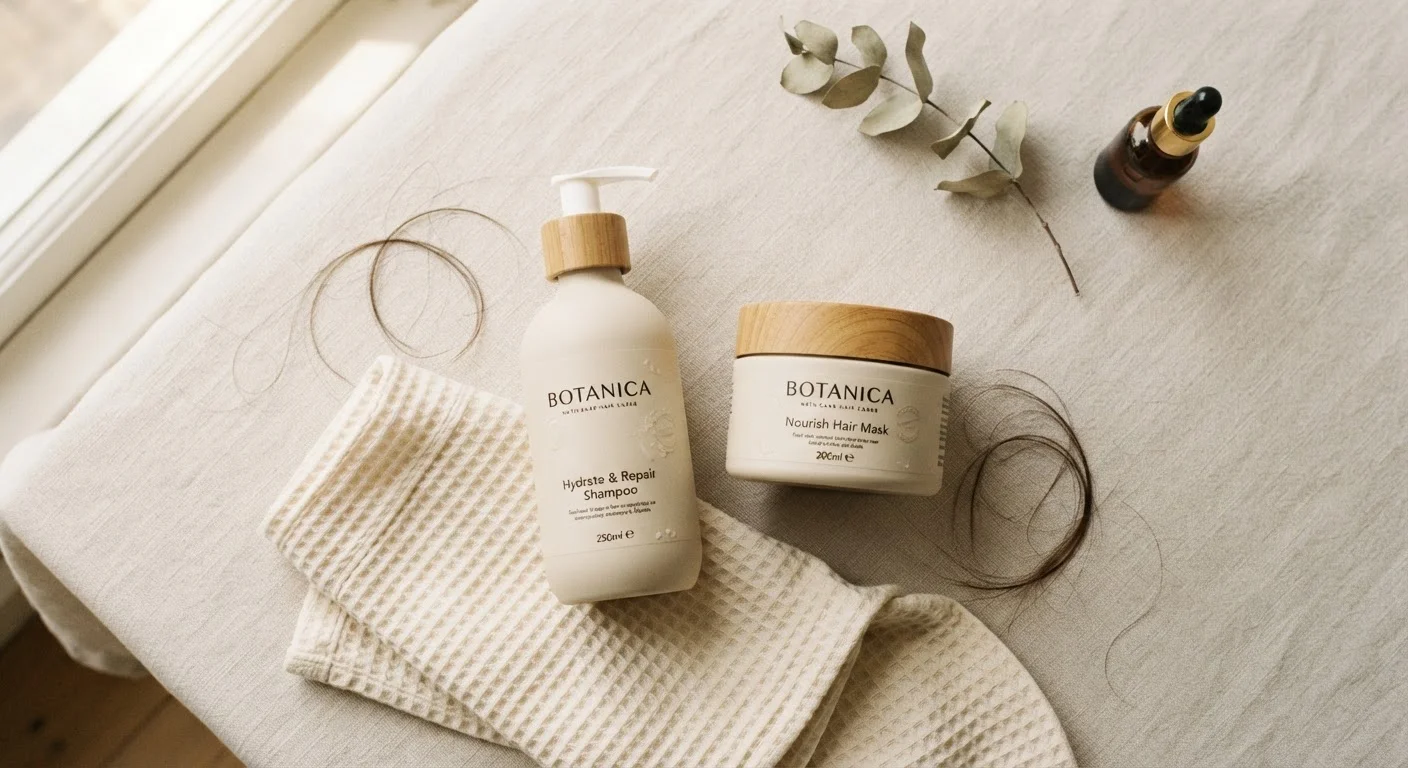
Option A
Regular Conditioner
The everyday surface-level smoother.
Best for: Daily or every-wash use to detangle, reduce frizz, and add light moisture to the hair's outer layer.
Option B
Deep Conditioner
The intensive, periodic repair treatment.
Best for: Weekly or biweekly use on dry, damaged, color-treated, or coarse hair that needs deeper structural moisture and repair.
What Each Product Actually Does
Regular conditioner and deep conditioner look similar on the shelf, but they work at fundamentally different levels of the hair structure — and that distinction determines when each one is useful.
A regular (rinse-out) conditioner primarily coats the outermost layer of the hair shaft, called the cuticle. Ingredients like silicones, cationic surfactants, and lightweight oils smooth the cuticle, reduce friction, improve detangling, and temporarily seal in surface moisture. The contact time is short — typically 2 to 3 minutes — because the formula only needs to interact with the exterior of each strand.
A deep conditioner is formulated to go further. It uses a higher concentration of moisturizing agents, humectants (ingredients that draw water into the hair), and sometimes proteins that can penetrate into the cortex — the hair's middle layer where structural integrity lives. That penetration requires time, which is why most deep conditioners are left on for 10 to 30 minutes, often under a shower cap or heat to help open the cuticle and allow absorption.
Understanding this difference is especially useful if you're trying to troubleshoot dryness, breakage, or texture issues. For a broader look at what's in these formulas, see hair care ingredients worth understanding before you shop.
| Criterion | Regular Conditioner | Deep Conditioner |
|---|---|---|
| Where it works | Hair cuticle (surface) | Cortex (inner structure) |
| Leave-on time | 2–3 minutes | 10–30 minutes |
| Frequency | Every wash | Weekly to monthly |
| Primary benefit | Detangling, frizz control, surface moisture | Repair, elasticity, deep hydration |
| Best hair types | All types, especially fine/low-porosity | Dry, damaged, coarse, high-porosity |
| Risk of overuse | Minimal for most | Over-softening, limpness in fine hair |
How Hair Type and Porosity Should Guide Your Choice
There's no universal rule for how often to use either product — your hair's porosity, texture, and condition are what matter most.
Porosity refers to how readily your hair absorbs and retains moisture. Low-porosity hair has tightly packed cuticles that resist product absorption; high-porosity hair has raised or damaged cuticles that absorb quickly but also lose moisture fast.
~60%
People who misidentify their hair porosity
Hair care educators frequently note that most consumers have never assessed their hair's porosity, often leading to product choices that underperform.
15–30 min
Optimal deep conditioner contact time
Most formulas require at least 15 minutes for key ingredients to begin penetrating the hair cortex, with heat further aiding absorption.
- Low-porosity hair: Benefits from lightweight regular conditioners used consistently. Deep conditioners can be helpful occasionally, but heavy formulas may just sit on the surface without absorbing — apply with heat to improve penetration.
- High-porosity hair: Loses moisture quickly and benefits more from regular deep conditioning — often weekly — to compensate for that moisture loss.
- Fine or thin hair: Can become limp or greasy with heavy products. Stick to rinse-out conditioners formulated for fine hair and limit deep conditioning to once or twice a month.
- Thick, coarse, or natural hair: Often has higher porosity and a drier texture by nature. Weekly deep conditioning is commonly recommended by stylists working with these hair types.
If you're unsure where your routine currently stands, check what's working before overhauling your products.
How to Use Each One Correctly
Frequency and application method make a significant difference in results — and using either product incorrectly can lead to buildup, limpness, or continued dryness.
Regular Conditioner
- Apply after every shampoo, focusing on the mid-lengths and ends rather than the scalp (conditioner near the roots can contribute to greasiness).
- Leave on for 2 to 3 minutes, then rinse thoroughly with cool water to help smooth the cuticle.
- Use consistently as part of every wash session.
Deep Conditioner
- Apply to clean, damp hair — shampooing first removes buildup so actives can absorb more effectively.
- Section hair and distribute evenly from root to tip, then cover with a shower cap.
- Leave on for the time specified on the label (usually 15 to 30 minutes). Gentle heat from a hooded dryer or even a warm towel can improve absorption.
- Rinse completely — residue left behind can cause buildup.
- For most hair types, once a week to once a month is the appropriate frequency.
Fitting these steps into a sustainable routine is easier than it sounds. The weekly hair care routine that works for most hair types offers a practical framework for doing exactly that.
Protein vs. Moisture: Know the Difference
Some deep conditioners contain proteins (like keratin or hydrolyzed wheat protein) that help rebuild the hair's internal structure. Others focus purely on moisture. Using a protein treatment when your hair is moisture-deficient — or vice versa — can worsen the problem. If your hair feels stiff and straw-like after a treatment, it may have received too much protein. If it's limp and stretchy, it likely needs more protein. Alternating between moisture-focused and protein-focused treatments is a strategy many stylists recommend for chemically treated hair.
The content on this site is for informational purposes only and is not a substitute for professional advice. Always consult a qualified professional for guidance specific to your situation.