

Why One Routine Can Work Across Many Hair Types
Hair care advice often feels impossibly specific — as if every texture, thickness, and condition requires an entirely different playbook. In practice, the foundational steps are the same for most people: cleanse, condition, treat, and style with protection. What changes is the frequency, the product formulas, and a few technique details.
If you're starting from scratch, our beginner's guide to intentional hair care covers the foundational concepts before you dive into a routine. If you already have a routine that isn't working, check what's actually broken first — a full overhaul isn't always necessary.
This routine assumes a standard week. Adjust frequency based on your scalp's oil production, your activity level, and your hair's porosity — its ability to absorb and hold moisture. Low-porosity hair (tends to repel water) benefits from lightweight products and heat-opened cuticles during conditioning. High-porosity hair (absorbs quickly but loses moisture fast) needs richer formulas and more sealing steps.
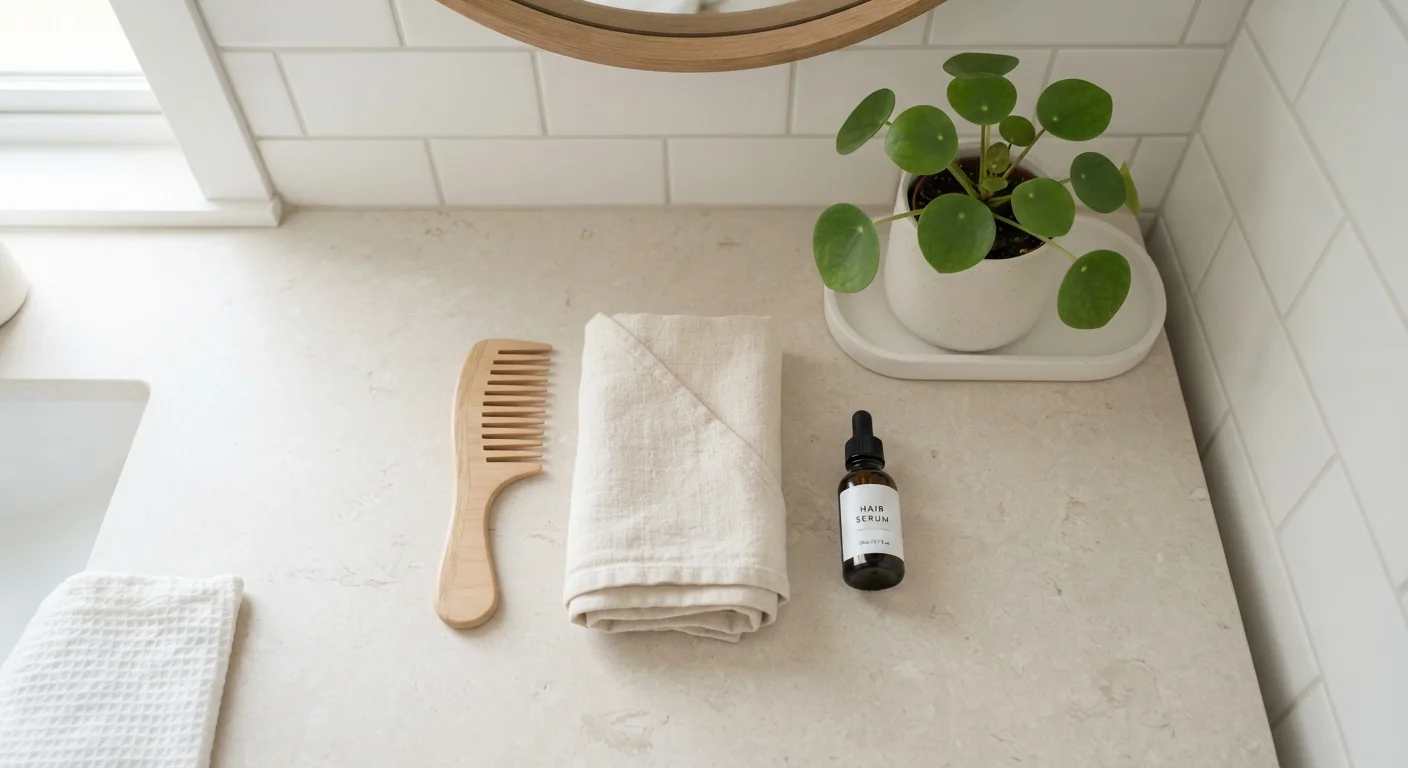
What you will need
The Step-by-Step Weekly Routine
Follow these steps across your week. Most people complete wash day in one session; the remaining steps are brief daily or mid-week habits.
Pre-wash: Detangle and optionally oil
Before water touches your hair, use a wide-tooth comb to gently detangle from ends to roots. This prevents knots from tightening when wet, which is a leading cause of breakage. For dry, coily, or color-treated hair, applying a small amount of a lightweight oil (such as jojoba or argan) to dry hair 20–30 minutes before washing can help reduce moisture loss during shampooing — a technique called a pre-poo treatment.
Wash: Shampoo the scalp, not the length
Apply shampoo primarily to your scalp, where oil, sweat, and product residue accumulate. Use your fingertips — not nails — to massage in gentle circular motions. Allow the lather to rinse through the length of your hair rather than scrubbing it directly. Most hair types do well with one wash; very oily scalps may need two passes on wash day.
Washing frequency matters: fine or oily hair typically needs cleansing two to three times per week, while thick, coily, or dry hair may only need it once a week or less.
Condition: Mid-lengths to ends every wash
Apply rinse-out conditioner from mid-shaft to ends, avoiding the scalp to prevent buildup and greasiness. Leave it on for two to five minutes — enough time for the ingredients to penetrate the cuticle — then rinse with cool water to help seal the cuticle and add shine. This step is non-negotiable: shampooing without conditioning strips moisture and leaves hair more prone to tangling and breakage.
Deep condition: Once per week on wash day
After rinsing out your regular conditioner, apply a deep conditioner or hair mask to damp hair from roots to ends. Cover with a shower cap and leave on for 20–30 minutes (or follow the product's instructions). The added time and concentration of conditioning agents restore elasticity and moisture more effectively than a standard rinse-out conditioner. This step is especially valuable for chemically treated, heat-styled, or naturally dry hair.
Dry: Gently, without friction
Squeeze — don't rub — excess water from your hair using a microfiber towel or soft cotton T-shirt. Standard terry-cloth towels create friction that roughens the hair cuticle and contributes to frizz and breakage over time. If air drying, allow hair to dry in a loose style to minimize manipulation while it's most fragile. If blow-drying, use the lowest effective heat setting and keep the nozzle moving.
Style: Protect before applying heat
If you use heat tools (flat irons, curling wands, blow dryers on high), apply a heat protectant to damp or dry hair before styling. These products create a barrier that slows heat transfer to the hair shaft. Keep hot tools below 400°F for most hair types; fine or damaged hair should stay below 350°F. Limit heat styling to two to three times per week at most to reduce cumulative damage.
Mid-week refresh: Hydrate without overwashing
Between wash days, lightly mist hair with water or a diluted leave-in conditioner spray to refresh moisture, smooth frizz, and revive your style. This is especially useful for curly and coily textures that lose definition quickly. Avoid applying heavy creams or oils to roots mid-week, as these will accelerate scalp buildup and make your next wash harder.
Consistency Beats Product Quantity
A three-product routine done consistently every week will outperform a ten-product routine done sporadically. Start with the essentials — shampoo, conditioner, deep conditioner, and a heat protectant — and add only when you identify a specific need. More products mean more potential for buildup and ingredient interactions.
Adapting Without Overcomplicating
The biggest mistake in hair care isn't skipping a step — it's adding too many products and steps in the hope of faster results. Over-layering products leads to buildup, which weighs hair down and can clog follicles over time. If your hair feels consistently dull, heavy, or unresponsive to conditioning, a clarifying wash (once or twice a month) is usually the fix.
Understanding what's in your products also matters more than most people realize. Our reference on common hair care ingredients breaks down what actually works versus what's just marketing. And if you're unsure whether regular conditioner is enough or you need a deep conditioner, this comparison explains the difference clearly.
Finally, even a well-designed routine can be undermined by daily habits — tight hairstyles, hard water, and rough towel-drying among them. Checking those habits that quietly damage hair can be just as impactful as upgrading your products.
Don't Overhaul Everything at Once
Switching multiple products at the same time makes it impossible to know what's helping or causing a reaction. Introduce one new product at a time and give it at least two to four weeks before evaluating. If you experience scalp irritation, itching, or unusual shedding after introducing a new product, discontinue use and consult a dermatologist.
This article is for general informational purposes only. If you're experiencing scalp conditions, significant hair loss, or other concerns, consult a licensed dermatologist or trichologist for personalized guidance.
The content on this site is for informational purposes only and is not a substitute for professional advice. Always consult a qualified professional for guidance specific to your situation.