

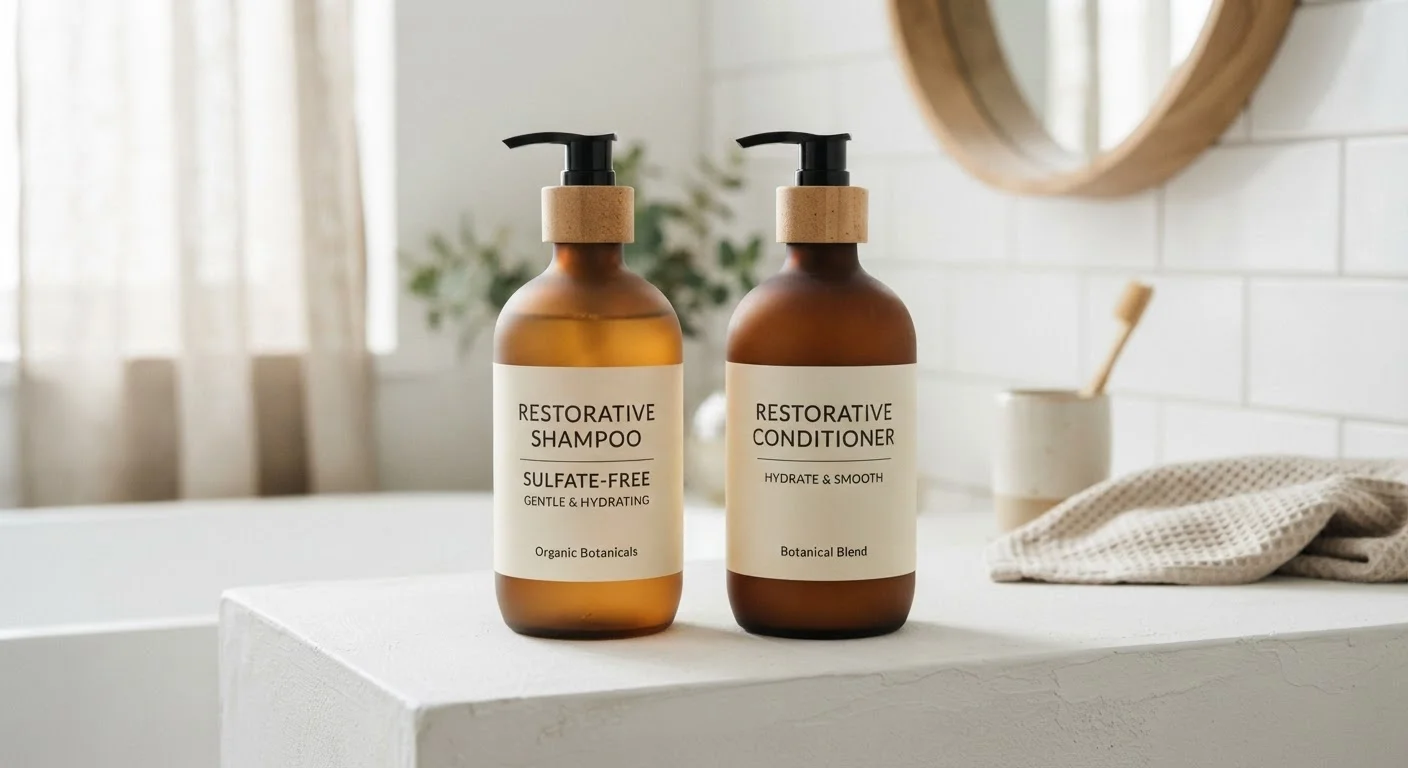
Option A
Sulfate-Free Shampoo
The gentler, moisture-preserving alternative.
Best for: Best for color-treated, chemically processed, dry, or curly hair that needs a less stripping cleanse.
Option B
Traditional Shampoo
The established, deep-cleansing standard.
Best for: Best for oily scalps, fine hair, or anyone who uses heavy styling products and needs thorough buildup removal.
What Separates These Two Formulas
The core difference between sulfate-free and traditional shampoos comes down to the type of surfactant — the cleansing agent — each formula uses. Traditional shampoos typically rely on sodium lauryl sulfate (SLS) or sodium laureth sulfate (SLES), which are highly effective at lifting oil, dirt, and product residue from the scalp and hair shaft. They're also responsible for the rich lather most people associate with a thorough wash.
Sulfate-free shampoos substitute these with milder alternatives such as cocamidopropyl betaine, sodium cocoyl isethionate, or decyl glucoside. These ingredients still cleanse, but with less aggressive action on the hair's outer cuticle and scalp oils. The trade-off is a thinner lather — something that can feel unfamiliar at first, even though foam volume has no direct bearing on cleansing effectiveness.
For a deeper look at what these and other common ingredients actually do, see our guide to hair care ingredients — it breaks down the most common compounds in plain language.
| Criterion | Sulfate-Free Shampoo | Traditional Shampoo |
|---|---|---|
| Primary surfactant type | Mild (e.g., betaines, glucosides) | Strong (SLS, SLES) |
| Lather volume | Low to moderate | High |
| Oil and buildup removal | Moderate | High |
| Moisture retention | Better preserved | More stripping |
| Color-treated hair | Recommended — reduces fade | Accelerates color fade |
| Fine or oily hair | May feel less clean | Often more effective |
| Scalp sensitivity | Generally better tolerated | May cause irritation |
| Cost range | Varies widely | Varies widely |
How Hair Type and Scalp Condition Factor In
The marketing around sulfate-free shampoos often implies they're better for everyone. That's not quite accurate. The right formula depends heavily on your hair's individual characteristics and how your scalp behaves.
Dry, curly, or coily hair tends to have a more porous structure that loses moisture easily. Sulfates can exacerbate this by stripping the natural oils (sebum) that travel down the hair shaft — oils that are especially important for hair types where the shaft's coiled shape slows sebum distribution. For these hair types, a gentler cleanser typically supports better moisture retention.
Fine or straight hair often produces more visible oil at the scalp and can feel weighed down by product residue. Here, the deeper cleansing action of traditional sulfate-based shampoos is frequently more effective — and using a gentler formula may require more frequent washing to achieve the same clean feeling.
Oily or acne-prone scalps may benefit from the stronger degreasing action of traditional shampoos, particularly if excess sebum is contributing to scalp imbalances. That said, overwashing — with any formula — can trigger rebound oil production, so wash frequency matters too.
~70%
Of Americans have color-treated hair at some point
Industry surveys suggest a significant majority of U.S. adults have used hair color, highlighting the relevance of formula choice for color longevity.
2–3x
Faster color fade with sulfate-containing shampoos
Hair care research indicates sulfate-based cleansers can accelerate dye molecule loss compared with gentler surfactant alternatives.
90 seconds
Average time shampoo contacts the scalp
Given brief contact time, surfactant strength — not lather or fragrance — is the most relevant factor for effective cleansing.
Color, Chemical Treatments, and Formula Choice
If your hair is color-treated, chemically straightened, or permed, formula choice becomes more consequential. Sulfates are known to speed up color fade by lifting the cuticle and allowing dye molecules to escape more readily with each wash. Most colorists routinely recommend sulfate-free shampoos after color services for this reason — and the recommendation has a clear technical basis, not just a commercial one.
Similarly, keratin treatments and chemical relaxers can be partially undone by repeated exposure to strong surfactants. Sulfate-free formulas are gentler on these treatments and help extend their results between salon visits.
If you're weighing how different styling and treatment methods affect your overall hair health, our overview of protective styles, heat tools, and chemical treatments provides a balanced look at the trade-offs involved.
One important note: switching formulas isn't always as straightforward as it seems. Some people experience a transition period when moving from traditional to sulfate-free shampoos — hair may initially feel heavier or less clean as the scalp adjusts. Before overhauling your entire routine, it's worth consulting our checklist for evaluating hair routine changes to identify what's actually driving any issues you're experiencing.
Lather Doesn't Equal Clean
One of the most persistent myths in hair care is that more foam means a more thorough cleanse. Lather is largely a cosmetic byproduct of sulfate concentration — it signals nothing about how well a shampoo removes dirt or oil. Sulfate-free shampoos often produce minimal foam but can still cleanse effectively for many hair types. Adjusting expectations around lather is often the biggest hurdle when switching formulas.
The content on this site is for informational purposes only and is not a substitute for professional advice. Always consult a qualified professional for guidance specific to your situation.