

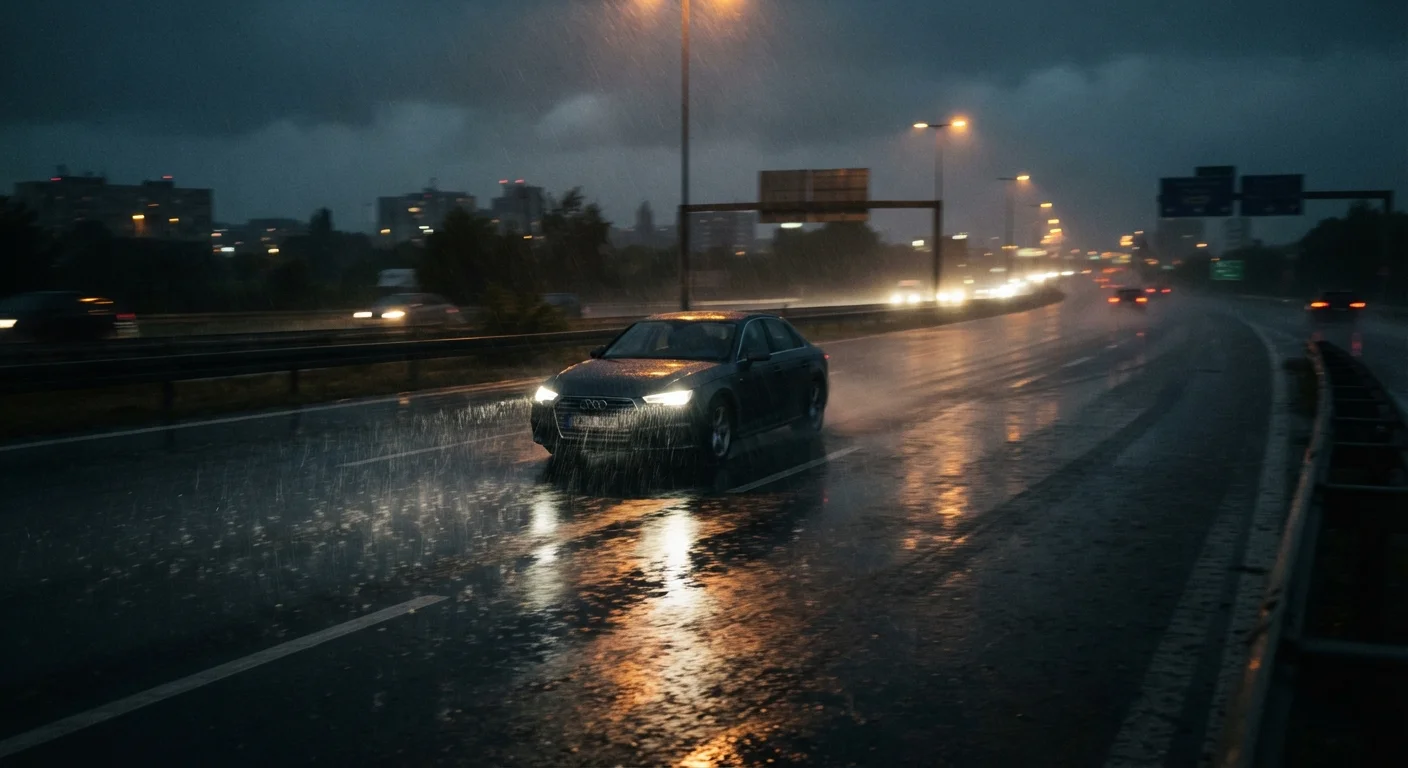
Why Weather Demands More Than Slowing Down
Most drivers know to ease off the gas when rain starts falling or snow begins to accumulate. But speed is only one variable. Poor weather simultaneously degrades traction, shrinks your field of vision, lengthens stopping distances, and raises the stakes of every decision you make behind the wheel. Treating it as a single-dial problem - just go slower - leaves too many hazards unaddressed.
Rain, fog, and snow each create a distinct combination of risks. Rain primarily affects traction and causes hydroplaning. Fog eliminates visual reference points entirely. Snow and ice alter friction in ways that can make ordinary steering inputs send a vehicle into a skid. Knowing how each condition works helps you respond correctly rather than applying a generic "be careful" mindset that doesn't translate into specific action.
This guide outlines the adjustments that experienced drivers make when conditions change - adjustments that go well beyond the speedometer. For a strong foundation, also review our seasonal car maintenance checklist to ensure your vehicle is mechanically ready before weather deteriorates.
Driving in Rain: Traction, Visibility, and Hydroplaning
Rain reduces road friction immediately, but the most dangerous moment is often the first few minutes of a shower. Oil and debris that have accumulated on dry pavement mix with water to create a slick surface before the rain washes it away. Treat early rainfall as high-risk, not merely inconvenient.
Increase following distance to at least four to six seconds in rain.
Wet roads extend braking distances considerably compared to dry conditions. A standard two-second following distance provides almost no margin for error when traction is reduced. Four to six seconds gives you room to react and brake without contact.
Switch to low-beam headlights in fog rather than high beams.
High beams scatter off water droplets in fog and reflect light back into your eyes, reducing rather than improving your effective visibility. Low beams project light downward along the road surface where it actually helps.
Brake earlier and more gradually on snow and ice.
Ice can increase stopping distances by three to twelve times compared to dry pavement, depending on temperature and surface type. Gradual, early braking gives tires time to shed speed progressively instead of locking up.
Turn off cruise control in any wet, foggy, or icy conditions.
Cruise control is designed for stable conditions. If your wheels lose traction momentarily, the system may accelerate to maintain speed - exactly the wrong response. Manual throttle control keeps you engaged and able to react instantly.
Reduce speed before curves and hills, not while navigating them.
Braking mid-curve or mid-hill on slick roads shifts vehicle weight abruptly and can cause a spin. Adjusting speed before the feature means you're already at a safe, controlled pace when traction is most challenged.
Recognize when conditions warrant postponing or canceling the trip entirely.
No destination or schedule is worth the risk of driving in genuinely dangerous conditions - whiteout snow, freezing rain, or dense fog near zero visibility. The decision to stay put is an active safety choice, not a passive one.
Hydroplaning - when a layer of water builds between your tires and the road, causing you to lose contact with the pavement - can happen at speeds as low as 35 mph on worn tires or flooded sections. If you feel your steering go light or unresponsive, ease off the accelerator smoothly and hold the wheel straight until traction returns. Do not brake hard.
Rain also creates glare and reduces contrast, making it harder to judge distances. Running your headlights - even in daytime rain - improves your visibility to other drivers significantly. Many states legally require headlights whenever wipers are in use; check your state's rules regardless.
Driving in Fog: Managing the Absence of Visual Reference
Fog is uniquely disorienting because it removes the visual cues drivers depend on to gauge speed, distance, and road curvature. High-beam headlights make fog worse by reflecting light back at you - use low beams and fog lights if your vehicle has them. If visibility drops below roughly 500 feet, pulling safely off the road and waiting is a legitimate and often correct decision.
“In fog, the most dangerous mistake is believing you can see well enough. Overconfidence in poor visibility is a leading factor in multi-vehicle pileups on highways.”
— National Safety Council, Non-profit organization focused on eliminating preventable deaths in the U.S.
Follow the road's edge markings rather than the center line when possible, and use lane-keeping discipline to avoid drifting. Increase following distance substantially - in dense fog, you may have only one or two seconds of reaction time to what appears ahead of you. Turn off cruise control entirely so you maintain active throttle awareness.
Fog and night driving share several risk factors. If you regularly navigate low-visibility roads after dark, our coverage of night driving hazards covers complementary techniques.
Driving in Snow and Ice: Friction Physics and Skid Recovery
Snow and ice reduce tire grip to a fraction of what dry pavement provides. All-wheel drive helps with acceleration and climbing hills, but it does not meaningfully improve braking or cornering on ice - a common and dangerous misconception. Every vehicle, regardless of drivetrain, needs significantly longer stopping distances on snow-covered roads.
17%
Of all vehicle crashes occur in winter conditions
According to the U.S. Federal Highway Administration, roughly 17 percent of all vehicle crashes occur during winter weather, including snow, sleet, and icy pavement.
3-12x
Increase in stopping distance on ice vs. dry road
Safety researchers have documented that stopping distances on ice can be three to twelve times greater than on dry pavement, depending on temperature and tire condition.
Brake earlier and more gently than you think necessary. If your vehicle has antilock brakes (ABS), apply steady pressure - ABS pulses automatically. Without ABS, threshold braking (applying pressure just short of lockup) is the correct technique. If you go into a skid, steer in the direction you want the front of the car to go; do not overcorrect.
Tire condition matters enormously in winter conditions. Worn tires with shallow tread depth lose grip dramatically faster than properly maintained tires. Our seasonal maintenance checklist includes tire inspection steps worth completing before the first frost of the year.
Winter Tires Make a Measurable Difference
All-season tires are a compromise. Winter tires - designed with softer rubber compounds and deeper tread patterns - maintain grip at temperatures below about 45°F. If you live in a region with sustained cold weather or regular snowfall, dedicated winter tires installed on a second set of wheels is a proven safety upgrade worth discussing with a qualified mechanic or tire professional.
Quick Adjustments You Can Make Immediately
Good weather driving habits don't automatically transfer to adverse conditions. The following practices help you close the gap between what you know and what you actually do when visibility drops or the road gets slick.
Weather-related crashes are among the most preventable. Sharing the road attentively is also critical - trucks, motorcycles, and cyclists are significantly more vulnerable in poor weather. Our guide to sharing the road with trucks, motorcycles, and cyclists explains how stopping distances and blind spots shift for each road user.
The content on this site is for informational purposes only and is not a substitute for professional advice. Always consult a qualified professional for guidance specific to your situation.