

Why One-Size-Fits-All Driving Doesn't Work
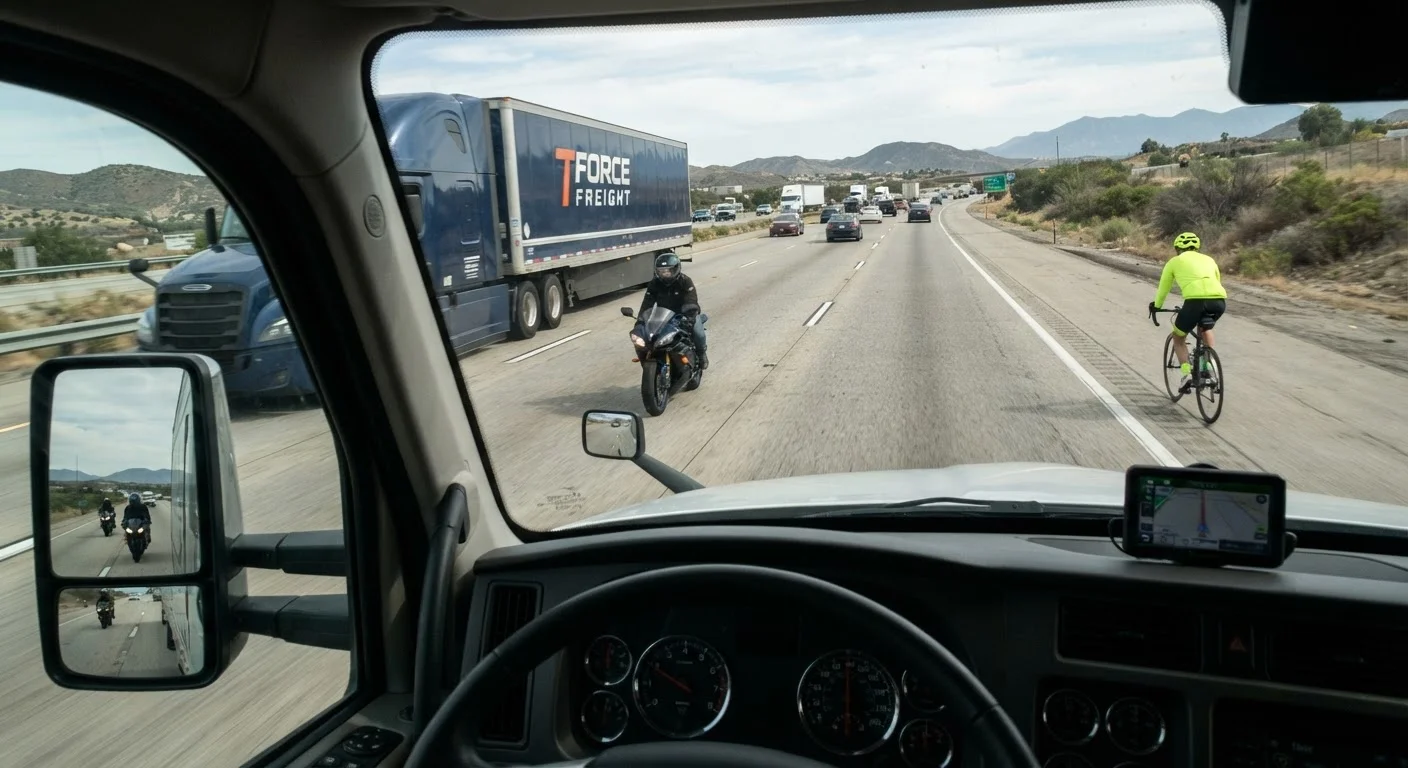
Most drivers adjust their behavior based on traffic volume and speed - but they rarely stop to consider that a semi-truck, a motorcyclist, and a cyclist each impose entirely different demands on the road environment. Blind spots vary by vehicle type. Stopping distances differ by orders of magnitude. Vulnerability is not evenly distributed.
Understanding these distinctions isn't just courteous driving - it's the foundation of crash prevention. As you'd adjust for wet pavement (see our article on driving in adverse weather conditions), you should adjust your habits for every road user you encounter.
| Truck blind spot length (rear) | Up to 200 feet behind the trailer (Federal Motor Carrier Safety Administration) |
| Truck stopping distance at 65 mph | Approximately 525 feet (FMCSA driver safety guidelines) |
| Motorcyclist fatality rate vs. car occupants | ~24x higher per mile traveled (NHTSA Traffic Safety Facts) |
| Cyclist deaths on US roads annually | Approximately 1,000 per year (NHTSA, recent multi-year data) |
| Minimum passing distance for cyclists | 3 feet in most US states (Varies by state law) |
| Truck No-Zone side blind spot width | Up to 3 lanes wide on the right side (FMCSA) |
Sharing the Road with Commercial Trucks
Commercial trucks - 18-wheelers, delivery semis, tanker trucks - are governed by physics that don't apply to your passenger vehicle. A fully loaded truck can weigh 80,000 pounds, and its stopping distance at highway speeds can exceed 500 feet. That's nearly twice the distance required by a typical car.
Understand the No-Zones
Truck drivers operate with substantial blind spots on all four sides of the vehicle. The FMCSA identifies these as "No-Zones": directly behind the trailer (up to 200 feet), immediately in front of the cab, and wide swaths along both sides - particularly the right side, which can extend across three lanes. If you can't see the driver's mirrors, the driver cannot see you. Our dedicated article on blind spots and lane changes explains how these zones form and how to check them reliably.
Practical Adjustments
- Pass decisively. Don't linger alongside a truck. Accelerate smoothly through the pass and establish a clear gap before moving back into the lane.
- Increase following distance. Maintain at least a 4-second following gap behind trucks - more on highways. See how tailgating creates risk in our guide on why tailgating is more dangerous than most drivers realize.
- Anticipate wide turns. Trucks often swing left before turning right. Never squeeze into the gap between a turning truck and a curb.
- Watch for tire blowouts. Truck tire debris can appear suddenly; maintain lateral space whenever possible.
~24x
Higher motorcyclist fatality rate vs. car occupants per mile
According to NHTSA Traffic Safety Facts, motorcyclists face dramatically higher fatal crash risk relative to distance traveled.
525 ft
Stopping distance for a loaded semi at 65 mph
The Federal Motor Carrier Safety Administration notes that a fully loaded commercial truck needs far longer to stop than a passenger car at highway speeds.
~1,000
Cyclists killed on US roads per year
NHTSA data consistently shows roughly 1,000 cyclist fatalities annually, with urban intersections and roadway edges as common crash sites.
Sharing the Road with Motorcycles
Motorcyclists are among the most vulnerable road users. Their smaller profile makes them harder to spot, and their lack of an enclosing frame means any collision carries severe injury risk. NHTSA data consistently shows motorcyclists face a fatality rate roughly 24 times higher than car occupants per mile traveled.
Visibility Is the Core Problem
The most common driver error in motorcycle crashes is a failure to see the rider before making a turn or lane change. Motorcycles are narrow - they can disappear into visual clutter, get lost in sun glare, or sit in your blind spot when you check your mirrors. Always conduct a dedicated head-check before any lane change, and give intersections an extra scan for approaching motorcycles.
Key Driving Adjustments
- Give riders a full lane. Motorcyclists legitimately use different parts of their lane to maximize visibility and road feel. Don't crowd them or attempt to share a lane.
- Double your following distance. Motorcycles can stop faster than cars in many conditions. If you're following too closely and they brake suddenly, the outcome is serious.
- Don't underestimate speed. Motorcycles can be harder to judge for approaching speed, especially head-on. When turning left at an intersection, wait for a clear gap - don't guess.
State Laws on Passing Cyclists Vary
Most US states have enacted a "3-foot passing law" requiring drivers to give cyclists at least 3 feet of clearance when overtaking. Some states require more space or mandate moving into an adjacent lane when safe. Check your state's specific traffic code, as enforcement and penalties differ.
Sharing the Road with Cyclists
Cyclists are legally permitted to use roadways in every US state, and in many jurisdictions they have the same rights and responsibilities as vehicle operators. Yet they remain acutely exposed - unprotected, slower-moving, and reliant on surrounding drivers exercising real care.
Common Driver Errors Around Cyclists
- The door prize. Opening a car door into the path of a passing cyclist - known as "dooring" - is a leading cause of cyclist injury in urban areas. Always check your mirror and blind spot before opening your door when parked along a roadway.
- Squeezing the pass. Passing too close at speed creates a dangerous wind turbulence effect and leaves no margin for error. Most US states require a minimum of 3 feet of clearance; when in doubt, move into the adjacent lane if it's clear.
- Cutting off at intersections. Drivers turning right often fail to account for a cyclist traveling straight alongside them. Yield before turning, and check the bike lane or shoulder.
Interpreting Cyclist Lane Position
When a cyclist rides near the center of a lane, it is usually intentional - avoiding drain grates, broken glass, or the door zone of parked cars. This is lawful behavior in most states. For guidance on how road positioning works differently in urban vs. highway environments, see our overview on highway vs. city driving differences.
This article provides general road safety information for educational purposes only. Always follow the traffic laws of your specific state and consult official sources for regulatory requirements.
The content on this site is for informational purposes only and is not a substitute for professional advice. Always consult a qualified professional for guidance specific to your situation.