

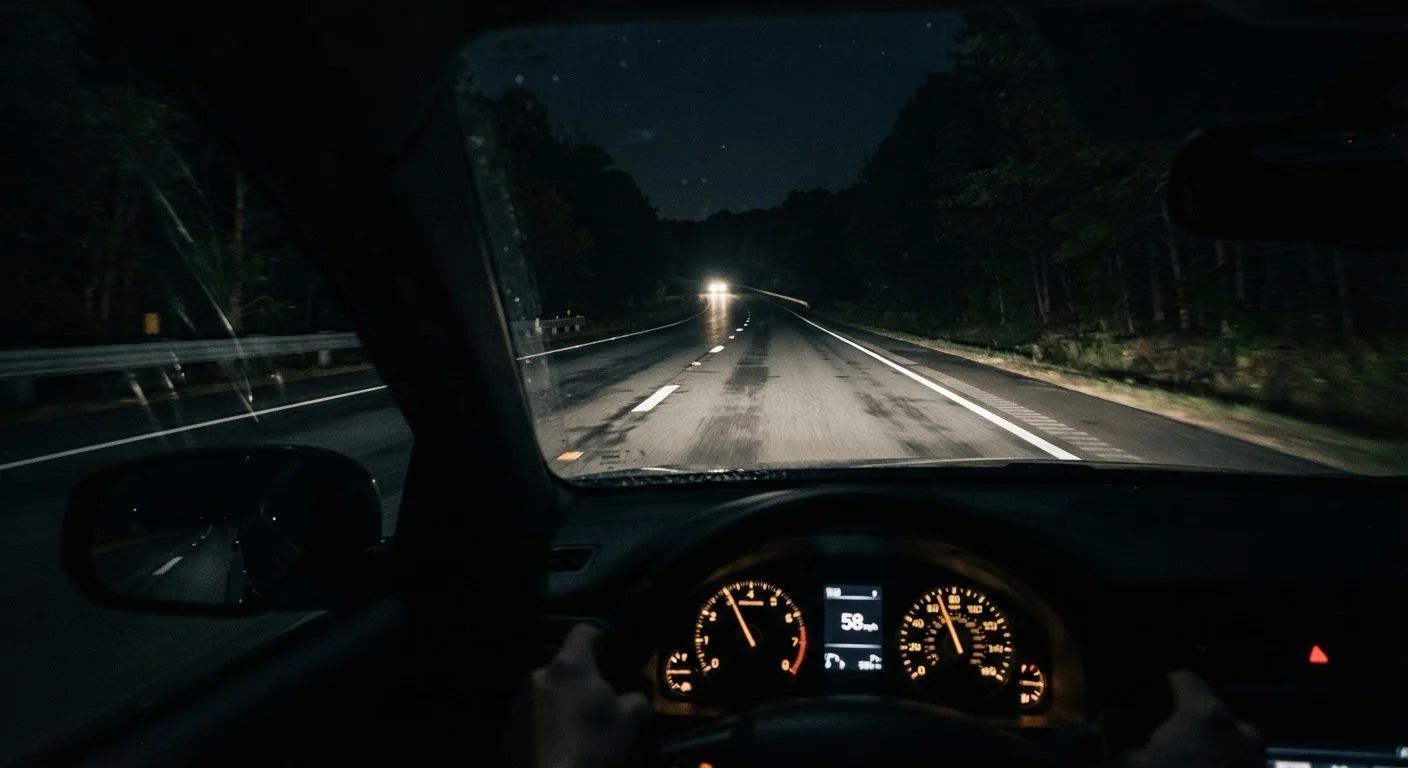
Why Night Driving Is Statistically More Dangerous
Although roughly half of all driving occurs after dark, the National Highway Traffic Safety Administration (NHTSA) has consistently found that a disproportionate share of fatal crashes happen at night. The core problem is simple: human eyes are not optimized for low-light driving. Depth perception, peripheral vision, and color recognition all degrade significantly once natural light disappears.
Beyond biology, nighttime roads bring a unique mix of hazards. Impaired and drowsy drivers are more prevalent after midnight. Pedestrians and cyclists are harder to spot. Wildlife crossings peak in early morning hours. And driver fatigue - which compounds every other risk - accumulates steadily through a long evening commute or late-night road trip. Understanding these overlapping factors is the first step toward addressing them systematically.
For a broader look at how risk profiles change depending on who is behind the wheel, see our article on how driving risks shift with age.
Essential Habits That Make Night Driving Safer
The following evidence-backed practices address the most common causes of nighttime crashes. Implementing even a few of them consistently can have a measurable effect on your safety margin after dark.
Keep your headlights, taillights, and windshield clean and properly aimed.
Dirty lenses can reduce headlight output by up to 70%, and a misaimed beam either blinds oncoming drivers or illuminates the wrong area. Windshield grime that seems invisible during the day scatters oncoming light into a blinding haze at night.
Reduce speed to match your actual sight distance, not the posted speed limit.
Most headlights illuminate roughly 160-250 feet ahead, but at 60 mph a vehicle travels about 88 feet per second. If a hazard appears at the edge of your headlight range, you may have fewer than two seconds to react and stop. Slowing down extends your effective decision window.
Increase your following distance to at least four seconds after dark.
Nighttime reaction chains are longer: you must detect a hazard, process it in lower-contrast conditions, decide, and execute. The standard three-second following distance leaves almost no margin when visibility is already compressed by darkness.
Dim your instrument panel and interior lighting to the lowest comfortable level.
Bright interior light - including phone screens and infotainment displays - contracts your pupils, reducing their ability to adapt to the dark road ahead. Even modest reductions in cabin brightness help maintain better night-adapted vision.
Scan wide and use the high-beam/low-beam switch strategically.
High beams can double usable sight distance on unlit roads, but drivers often forget to switch between modes appropriately. Failing to dim for oncoming vehicles is illegal in most states and a genuine safety hazard; failing to use high beams when the road is clear wastes available light.
Distraction compounds every nighttime risk. Our guide on distracted driving and crash data explains why multitasking behind the wheel is far more dangerous than most drivers assume.
Managing Glare and Oncoming Headlights
Glare from modern LED and high-intensity headlights can temporarily blind a driver for several seconds - more than enough time for a serious incident at highway speeds. The standard technique is to shift your gaze to the right edge of the road or the painted white line when oncoming headlights are intense. Avoid looking directly into the source of glare.
Use the Right Edge Line, Not Oncoming Lights
When an oncoming vehicle's headlights are blinding, shift your gaze to the white edge line on the right side of your lane rather than looking at the light source. This keeps you tracking your lane position while protecting your night-adapted vision. After the vehicle passes, allow a few seconds for your eyes to readjust before resuming your normal scan pattern.
If your vehicle has an auto-dimming rearview mirror, verify that the sensor is clean and functioning. Manual-dimming mirrors have a flip tab on the bottom that reduces reflective glare from vehicles behind you. Using it on bright-headlight roads is a simple habit with real payoff.
Fatigue: The Hidden Night Driving Risk
Drowsy driving is among the most underreported contributors to nighttime crashes. Fatigue narrows attention, slows reaction time, and - at its most severe - causes microsleeps lasting several seconds. At 65 mph, a four-second microsleep means traveling nearly the length of a football field with no awareness of the road.
3×
Higher fatal crash rate at night vs. daytime
The NHTSA has reported that the fatality rate per mile driven is roughly three times higher at night than during daylight hours.
~37,000
Annual US deaths in drowsy-driving-related crashes
The AAA Foundation for Traffic Safety has estimated tens of thousands of annual fatalities involve driver fatigue as a contributing factor.
The warning signs of dangerous fatigue include heavy eyelids, drifting out of your lane, missing exits, and an inability to recall the last few miles driven. If you experience any of these, pulling off safely and resting is not optional - it is the correct response. Our detailed breakdown of what drowsy driving does to reaction time covers the cognitive science in depth.
Maintaining a safe following distance matters even more at night, when your stopping window is already compressed by reduced visibility. See why tailgating is more dangerous than most drivers realize for the underlying physics.
The content on this site is for informational purposes only and is not a substitute for professional advice. Always consult a qualified professional for guidance specific to your situation.