

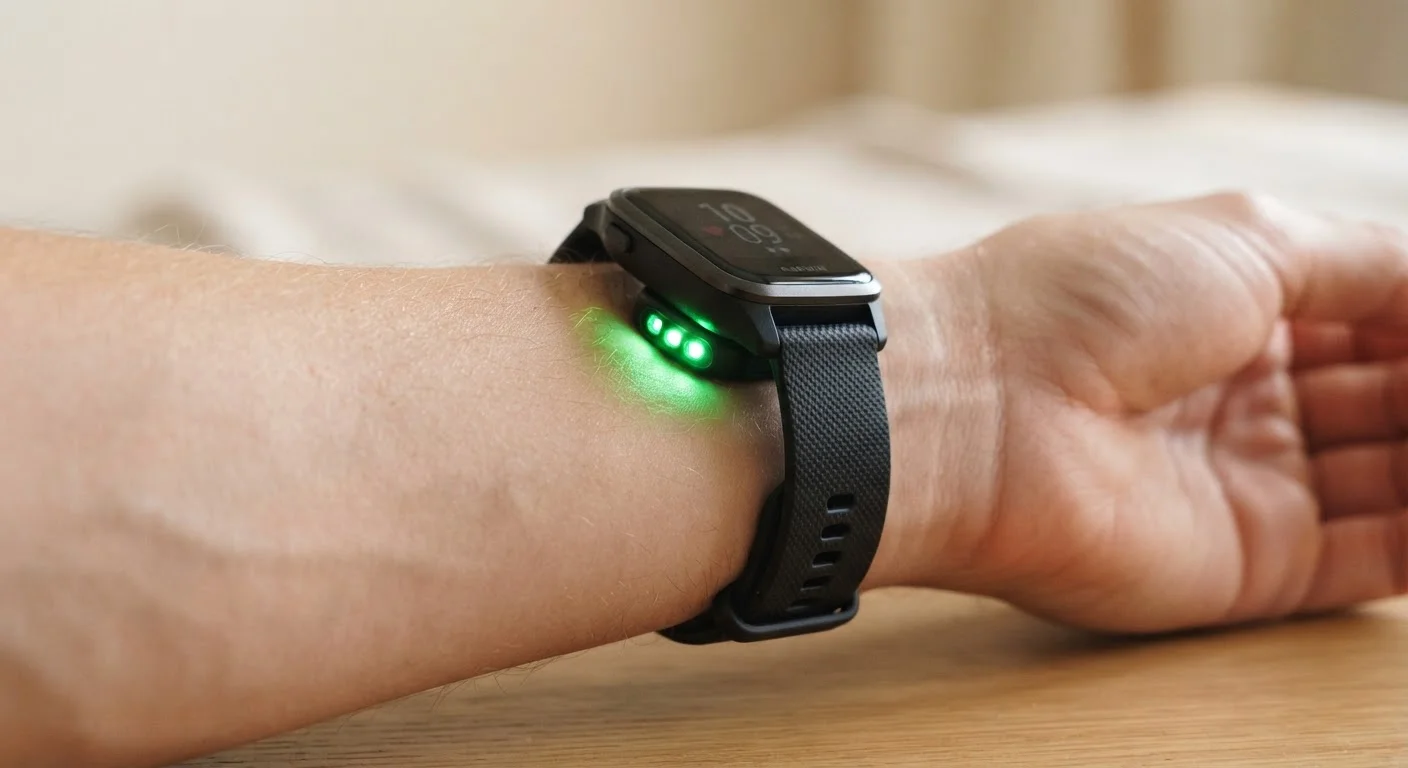
The Science Behind the Sensor
Every time your heart beats, it pushes a wave of blood through your arteries - including the small blood vessels just beneath the surface of your wrist. Fitness trackers exploit this biological rhythm using a technology called photoplethysmography, or PPG.
Here's the basic process: the tracker's sensor array flashes green LEDs against your skin dozens or even hundreds of times per second. Some of that light is absorbed by the blood in your capillaries; the rest reflects back to a photodetector on the device. When your heart beats and blood flow surges, more light is absorbed. Between beats, less is absorbed. The sensor records this rhythmic rise and fall in light absorption and translates it into a beats-per-minute (BPM) figure.
An onboard algorithm then filters out noise - like random movement of your arm - and smooths the signal into a readable heart rate. The more sophisticated the algorithm, the better the tracker handles real-world conditions like walking, typing, or fidgeting.
“Wearable photoplethysmography has democratized continuous heart rate monitoring, but consumers should understand that convenience and clinical precision are not the same thing. These tools are most powerful when users know what the data can and cannot tell them.”
— Dr. Jessilyn Dunn, Biomedical engineering researcher focused on wearable health technology
What Affects Accuracy
PPG is clever, but it has real-world limitations every user should understand.
- Movement (motion artifact): Wrist movement during exercise creates "noise" that can confuse the sensor. Most trackers use accelerometers to detect and compensate for motion, but fast or erratic movement - like weightlifting - still degrades accuracy.
- Fit: A loose tracker that slides around breaks the seal between sensor and skin, scattering light and distorting readings. A consistent, snug fit is the single biggest thing you can control.
- Skin characteristics: Tattoos with dark or red pigment absorb light the same way blood does, which can throw off readings. Body hair and very dry skin can also reduce sensor contact quality.
- Skin tone: Some PPG implementations have demonstrated lower accuracy on darker skin tones - a hardware equity issue the industry is still actively working to address.
- Cold temperatures: In cold conditions, blood vessels near the skin surface constrict, reducing blood flow to the wrist and making the signal harder to detect.
Wear It Right for Better Data
Position your fitness tracker one to two finger-widths above your wrist bone - not directly on the joint - and make sure it sits snugly against your skin without digging in. A secure, consistent fit is the most effective way to reduce inaccurate readings without changing any settings.
Understanding these limitations helps you interpret your data more thoughtfully. If a reading seems off during an intense session, it likely is - and that's a known constraint of the technology, not a defective device.
PPG vs. ECG: Knowing the Difference
Some fitness trackers and smartwatches now include a second heart monitoring mode: an electrocardiogram (ECG) feature. It's important not to confuse the two.
PPG (the optical sensor) runs continuously and estimates heart rate from light reflection. ECG, by contrast, measures the actual electrical signals your heart produces and requires you to hold a finger on a metal contact to complete a circuit. ECG can detect certain irregular rhythms - such as atrial fibrillation - in a way that PPG alone cannot reliably do.
However, even wrist-based ECG features are considered screening tools, not clinical diagnostics. If your tracker flags an irregular reading or you experience symptoms like palpitations or dizziness, seek evaluation from a healthcare professional rather than relying solely on your wearable.
For a broader look at how these sensors fit into your daily device habits, see which smartwatch features genuinely earn daily use.
~95%
PPG accuracy at rest vs. clinical ECG
Research published in peer-reviewed journals has found consumer PPG devices can achieve roughly 95% agreement with ECG for resting heart rate, though accuracy declines during vigorous exercise.
30%+
Error increase during high-intensity exercise
Studies examining wrist-worn optical monitors during activities like interval training have documented substantially higher error margins compared to resting conditions, often exceeding 30% deviation.
Getting the Most Reliable Readings
A few simple habits make a meaningful difference in the data your tracker produces:
- Position the tracker correctly. Wear it one to two finger-widths above your wrist bone. This part of the wrist has better blood vessel coverage than right at the joint.
- Keep it clean. Sweat, sunscreen, and skin buildup between the sensor and your wrist scatter light. Rinse the back of the tracker and your wrist regularly.
- Let it settle. After putting the tracker on, wait 30-60 seconds before checking your heart rate. The sensor needs a moment to establish a stable signal.
- Stay still for resting measurements. If you want an accurate resting heart rate, sit quietly for a few minutes before checking. Movement - even typing - adds noise.
Health self-tracking tools work best when you understand what they're actually measuring. If you're also using apps to track other wellness signals, it's worth exploring the trade-offs that come with self-tracking your mood for a balanced perspective on digital health monitoring.
This article is for general informational and educational purposes only and does not constitute medical advice. Consult a qualified healthcare professional for any concerns about your heart health or fitness monitoring needs.
Frequently Asked Questions
For resting heart rate, most modern fitness trackers are reasonably accurate - typically within a few beats per minute of clinical measurements. Accuracy drops during high-intensity exercise due to increased wrist movement. They are not medical-grade devices and should not replace professional cardiac monitoring.
Green light is absorbed more strongly by hemoglobin (the oxygen-carrying protein in red blood cells) than other colors, making it easier for the sensor to detect changes in blood volume with each heartbeat. Some trackers also use red and infrared light for SpO2 measurements.
Yes. Tattoos with dark or red ink can interfere with the sensor's light absorption readings. Research has also noted that some PPG sensors show reduced accuracy on darker skin tones, a known limitation that device manufacturers are actively working to address.
Wear it snug enough that the sensor maintains consistent contact with your skin, but not so tight it restricts blood flow. A loose tracker that slides around on your wrist is the most common cause of inaccurate readings.
No. Consumer fitness trackers are wellness tools, not medical devices. If you have concerns about your heart health, consult a healthcare professional who uses clinical-grade equipment such as an ECG (electrocardiogram).
The content on this site is for informational purposes only and is not a substitute for professional advice. Always consult a qualified professional for guidance specific to your situation.