

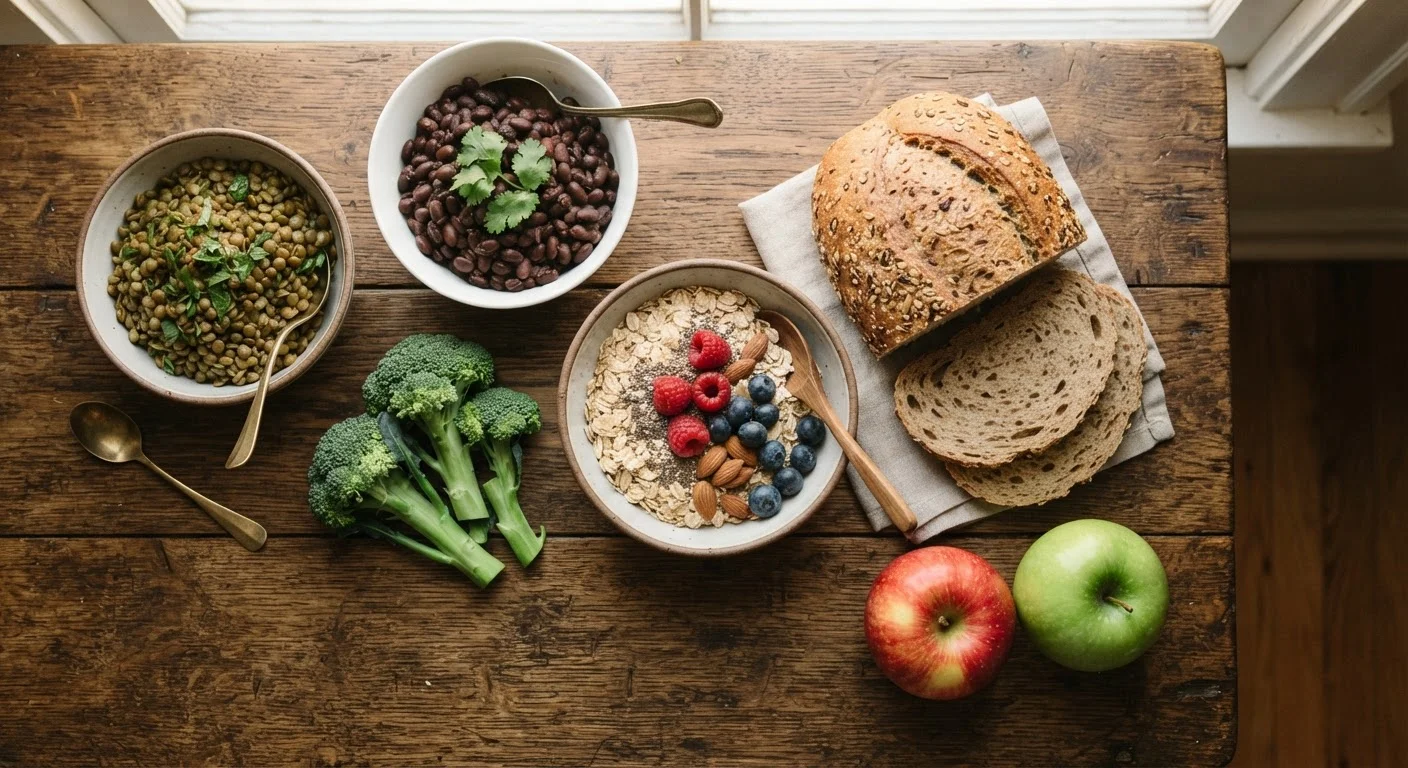
Why Fiber Is Considered an Underconsumed Nutrient
The U.S. Dietary Guidelines have repeatedly flagged dietary fiber as a nutrient of public health concern - meaning most Americans fall significantly short of recommended intake. Estimates from federal nutrition surveillance data suggest average adult consumption hovers around 15-17 grams per day, roughly half the generally recommended amount.
The shortfall is largely structural. Ultra-processed foods - which make up a substantial share of calories in the typical American diet - are low in fiber almost by definition. Refining grains removes the bran and germ, stripping away the fiber-rich portions. Processed snacks, fast food, and packaged convenience meals tend to prioritize palatability over fiber content.
~15-17g
Average daily fiber intake for U.S. adults
Federal dietary surveillance data consistently shows average adult consumption falls well below recommended levels.
25-38g
Recommended daily fiber intake for adults
The Dietary Guidelines for Americans suggest approximately 25g/day for women and 38g/day for men, varying by age and caloric intake.
~90%
Americans falling short of fiber recommendations
Research published in the American Journal of Lifestyle Medicine estimated that roughly 90% of Americans do not meet recommended fiber intakes.
Understanding what fiber actually does - and where it comes from - is the practical starting point for closing this gap. You don't need exotic ingredients or expensive supplements. The most fiber-dense foods are also among the most affordable: beans, lentils, oats, brown rice, and seasonal produce. See our guide to nutritious eating on a budget for practical strategies that work at any price point.
What Fiber Actually Does in Your Body
Fiber's benefits span several body systems, which is why it shows up in nutrition guidance across so many different health conditions.
Digestive Health
Insoluble fiber adds bulk to stool and helps regulate transit time - how quickly food moves through the intestines. This supports regular bowel movements and may reduce the risk of constipation. A fiber-rich diet is also associated with lower rates of diverticular disease, a condition where small pouches form in the colon wall.
Blood Sugar Regulation
Soluble fiber - found in foods like oats, apples, and beans - slows the absorption of glucose into the bloodstream. This blunts the blood sugar spike that follows a meal, which can be meaningful for people managing or trying to prevent type 2 diabetes. It's worth noting that fiber is just one piece of a broader dietary pattern; individual responses vary and anyone managing a metabolic condition should work with their healthcare team.
Heart Health
Soluble fiber binds to bile acids in the digestive tract. The liver compensates by pulling LDL cholesterol from the blood to make more bile, which can modestly lower circulating LDL levels over time. Large observational studies consistently link higher fiber intake with lower rates of cardiovascular disease, though diet is complex and causation is difficult to isolate.
Hydration Matters When Adding Fiber
Fiber absorbs water as it moves through your digestive tract, which is part of how it supports regularity. When you increase your fiber intake, also increase your fluid intake - water in particular. Without adequate hydration, a high-fiber diet can paradoxically worsen constipation. See our overview of hydration and daily diet for more on how water and nutrition interact.
Gut Microbiome Support
Certain fibers - classified as prebiotics - serve as fuel for beneficial bacteria in the colon. Fermentation of these fibers produces short-chain fatty acids, which appear to support colon health and may have broader systemic effects. This is an active area of research, and the science continues to develop.
Practical Ways to Eat More Fiber Every Day
Increasing fiber intake doesn't require a dramatic diet overhaul. Small, consistent substitutions add up quickly.
- Swap refined grains for whole grains. Choosing whole wheat bread, brown rice, or oats over their refined counterparts is one of the simplest high-impact changes. Check the Nutrition Facts label for grams of fiber per serving - 3 grams or more per serving is generally considered a good source.
- Add legumes to regular meals. Beans, lentils, and chickpeas are among the most fiber-dense foods available. A half-cup of cooked lentils provides roughly 8 grams of fiber. They work well in soups, salads, grain bowls, and tacos.
- Keep fruit whole, not juiced. Whole fruit retains its fiber; juicing removes most of it. An apple with its skin contains roughly 4-5 grams of fiber, while apple juice contains almost none.
- Leave skins on vegetables and potatoes. Much of a vegetable's fiber sits in or just under the skin. Roasting potatoes or carrots with their skins intact preserves this.
- Increase intake gradually. Adding large amounts of fiber suddenly can cause bloating, gas, and cramping. A gradual increase over several weeks, paired with adequate water intake, allows the digestive system to adjust.
Fiber Is Not the Same as a Carbohydrate
Fiber is technically classified as a carbohydrate, but it behaves differently from starches and sugars because the body cannot digest it for energy. On a Nutrition Facts label, fiber is listed under total carbohydrates. Some people following low-carbohydrate eating patterns subtract fiber from total carbs to calculate "net carbs" - a practice not universally recognized in clinical nutrition but commonly used in certain dietary frameworks.
Fiber doesn't exist in isolation - it comes packaged with other beneficial compounds in whole plant foods. This is one reason micronutrients like vitamins and minerals also tend to be more abundant in fiber-rich diets built around whole foods rather than processed alternatives.
“Dietary fiber is consistently associated with health benefits across multiple organ systems, yet it remains one of the most overlooked and underconsumed components of the American diet. The simplest intervention is often just eating more whole plant foods.”
— Joanne Slavin, Professor of Food Science and Nutrition, University of Minnesota, and fiber researcher
This article is for general informational and educational purposes only and is not a substitute for professional medical or dietary advice. Consult a qualified healthcare provider or registered dietitian before making significant changes to your diet, especially if you have a health condition.
Frequently Asked Questions
General dietary guidelines suggest adults aim for roughly 25 grams per day for women and 38 grams per day for men, though individual needs vary. After age 50, recommendations decrease slightly. Most Americans currently consume well under these amounts. A qualified healthcare provider or registered dietitian can help determine a target suited to your specific health situation.
Soluble fiber dissolves in water and forms a gel that can help slow digestion, support healthy blood sugar, and lower LDL cholesterol. Insoluble fiber does not dissolve; it adds bulk to stool and helps food move efficiently through the digestive tract. Most plant foods contain both types, so eating a varied diet naturally provides both.
Yes. Consuming very large amounts of fiber - especially rapidly - can cause bloating, gas, cramping, and in some cases constipation rather than relieving it. Drinking adequate water is important when increasing fiber intake. If you have a digestive condition such as irritable bowel syndrome or Crohn's disease, speak with a healthcare provider before significantly changing your fiber intake.
Fiber supplements can help fill gaps, but whole foods deliver fiber alongside vitamins, minerals, and phytonutrients that supplements lack. Research generally supports whole-food sources as more beneficial for overall health outcomes. Supplements may be appropriate in certain situations - a registered dietitian can help you decide.
Cooking softens fiber but does not eliminate it. Steamed, roasted, or boiled vegetables still contain meaningful amounts of fiber. Raw vegetables may provide slightly more fiber per gram in some cases, but both raw and cooked vegetables are valuable sources worth including regularly in your diet.
The content on this site is for informational purposes only and is not a substitute for professional advice. Always consult a qualified professional for guidance specific to your situation.