

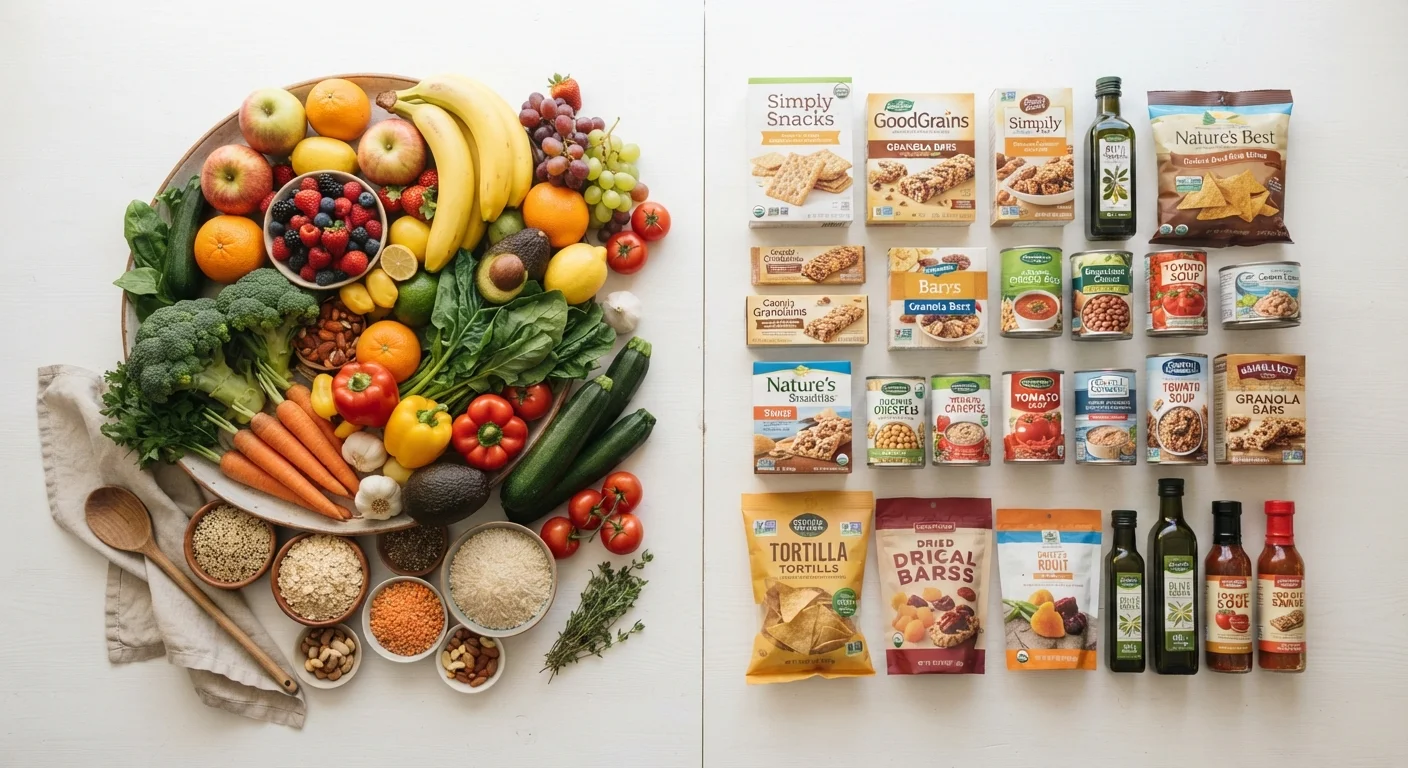
Option A
Whole Foods
Foods in their natural, minimally altered state.
Best for: People aiming to maximize nutrient density and reduce added sugars, sodium, and artificial additives in their daily diet.
Option B
Processed Foods
Foods that have been altered from their original form through industrial or culinary methods.
Best for: Consumers who need convenience, shelf stability, or affordability — provided choices are made with label awareness.
Defining the Terms: What Makes a Food 'Whole' or 'Processed'?
A whole food is one that remains close to its original form — an apple, a handful of oats, a raw chicken breast, or a handful of lentils. It has not been substantially altered by industrial processes, and it doesn't carry a long list of additives. The nutrients inside are largely as nature produced them.
Processed food, on the other hand, describes virtually anything that has been changed from its raw state — and that definition covers an enormous range. Pasteurized milk, bagged salad greens, frozen peas, and canned tomatoes are all technically processed. So are potato chips, breakfast cereals with added sugar, and frozen dinners with 40 ingredients. Treating these as equivalent is where the conversation goes wrong.
A widely used research framework called the NOVA classification groups foods into four categories based on the degree and purpose of processing: unprocessed or minimally processed foods (fresh vegetables, plain meats, eggs); processed culinary ingredients (olive oil, flour, salt); processed foods (canned fish, cheese, simple bread); and ultra-processed foods (packaged snacks, sweetened drinks, reconstituted meat products). Understanding where a food lands in this spectrum is far more useful than a simple whole vs. processed label.
For a broader grounding in how food choices fit together, see our nutrition primer for beginners.
Where Nutrition Actually Diverges
The nutritional gap between whole and processed foods widens most sharply at the ultra-processed end of the spectrum. Research consistently associates high ultra-processed food consumption with lower intake of fiber, vitamins, and minerals, and higher intake of added sugar, sodium, and saturated fat — all dietary patterns linked to increased risk of chronic disease. This is general population-level data, not a guarantee about any individual's outcome.
| Criterion | Whole Foods | Ultra-Processed Foods |
|---|---|---|
| Fiber content | Generally high and intact | Often low or removed |
| Added sugars | None added | Frequently high |
| Sodium | Naturally low | Often elevated |
| Micronutrient density | High and naturally occurring | Variable; may be fortified |
| Shelf life | Short without preservation | Long due to processing |
| Cost and accessibility | Varies; fresh can cost more | Often lower cost |
| Ingredient list length | Single ingredient or very few | Typically long, with additives |
Whole foods typically deliver fiber in its original matrix — the physical structure of plant cells that slows digestion and supports gut health. Processing often strips or fragments this structure. Refined white flour, for example, removes the bran and germ from whole wheat, reducing fiber and several B vitamins in the process.
That said, some processing improves nutrition. Cooking tomatoes increases bioavailable lycopene. Fermenting dairy into yogurt adds beneficial bacteria. Fortifying cereals with iron and folate addresses documented public health deficiencies. Processing is a tool — the question is what it's used for.
Understanding what macronutrients do in the body helps put these distinctions in context. See our guide to macronutrients for a plain-language breakdown.
57%
Share of U.S. calories from ultra-processed foods
A 2016 analysis published in BMJ Open estimated that ultra-processed foods account for more than half of total caloric intake among American adults.
~28g
Daily fiber gap for most Americans
The U.S. Dietary Guidelines note that most Americans consume well below the recommended daily fiber intake, a gap closely tied to low whole-food consumption.
4x
Sodium difference between processed and whole food equivalents
Nutrition research consistently finds that processed and restaurant foods account for the vast majority of sodium intake compared to naturally occurring sodium in whole foods.
Practical Ways to Shift Your Dietary Balance
The goal isn't to eliminate all processing from your diet — it's to make whole and minimally processed foods the foundation, while using more heavily processed products selectively and with awareness.
A few evidence-informed approaches:
- Use the ingredient list as your guide. A short ingredient list of recognizable items usually signals minimal processing. A long list featuring hydrogenated oils, high-fructose corn syrup, or unfamiliar emulsifiers suggests ultra-processing. The Nutrition Facts label guide walks through what each section actually tells you.
- Embrace nutritionally strong processed staples. Frozen vegetables, canned beans (rinsed to reduce sodium), and plain rolled oats are processed yet nutritionally dense. These can anchor a practical, affordable diet.
- Plan for convenience without defaulting to ultra-processed options. Batch-cooked grains, hard-boiled eggs, and precut vegetables offer convenience without the additive load of most packaged snacks.
- Don't let perfect be the enemy of good. A diet with occasional processed food but strong whole-food foundations is far healthier than one paralyzed by rigid rules.
Not All Processing Is a Red Flag
Pasteurization makes dairy and juice safe to drink. Canning preserves vegetables at peak nutrition. Fortification has reduced conditions like folate-deficiency neural tube defects. The processing methods most associated with health concerns are those that add sugar, sodium, and artificial additives while removing fiber and micronutrients — not preservation techniques that make food safer or more accessible.
For context on how protein sources fit into these patterns, plant-based vs. animal protein trade-offs covers the key nutritional distinctions without diet-culture framing.
This article is for general informational purposes only and does not constitute medical or dietary advice. Consult a qualified healthcare professional or registered dietitian for guidance tailored to your individual health needs.
The content on this site is for informational purposes only and is not a substitute for professional advice. Always consult a qualified professional for guidance specific to your situation.