

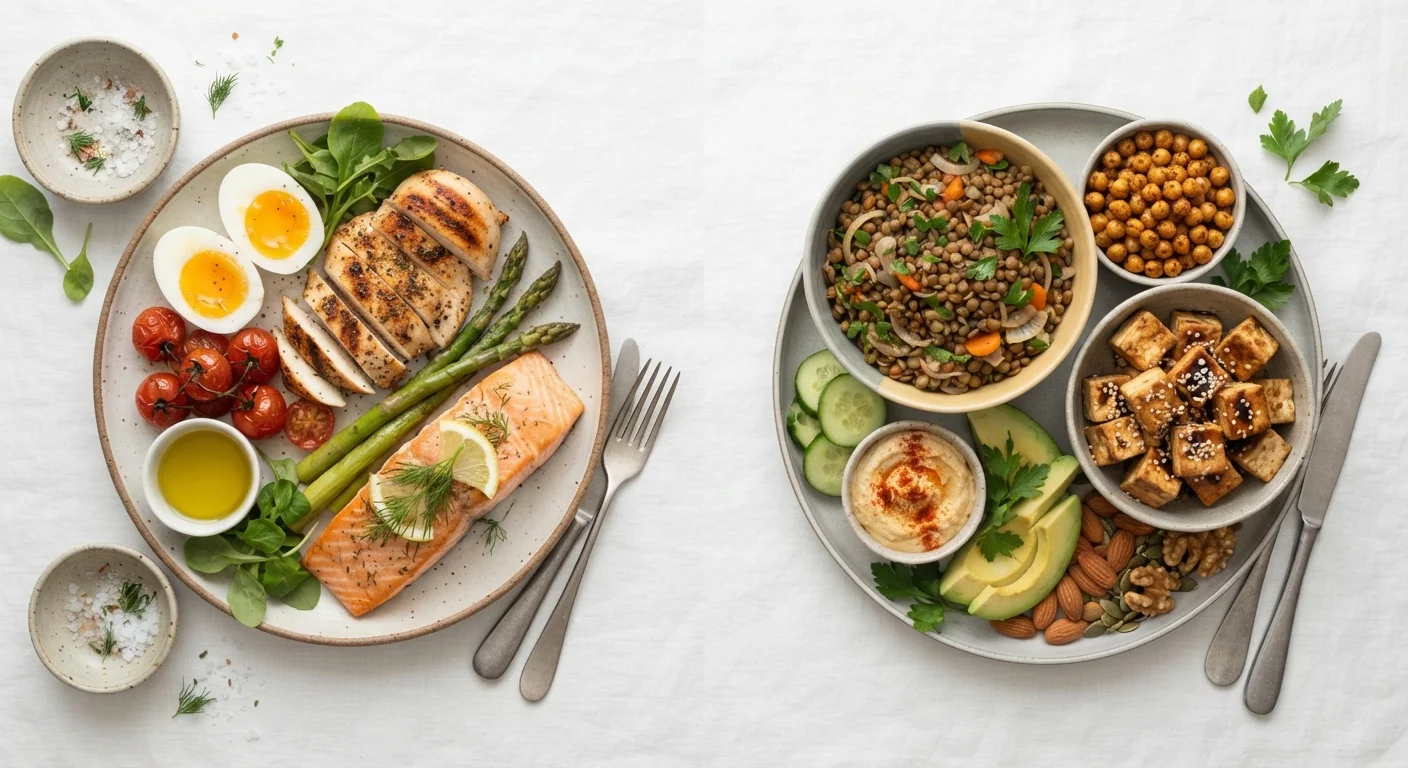
Option A
Animal Protein
The complete, highly bioavailable benchmark.
Best for: People who eat meat, dairy, or eggs and want a straightforward way to meet daily protein and essential amino acid needs.
Option B
Plant-Based Protein
The versatile, fiber-rich alternative.
Best for: People following vegetarian or vegan diets, or anyone looking to diversify protein sources with more fiber and phytonutrients.
What Makes a Protein 'Complete' or 'Incomplete'?
Protein is made up of amino acids - twenty in total, nine of which the human body cannot manufacture on its own. These nine are called essential amino acids, and we must obtain them from food. A protein source that contains all nine in sufficient quantities is called complete; one that falls short in one or more is incomplete.
Animal proteins - meat, poultry, fish, eggs, and dairy - are universally complete. Most plant proteins are not. Legumes tend to be low in methionine; grains are often low in lysine. This is not a crisis for plant-based eaters, however. The body draws on a daily pool of amino acids from all foods consumed, so eating a variety of plant proteins across the day - say, rice and lentils, or hummus on whole-grain bread - covers the full essential amino acid spectrum without precise meal-by-meal matching.
Soy is a notable exception among plants: it is considered a complete protein with an amino acid profile that compares favorably to many animal sources.
Bioavailability: How Much Protein Does Your Body Actually Use?
Grams of protein on a nutrition label don't tell the whole story. Bioavailability - the proportion that the body actually digests, absorbs, and uses - varies considerably between sources. The most widely used measure is the PDCAAS, which scores protein quality on a scale of 0 to 1 based on amino acid content and digestibility.
| Criterion | Animal Protein | Plant-Based Protein |
|---|---|---|
| Amino acid completeness | Complete (all 9 essential AAs) | Often incomplete; soy is an exception |
| Bioavailability (PDCAAS) | Generally 0.9-1.0 | Generally 0.5-0.9, varies by source |
| Saturated fat content | Often higher (varies by source) | Generally lower |
| Dietary fiber | None | Present in legumes, grains, nuts |
| Vitamin B12 | Naturally present | Absent; supplementation often needed |
| Heme iron | Present (highly absorbable) | Non-heme iron only (less absorbable) |
| Cost per gram of protein | Varies; meat can be expensive | Legumes among most affordable options |
| Phytonutrient content | Minimal | Rich in phytonutrients and antioxidants |
Egg whites, whey, and casein (from milk) score at or near the maximum. Most plant proteins score lower, partly because plant cell walls and naturally occurring compounds called antinutrients - such as phytates in legumes and grains - can partially impair absorption. Cooking, soaking, and fermenting plant foods reduce antinutrient levels significantly, improving usability. Because of this difference, some nutrition researchers suggest plant-based eaters may benefit from slightly higher total protein intake to account for lower bioavailability, though individual needs vary. For personalized guidance, consulting a registered dietitian is always advisable.
Understanding what you're consuming starts with reading labels accurately - see our guide to reading a Nutrition Facts label for help decoding protein and other key figures.
What Else Comes Along for the Ride?
Protein never travels alone. What surrounds it in a food - fats, fiber, vitamins, minerals - shapes the overall nutritional picture in ways that matter for long-term health.
~7%
Average American fiber intake shortfall
The Dietary Guidelines for Americans note that dietary fiber is an underconsumed nutrient of public health concern, with most adults falling well short of the 25-38g daily recommendation.
0-1.0
PDCAAS protein quality score range
The Protein Digestibility Corrected Amino Acid Score (PDCAAS), used by the FAO/WHO, accounts for both amino acid profile and digestibility; egg white and whey score at 1.0, while many plant proteins score 0.5-0.8.
~30%
Less saturated fat in legume-based meals vs. red meat
Research published in nutritional epidemiology literature consistently finds that substituting legumes for red meat measurably reduces saturated fat intake at the meal level, though exact figures vary by preparation.
Animal proteins can deliver significant amounts of heme iron (highly absorbable), zinc, vitamin B12, and omega-3 fatty acids (especially from fatty fish). Red and processed meats also often carry substantial saturated fat and sodium - context that large nutritional studies consistently flag as relevant to cardiovascular health.
Plant proteins bring dietary fiber, a wide range of phytonutrients (beneficial plant compounds), magnesium, and folate. They are generally lower in saturated fat. The fiber and phytonutrient content is a meaningful advantage: most Americans consume far less fiber than the Dietary Guidelines recommend, and legumes are among the most efficient ways to close that gap.
It's also worth noting that not all plant-based protein products are nutritionally simple. Heavily processed plant-based meat alternatives can be high in sodium and additives. For a broader lens on how processing affects food quality, our article on whole foods vs. processed foods is a helpful reference.
Practical Guidance for Everyday Eating
No single protein source is a nutritional silver bullet, and the research does not support ranking animal versus plant protein as categorically superior. What the evidence does support is dietary variety and attention to the full nutritional package each food delivers.
Special Populations: Extra Caution Applies
Older adults, pregnant individuals, growing children, and people managing chronic kidney disease have protein needs that differ meaningfully from general guidelines. For these groups, the source, amount, and timing of protein intake can have significant health implications. Please consult a qualified healthcare provider or registered dietitian rather than relying on general population guidance.
A few practical principles worth keeping in mind:
- Diversify sources. Mixing plant and animal proteins - or rotating among several plant sources - helps cover the amino acid spectrum and broadens overall nutrient intake.
- Consider the whole food. A salmon fillet and a processed deli product are both animal proteins, but their health profiles differ enormously. Similarly, lentils and highly processed vegan burgers are both plant-based but nutritionally distinct.
- Budget matters. Beans, lentils, eggs, and canned fish are among the most affordable protein sources available. Our article on healthy eating on a budget covers this in more depth.
- Timing is less critical than totals. Distributing protein across meals supports muscle synthesis, but total daily intake within an overall balanced pattern is the larger driver. Meal timing research continues to evolve, but overall diet quality remains the foundation.
This article is for general informational and educational purposes only and is not a substitute for personalized medical or dietary advice. Consult a qualified healthcare professional or registered dietitian before making significant changes to your diet, particularly if you have an existing health condition.
The content on this site is for informational purposes only and is not a substitute for professional advice. Always consult a qualified professional for guidance specific to your situation.