

Our Verdict
Pen-and-paper budgeting is a genuinely effective method — not a relic — for people who benefit from deliberate, friction-filled engagement with their money. It costs nothing, requires no technology, and research in cognitive science consistently links handwriting to stronger memory encoding. Its real limits are speed and convenience: it cannot pull transaction data automatically, and it demands consistent manual effort to stay accurate.
Best suited for people who feel disconnected from their finances using apps, those just starting to budget, anyone seeking a low-cost zero-tech option, or those who want greater mindfulness around spending decisions.
Why Budgeting by Hand Still Deserves Serious Attention
In an era of automatic transaction imports and AI-powered spending insights, recommending a notebook and pen might seem counterintuitive. But manual budgeting has retained a dedicated following — and for reasons grounded in how people actually learn and retain financial habits.
The core premise is simple: when you write a number down yourself, you own it differently than when software calculates it for you. That friction is the point. Digital apps are optimized for convenience; pen-and-paper is optimized for engagement. Whether that trade-off works in your favor depends on what your budget needs to do for you.
This article gives you an honest look at both sides — the genuine advantages manual tracking offers, and the real limitations you should plan around. For a wider comparison of budgeting structures, see our budgeting methods overview.
The Real Advantages of Tracking Spending by Hand
Manual budgeting's strengths are behavioral and practical, not just nostalgic.
Writing by hand deepens financial awareness
Cognitive research consistently shows that handwriting engages memory and processing more actively than typing or passive reading. Logging each expense manually forces you to confront spending decisions rather than scroll past them.
No cost, no subscription, no app required
A notebook and pen are the only tools needed. There are no recurring fees, no software updates to manage, and no dependency on a company continuing to support a product.
Complete data privacy and security
Manual tracking requires no bank account linking, no personal data shared with third parties, and no exposure to app data breaches — a growing concern as financial apps hold increasingly sensitive user information.
Works seamlessly with cash-based spending
Cash transactions are invisible to most budgeting apps unless entered manually anyway. A handwritten ledger captures cash spending as naturally as card transactions, making it ideal for envelope-style budgeters.
Eliminates screen-time distractions during budgeting
Opening a finance app often means navigating notifications, ads, and upsell prompts. A notebook provides a focused, distraction-free environment for financial reflection.
Highly customizable to your actual life
You design the categories, layout, and tracking periods rather than fitting your finances into a predefined software template. This flexibility suits irregular budgets or unique household structures.
65%
Adults who say they feel stressed about money
According to the American Psychological Association's annual Stress in America survey, financial stress remains among the most commonly reported stressors for U.S. adults.
1 in 3
Americans without a monthly budget
Surveys by the National Foundation for Credit Counseling have consistently found that a significant share of U.S. adults do not follow any formal budgeting method.
Beyond the cognitive benefits, handwritten budgets offer complete privacy — no financial data is stored on a server, shared with advertisers, or exposed in a data breach. For people uneasy about linking bank accounts to third-party platforms, this matters. There's also zero cost: a notebook and pen are a one-time, negligible expense compared to app subscriptions that can run $5–$15 per month.
Manual tracking also works for cash-heavy households. If you use the envelope method or pay for expenses in cash, a physical ledger captures your spending in a way that purely digital tools can't replicate well. Our comparison of cash envelopes and digital tracking explores this interaction in more depth.
The Limitations You Should Know Before Committing
Pen-and-paper budgeting has genuine drawbacks that aren't offset by its advantages for every person or lifestyle.
No automatic transaction syncing
Every purchase must be logged manually. A single missed week can make the ledger inaccurate, and there's no fallback mechanism to catch forgotten entries the way a connected app would.
Time-consuming compared to automated tools
Gathering receipts, categorizing expenses, and running totals takes real time each week. For busy households or people managing complex finances, this time cost adds up meaningfully.
No real-time overspending alerts
Pen-and-paper tracking is inherently backward-looking — you discover you overspent in a category after the fact, not the moment it happens, which limits your ability to course-correct quickly.
Difficult to scale for complex financial situations
Managing multiple income streams, investment accounts, or business expenses in a handwritten format becomes unwieldy. Digital tools offer aggregation and reporting that manual systems can't replicate efficiently.
No built-in data backup or history
A lost or damaged notebook means losing your financial record. Digital systems store data in the cloud with redundancy; a handwritten ledger has no equivalent protection.
Hybrid Approaches Are Common and Practical
Many effective budgeters use pen-and-paper for day-to-day expense logging while relying on automated tools for bill payments and savings transfers. This preserves the cognitive benefits of manual tracking without sacrificing the convenience of automation where it genuinely helps. If you're curious how automation fits into a broader money plan, see our guide on what to automate and what to keep manual.
The most significant challenge is maintenance. A handwritten budget is only as accurate as your last entry. Miss a week of receipts, and your ledger no longer reflects reality — unlike a synced app that pulls transactions continuously. This makes it harder to catch overspending in real time.
For people managing complex finances — multiple income streams, investment accounts, side businesses — manual tracking can become impractical at scale. In those cases, selective automation may serve better. The goal is accurate awareness, not method purity.
Making It Work: Practical Tips for Manual Budgeters
If you decide to try handwritten budgeting — or combine it with limited digital tools — a few habits make the difference between a system that sticks and one that gets abandoned by week three.
- Choose a consistent format. Use the same categories every month so you can compare spending over time. Common categories include housing, food, transportation, utilities, personal, savings, and debt payments.
- Set a daily or weekly entry time. Sporadic updates create gaps. A five-minute nightly receipt review or a Sunday weekly reconciliation keeps the ledger accurate without becoming overwhelming.
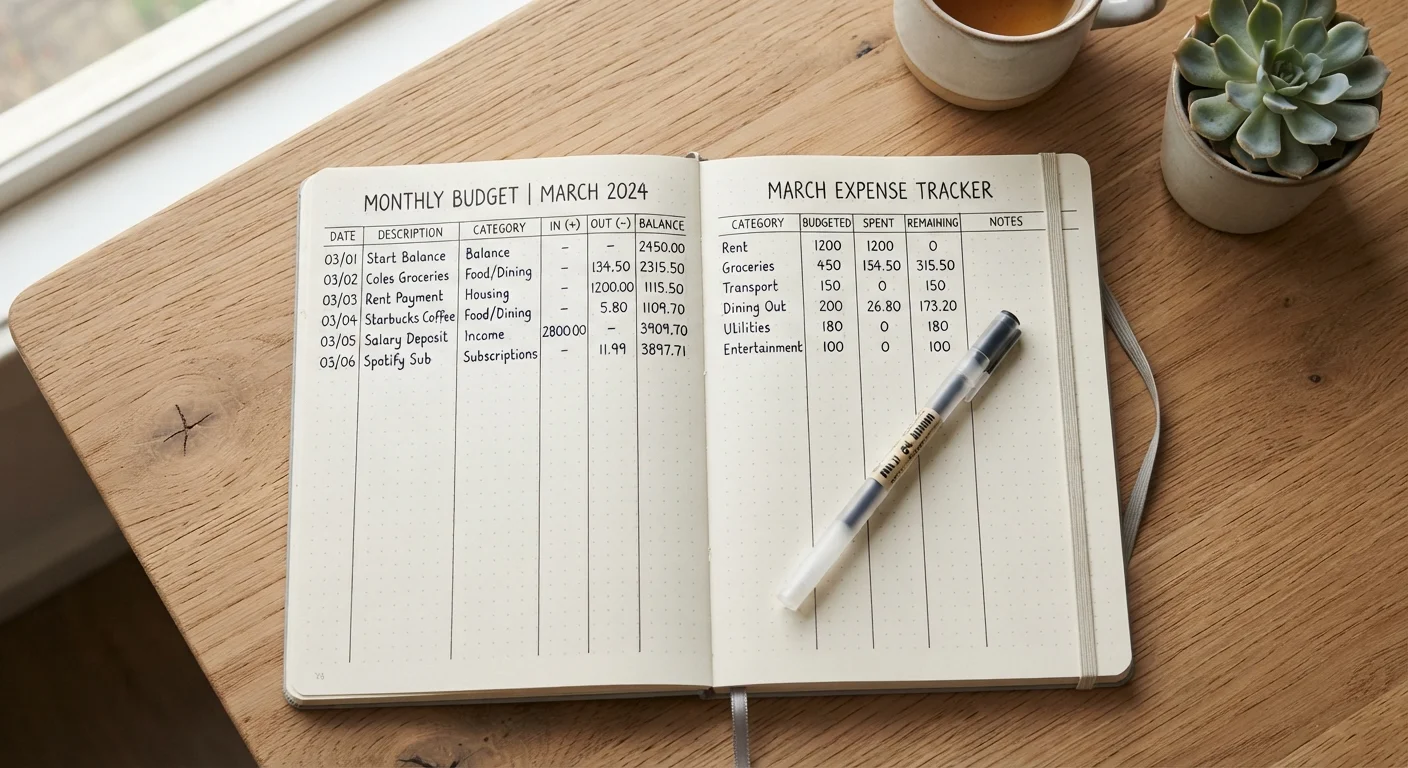
- Use a running balance column. Don't just log expenses — subtract them from your category budget in real time so you always know what's left.
- Keep receipts until you've logged them. A small envelope or pocket in your notebook works. Once logged, discard or file them.
- Review monthly before the new month starts. Look at categories where you overspent and adjust allocations — this is the habit that builds genuine financial awareness over time.
For broader guidance on building consistent financial habits, the spending patterns worth building into any budget offers evidence-backed practices that apply regardless of which tracking method you use.
This article is for general informational and educational purposes only and does not constitute personalized financial advice. Consult a qualified financial professional for guidance specific to your situation.
The content on this site is for informational purposes only and is not a substitute for professional advice. Always consult a qualified professional for guidance specific to your situation.