

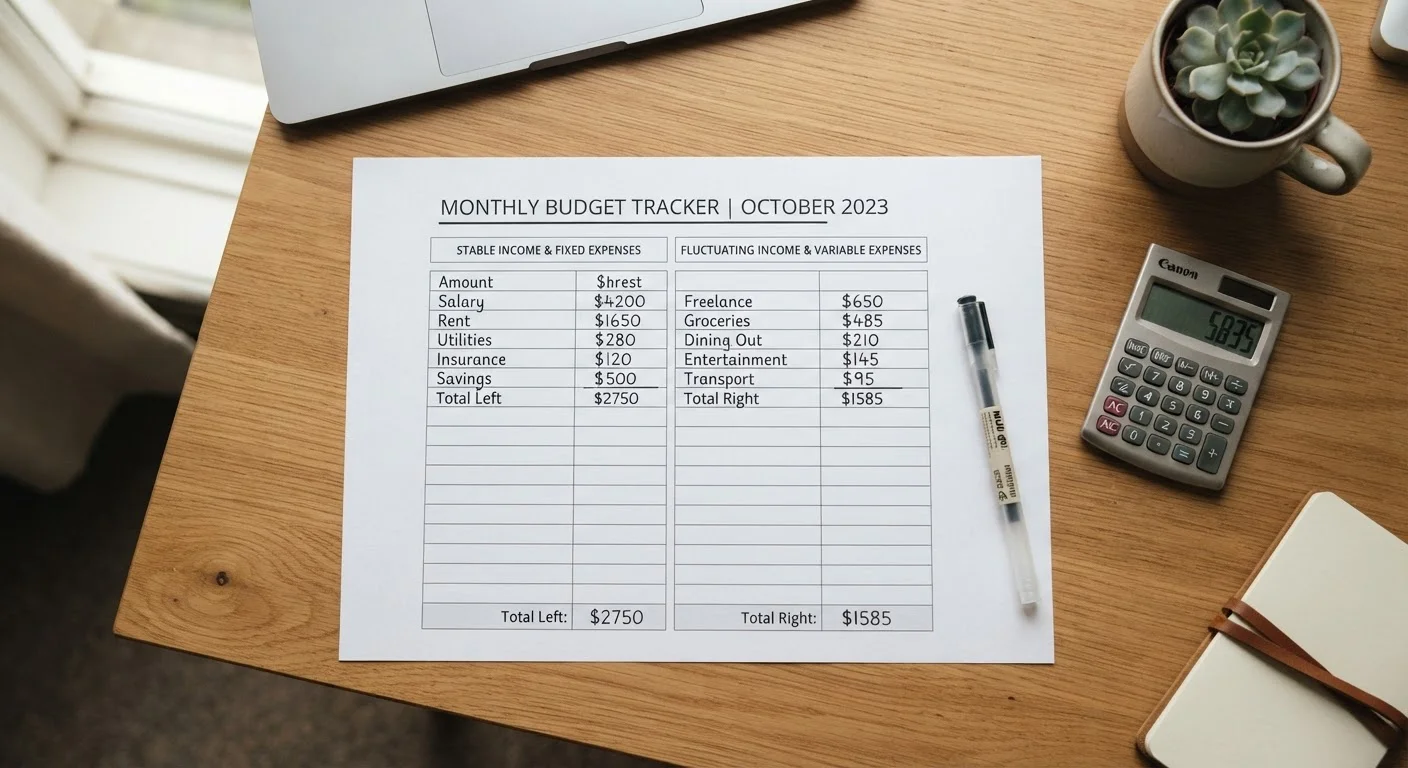
Why the Distinction Matters Before You Write a Single Budget Line
Most budgeting advice jumps straight to categories — housing, food, transportation — without explaining that not all expenses behave the same way. Some costs arrive like clockwork at an identical amount. Others swing unpredictably depending on how you live that month. Treating both the same way leads to a budget that feels accurate on paper but falls apart in practice.
Separating your expenses into fixed and variable columns isn't just an organizational habit. It's how you figure out how much flexibility you actually have — and where your real financial choices live. See our complete budgeting planning resource for a broader look at how these pieces connect.
~33%
Average share of income spent on housing
According to the U.S. Bureau of Labor Statistics Consumer Expenditure Survey, housing consistently represents the largest fixed expense category for American households.
60%+
Americans without a detailed monthly budget
Surveys by the National Financial Educators Council and similar organizations consistently find that most Americans track spending loosely rather than by formal category.
Fixed Expenses: The Non-Negotiable Floor
Fixed expenses are the costs you've already committed to — amounts that don't change regardless of how little or how much you use that month. Once you sign a lease or take out a loan, that payment is locked in until the agreement ends or you renegotiate.
Common Fixed Expenses
- Rent or mortgage payment
- Car loan or lease installment
- Insurance premiums (health, auto, renters, life)
- Minimum loan or student debt payments
- Fixed-rate subscription services
The practical value of identifying fixed expenses is straightforward: add them up and you know the absolute minimum your monthly income must cover. Everything below that number is non-negotiable without a significant lifestyle change. This is your financial floor.
List Fixed Costs Before Anything Else
When starting a new budget, write down every fixed expense and sum them before touching variable categories. This single step shows you your minimum monthly income requirement — a number many people have never calculated explicitly. If your fixed costs alone exceed a significant portion of your take-home pay, that's an important signal about where to focus first.
Variable Expenses: Where Your Real Budget Decisions Happen
Variable expenses are the costs that shift based on your behavior — how often you cook at home versus eat out, how many miles you drive, whether this is a month you need new clothes or a dentist visit. These costs aren't random, but they aren't fixed either.
Common Variable Expenses
- Groceries and household supplies
- Gasoline and transportation
- Dining and takeout
- Entertainment and recreation
- Utilities (electricity, water, gas)
- Personal care and clothing
Variable expenses are where most people either gain control of their budget or quietly lose it. The small daily habits that quietly derail a monthly budget are almost always variable — recurring small purchases that feel minor individually but compound quickly.
Building a Budget That Accounts for Both
A reliable budget starts by listing fixed expenses first. Once your non-negotiable costs are on paper, you subtract them from your monthly take-home income. What remains is your variable spending pool — the actual discretionary income available to allocate across food, transportation, lifestyle, savings, and debt payoff.
For variable categories, look at three to six months of actual bank or card statements and calculate a realistic average rather than guessing. This approach, sometimes called historical budgeting, grounds your plan in reality rather than optimism.
Frameworks like the 50/30/20 rule — where roughly 50% of take-home pay covers needs (mostly fixed), 30% covers wants (mostly variable), and 20% goes toward savings and debt — give you a starting ratio to test against your actual numbers. Adjust from there based on your own income and goals. For additional guidance on spending patterns worth building into any budget, consistent tracking is the common thread in budgets that hold.
“A budget is telling your money where to go instead of wondering where it went. The clearest way to do that is to know, upfront, which dollars are already spoken for.”
— Dave Ramsey, Personal finance author and radio host
This article is for general informational purposes only and does not constitute personalized financial advice. Consult a qualified financial professional for guidance specific to your situation.
Frequently Asked Questions
Common fixed expenses include rent or mortgage payments, car loan installments, insurance premiums, and subscription services billed at a flat monthly rate. These amounts don't change unless you renegotiate a contract or cancel a service.
Groceries, gasoline, dining out, entertainment, clothing, and utility bills are all typical variable expenses. They shift month to month based on your choices, consumption, and seasonal factors.
Variable expenses are generally easier to reduce in the short term because they're tied to discretionary choices. Fixed expenses usually require a contract change, refinancing, or cancellation — which takes more time and planning.
Review three to six months of past spending in each variable category and use the average as your monthly target. Giving yourself a range rather than a hard number can reduce the stress of months when costs run slightly higher.
Most utility bills are variable because the amount changes with usage. Some plans offer a 'budget billing' option that averages your annual usage into a flat monthly payment, which would then function as a fixed expense.
The content on this site is for informational purposes only and is not a substitute for professional advice. Always consult a qualified professional for guidance specific to your situation.