

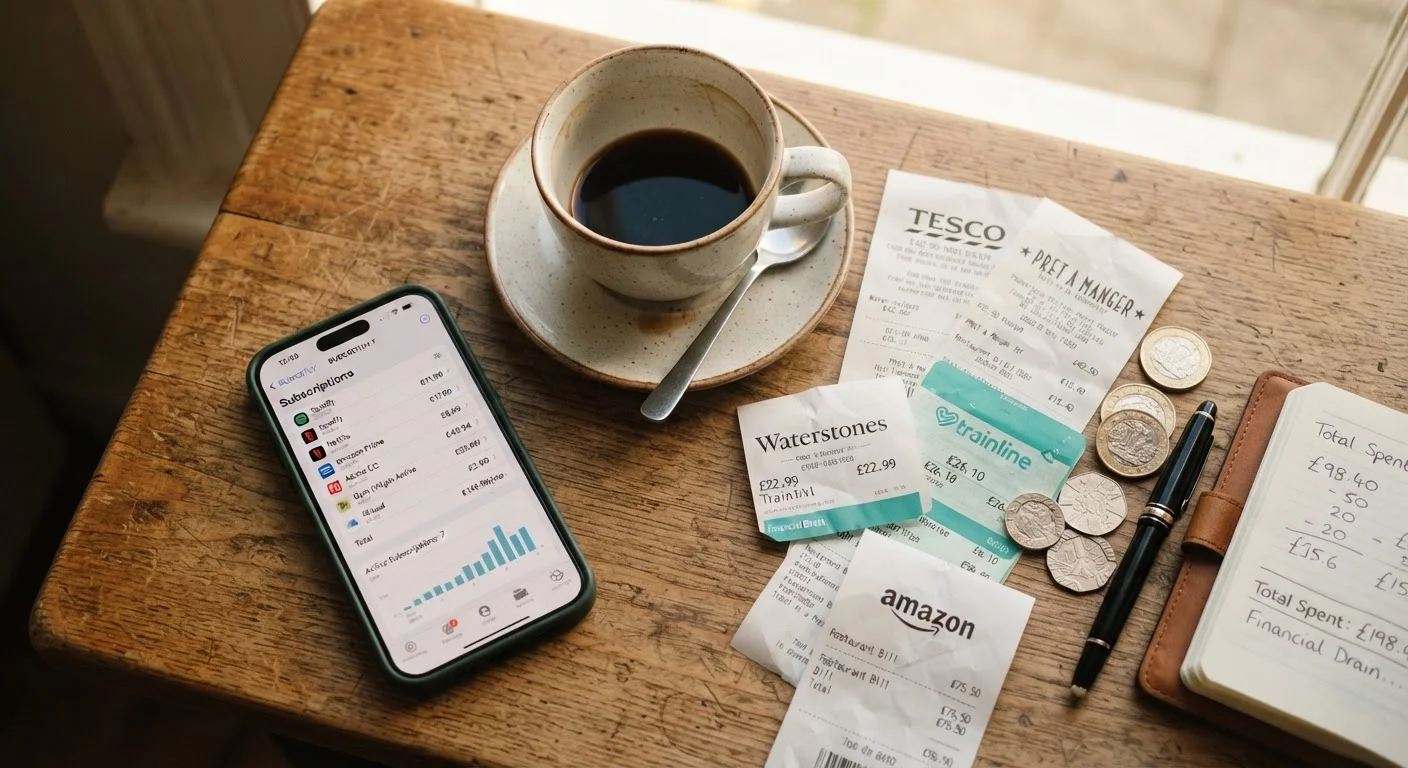
Why Small Spending Is the Hardest Kind to Control
Most people who struggle with their budget assume the problem is a single large expense — an unexpected car repair, a medical bill, or an indulgent vacation. In reality, it's usually the $6, $12, and $18 purchases that accumulate into a meaningful monthly shortfall. Because each transaction feels inconsequential, it bypasses the mental scrutiny we'd apply to a $200 purchase.
Behavioral economists describe this as the small-purchase blindspot: our brains process small expenditures differently, treating them as negligible rather than as components of a cumulative total. A daily convenience store coffee at $4.50 costs roughly $135 per month — the equivalent of a utility bill — yet rarely appears in anyone's mental budget estimate.
Understanding which daily habits quietly drain a budget is the first step toward correcting them. This isn't about eliminating enjoyment; it's about making spending decisions consciously rather than by default. For a broader look at how these patterns connect to overall budget failure, see why budgets typically collapse after month two.
Treating subscription renewals as a one-time decision rather than an ongoing cost.
Why it happens: Subscriptions are easy to sign up for and easy to forget. Auto-renewal removes the active decision each month, so the charge appears without triggering any conscious spending choice.
Paying convenience premiums repeatedly without noticing the cumulative cost.
Why it happens: Delivery fees, service charges, and ATM fees each seem minor in isolation. Because they're framed as a fee for a service rather than a discretionary purchase, they rarely register as controllable spending.
Underestimating food and beverage spending outside of grocery purchases.
Why it happens: Lunches bought near the office, gas station snacks, and weekday coffee runs happen in different locations and at different times, making them hard to group mentally as a single spending category.
Making small digital purchases impulsively without treating them as real spending.
Why it happens: App purchases, in-game transactions, digital downloads, and streaming add-ons are frictionless by design. Payment is one tap away and rarely involves entering card details, which reduces the psychological weight of the transaction.
Letting social spending drift above budget due to a failure to plan ahead.
Why it happens: Plans with friends and family are often spontaneous or upgraded in the moment — a casual dinner becomes a cocktail round, or a group trip adds activities. Social pressure makes it uncomfortable to opt out.
How to Spot and Correct These Patterns
Awareness alone rarely changes behavior — you need a system. A practical starting point is a weekly spending scan: spend five minutes every Sunday reviewing your bank and credit card transactions from the past seven days. Group charges into categories and look for anything you didn't consciously plan. This habit makes the invisible visible without requiring a complex spreadsheet.
$314
Average monthly spend on impulse purchases
A Slickdeals survey found American consumers reported spending an average of $314 per month on unplanned purchases, with small daily items being the most frequently cited category.
42%
Adults unsure how many subscriptions they pay for
Research from C+R Research found that roughly 42% of consumers had forgotten about at least one recurring subscription charge on their account.
For recurring charges specifically, pull a full 30-day statement once a month and highlight every subscription or automatic renewal. Cancel anything you haven't actively used in the past 30 days. The monthly spending audit is a structured approach to doing exactly this on a regular cadence.
On the behavioral side, introduce a simple friction rule: for any unplanned non-essential purchase under $30, wait 24 hours before completing it. This short delay interrupts the impulse loop without requiring significant willpower. You can also build positive spending patterns that make conscious choices the default rather than the exception.
Cutting Too Aggressively Can Backfire
When people discover how much small purchases are costing them, the instinct is often to eliminate the category entirely. Strict bans on coffee, takeout, or entertainment rarely hold beyond a few weeks. Instead, set a realistic weekly allowance for these categories — enough to allow occasional indulgence without open-ended spending. Sustainable reduction outperforms short-term deprivation every time.
Ultimately, small spending leaks are a structural problem, not a discipline problem. Redesigning your environment — turning off app notifications, removing saved payment info from retail sites, automating savings transfers before spending begins — addresses the root cause more reliably than trying to resist temptation each time. For strategies that build on this approach, building savings on a tight budget offers grounded, practical principles that complement a tighter daily spending practice.
This article is for general informational and educational purposes only and does not constitute personalized financial advice. Consult a qualified financial professional for guidance specific to your situation.
The content on this site is for informational purposes only and is not a substitute for professional advice. Always consult a qualified professional for guidance specific to your situation.