

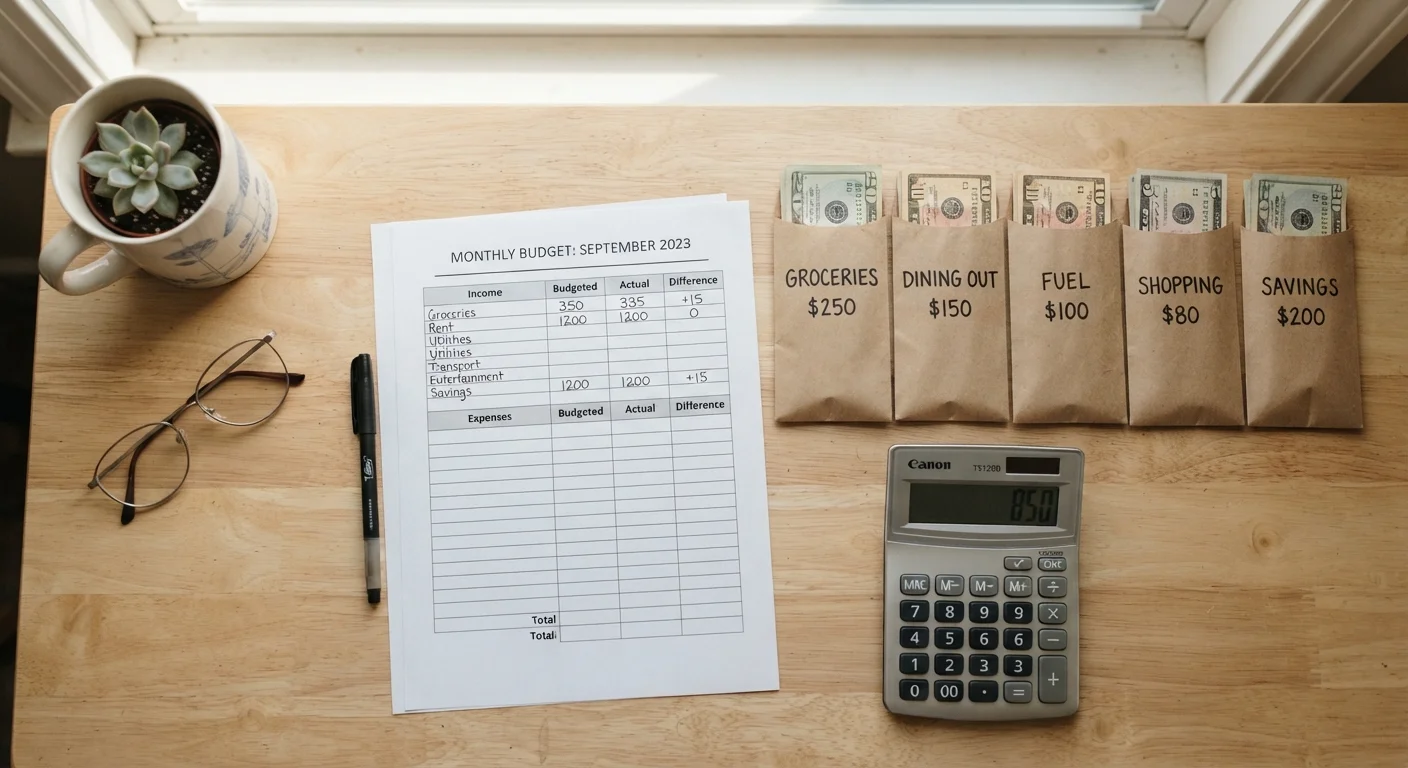
Option A
The 50/30/20 Rule
The percentage-based framework for flexible, big-picture budgeting.
Best for: People who want a simple mental model for allocating income without tracking every dollar.
Option B
Envelope Budgeting
The hands-on, category-by-category cash control system.
Best for: People who overspend in specific categories and need a physical or visual limit to stay on track.
How Each Method Works
The 50/30/20 rule divides your after-tax (take-home) income into three percentage-based buckets: 50% toward needs (rent, groceries, utilities, minimum debt payments), 30% toward wants (dining out, subscriptions, entertainment), and 20% toward savings and debt repayment. You don't track individual transactions — you monitor whether each broad category stays within its target share of income. For a deeper look at what qualifies as a need versus a want, see our 50/30/20 rule explainer.
Envelope budgeting works at the transaction level. At the start of each pay period, you divide your cash (or a digital equivalent) into labeled categories — groceries, gas, dining, clothing, and so on. Each category gets a fixed dollar amount. When the envelope is empty, spending in that category stops for the month. It's a zero-sum system: every dollar gets a home before you spend a single one.
| Criterion | 50/30/20 Rule | Envelope Budgeting |
|---|---|---|
| Structure | 3 broad percentage buckets | Multiple fixed-dollar categories |
| Tracking effort | Low — monitor category totals | High — allocate every dollar upfront |
| Flexibility | High — scales with income changes | Lower — requires monthly reallocation |
| Overspending control | Moderate — broad buckets can hide issues | Strong — empty envelope is a hard stop |
| Best payment type | Any (card, cash, digital) | Cash or digital envelope apps |
| Setup time | Minutes | 30–60 minutes per pay period |
| Ideal user | Steady earners with stable habits | Impulse spenders needing firm limits |
Practical Trade-Offs to Weigh
The 50/30/20 rule's biggest strength is its flexibility. Because it works with percentages, it scales with income changes without requiring you to recalculate every line item. Its biggest weakness: three broad buckets can mask problem spending. You might stay inside your 30% "wants" ceiling overall while quietly overspending on takeout every single week.
Envelope budgeting's greatest asset is behavioral friction — the discomfort of physically handing over cash, or seeing a near-empty envelope, slows spending in ways that mental math simply doesn't. Research in behavioral economics consistently shows that paying with cash reduces the psychological ease of spending compared to cards. The trade-off is maintenance: you need to count, allocate, and re-envelope money every pay period, which takes real time and discipline.
~33%
Americans with a detailed monthly budget
Gallup polling has consistently found that fewer than one in three U.S. adults maintains a detailed household budget, underscoring how many people operate without any formal spending framework.
18%
Reduction in spending using cash vs. cards
Multiple behavioral finance studies, including work by Drazen Prelec and Duncan Simester, found consumers tend to spend meaningfully less when paying with physical cash compared to credit or debit cards.
If you prefer writing over digital tools, envelope budgeting pairs naturally with pen-and-paper tracking, which shares similar strengths around mindfulness and low-tech reliability.
Which Method Fits Your Situation?
Neither system is universally superior. The right fit depends on two things: how detailed you need your budget to be and how much time you'll realistically invest in maintaining it.
If your finances are broadly stable — consistent income, no major debt spiral, reasonable spending habits — the 50/30/20 rule provides enough structure to stay on track without consuming your weekends. It works best as a guardrail, not a microscope.
If you have specific spending categories that repeatedly blow up your budget, envelope budgeting provides the targeted accountability the 50/30/20 rule cannot. The constraint is built into the system rather than relying on willpower.
Digital Envelope Tools Are an Option
You don't have to use physical cash to practice envelope budgeting. Several budgeting apps replicate the envelope model digitally, letting you assign dollars to virtual categories and track spending against each limit in real time. This approach captures the accountability of the envelope method while accommodating a card-based lifestyle. The cash vs. digital tracking comparison covers how these approaches stack up in practice.
You can also combine both methods: use the 50/30/20 percentages to determine how much total cash flows into your "wants" envelopes each month, then subdivide that total across individual envelopes. This hybrid approach is explored further in our budgeting methods comparison. Whatever structure you choose, the consistent habits that make any budget stick are covered in our guide to spending patterns worth building into any budget.
This article is for general informational purposes only and does not constitute personalized financial advice. Consult a licensed financial professional for guidance tailored to your individual circumstances.
The content on this site is for informational purposes only and is not a substitute for professional advice. Always consult a qualified professional for guidance specific to your situation.