

Start here
What a Budget Actually Is (and Isn't)
Next
Know Your Numbers First
Then
Choosing a Budgeting Framework
Apply it
Your First Week of Budgeting
Keep going
Building the Habit Over Time
What a Budget Actually Is (and Isn't)
A budget is a written plan that tells your money where to go before the month begins — not a record of regret after it ends. Many people avoid budgeting because they associate it with deprivation, but the opposite is closer to the truth: a budget is how you make sure the things you care about actually get funded.
What a budget is not: a guarantee of financial perfection, a tool only for people in debt, or something that requires special software or a finance degree. It is simply intentional math applied to your own income and expenses.
Net income
The money you actually take home after taxes and payroll deductions are removed — the real figure to build a budget around.
Fixed expenses
Regular monthly costs that stay the same each period, such as rent, a car loan payment, or a monthly insurance premium.
Variable expenses
Costs that change month to month based on your choices and usage, like groceries, gas, or dining out.
Discretionary spending
Money spent on non-essential wants — entertainment, hobbies, restaurants — that can be adjusted more freely than fixed obligations.
Sinking fund
A savings category you add to gradually each month to cover a known future expense, like a car repair or annual subscription.
Budget margin
The positive difference between your income and your total expenses — money available to direct toward savings or debt repayment.
If the vocabulary of personal finance still feels fuzzy, the budgeting terms glossary is a useful companion as you read on.
Know Your Numbers First
No budgeting framework works without two figures: what comes in and what goes out. Before you pick a method, spend one week collecting real data.
- Calculate your net income. Net income is your take-home pay after taxes and deductions — the actual dollars that hit your account. If your income varies, use a conservative recent average.
- List your fixed expenses. These are consistent monthly obligations: rent or mortgage, insurance premiums, loan minimums, subscriptions. Write down the exact amounts.
- Estimate your variable expenses. Groceries, gas, dining out, clothing, and entertainment shift month to month. Pull the last two or three months of bank or card statements and calculate an honest average.
- Identify irregular expenses. Annual bills, car maintenance, medical co-pays, and gifts don't show up every month but are entirely predictable over a year. Divide the yearly total by 12 and treat that amount as a monthly budget line.
Use Real Averages, Not Ideal Figures
When estimating variable expenses, pull actual bank or card statements rather than guessing what you hope to spend. Most people underestimate dining, groceries, and miscellaneous purchases by 20–30% when working from memory alone. Accurate data produces a plan that holds up in real life.
Once you have these numbers, subtract total expenses from net income. A positive result means margin to direct toward goals. A negative result means cuts or income growth are needed — and now you know exactly where to look.
Choosing a Budgeting Framework
Several structured approaches exist, each suited to different personalities and situations. The goal isn't to find the objectively best method — it's to find one you'll actually use consistently.
- 50/30/20
- Allocates roughly half of net income to needs, 30% to wants, and 20% to savings and debt repayment. It's flexible and forgiving, making it popular with beginners. High cost-of-living areas may require adjusting the ratios.
- Zero-based budgeting
- Every dollar of income is assigned a purpose until income minus allocations equals zero. Nothing is unaccounted for. It demands more active management but leaves no money drifting unintentionally. See how zero-based budgeting works for a full breakdown.
- Pay-yourself-first
- Savings and investment contributions are transferred out automatically on payday; the remainder is available for everything else. This method prioritizes building wealth before discretionary spending begins.
For a side-by-side comparison of these and other common frameworks, the budgeting methods comparison guide walks through honest trade-offs for each.
Budgeting Basics Hub
A structured collection of articles covering every stage of personal budgeting — from choosing a method to tracking spending and adjusting for life changes.
Monthly Budget Worksheet
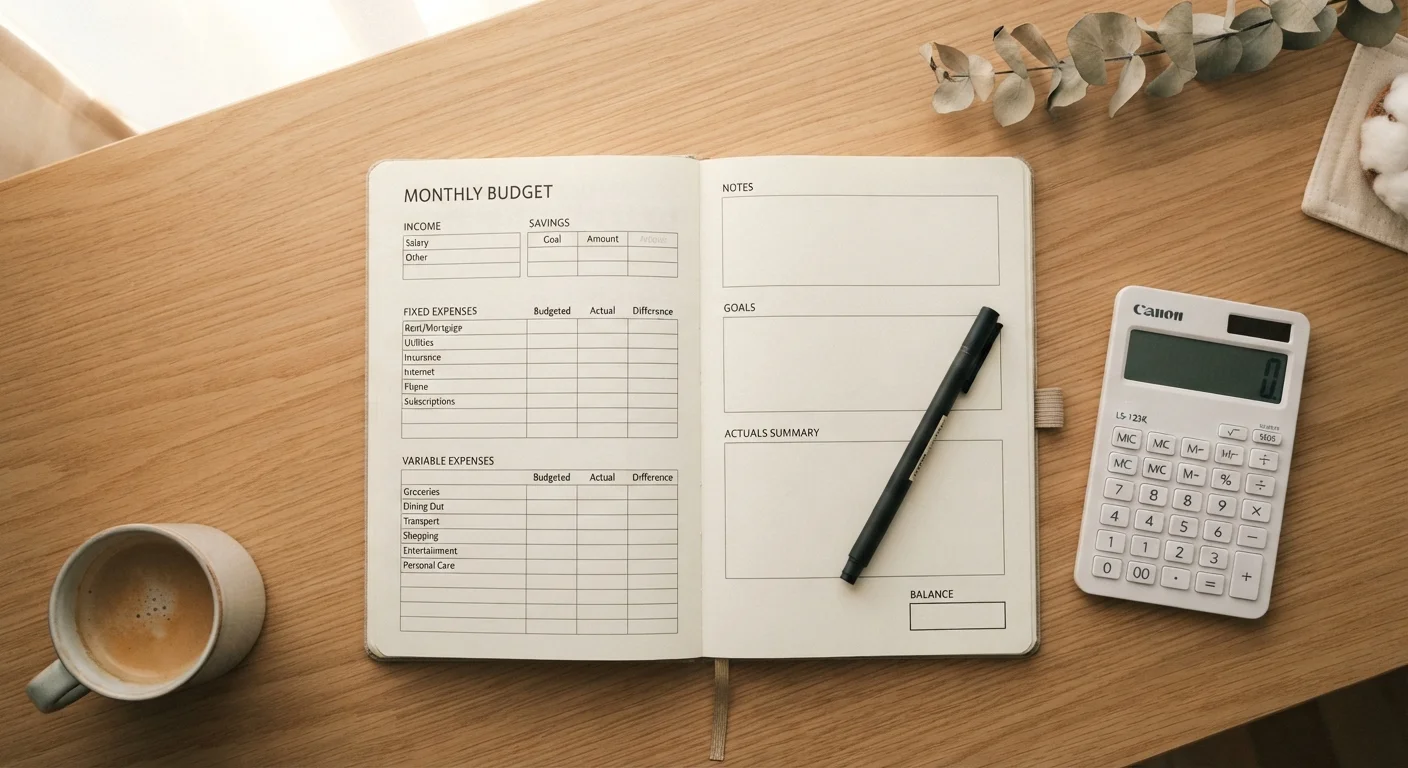
A printable or digital template for listing income, fixed expenses, variable expenses, and savings goals in one organized place — useful for your first draft budget.
Your First Week of Budgeting
The first week is not about executing a perfect plan — it's about building awareness and setting up a simple structure. Here's a realistic sequence:
- Day 1–2: Gather the income and expense data described above. Don't filter or judge yet — just collect.
- Day 3: Choose a tracking method. A spreadsheet, a notebook, or a basic app all work. The simpler the tool, the lower the barrier to using it daily.
- Day 4–5: Draft your first monthly plan using your chosen framework. Assign every expense category an amount. If the numbers don't balance on the first attempt, that's expected and normal.
- Day 6–7: Track every transaction from these two days, however small. This practice makes the plan feel real and quickly reveals categories you may have underestimated.
For a plain-language walkthrough of this setup process, your first budget in six steps picks up right where this introduction leaves off.
Don't Over-Restrict in Month One
A common beginner mistake is setting spending limits so tight that one normal expense blows up the whole plan. Build in a small buffer — often called a miscellaneous category — to absorb the unexpected costs that will inevitably appear. An overly rigid first budget is more likely to be abandoned than followed.
Building the Habit Over Time
A budget reviewed once and forgotten changes nothing. The practice that produces results is a brief weekly check-in — five to ten minutes comparing what you planned against what you actually spent.
After the first full month, expect to revise. Real spending rarely matches estimates perfectly the first time. Adjusting categories based on actual behavior isn't failure; it's how an accurate, useful budget gets built.
Over time, the habit compounds. You'll begin anticipating irregular expenses before they arrive, reducing financial surprises. Margin you didn't know existed starts appearing. Savings goals become achievable because they're funded intentionally rather than funded by whatever happens to be left at month's end.
The complete personal finance planning resource covers how to evolve your approach as your goals and income change. And if building better financial habits feels similar to building any other new routine, you may find it useful to see how those principles apply in other areas — for example, the same incremental approach described in building a fitness habit from scratch mirrors what works here.
The Budgeting Basics hub and the broader Saving & Debt section offer next steps once the monthly plan feels stable.
This article is for general informational and educational purposes only and does not constitute personalized financial advice. Consider consulting a qualified financial professional for guidance specific to your situation.
Frequently Asked Questions
You can start budgeting with any income level — there is no minimum. A budget is simply a plan for the money you already have. Even a modest income benefits from a clear spending plan.
The 50/30/20 rule suggests directing roughly 50% of after-tax income to needs, 30% to wants, and 20% to savings or debt repayment. It's a guideline, not a rigid law, and may need adjustment for your cost of living.
No — a spreadsheet or even pen and paper works fine for beginners. Apps can add convenience later, but the underlying method matters more than the tool you use to track it.
Most people find the process feels more routine after two to three months of consistent tracking. The first month is typically the hardest because you're still learning your real spending patterns.
Variable-income budgeting usually means building your plan around your lowest expected monthly income. Anything above that baseline can be allocated to savings or irregular expenses once it arrives.
No — a budget is a monthly spending plan, while an emergency fund is a savings reserve for unexpected costs. A good budget includes a line item for building that fund over time.
The content on this site is for informational purposes only and is not a substitute for professional advice. Always consult a qualified professional for guidance specific to your situation.