

Our Verdict
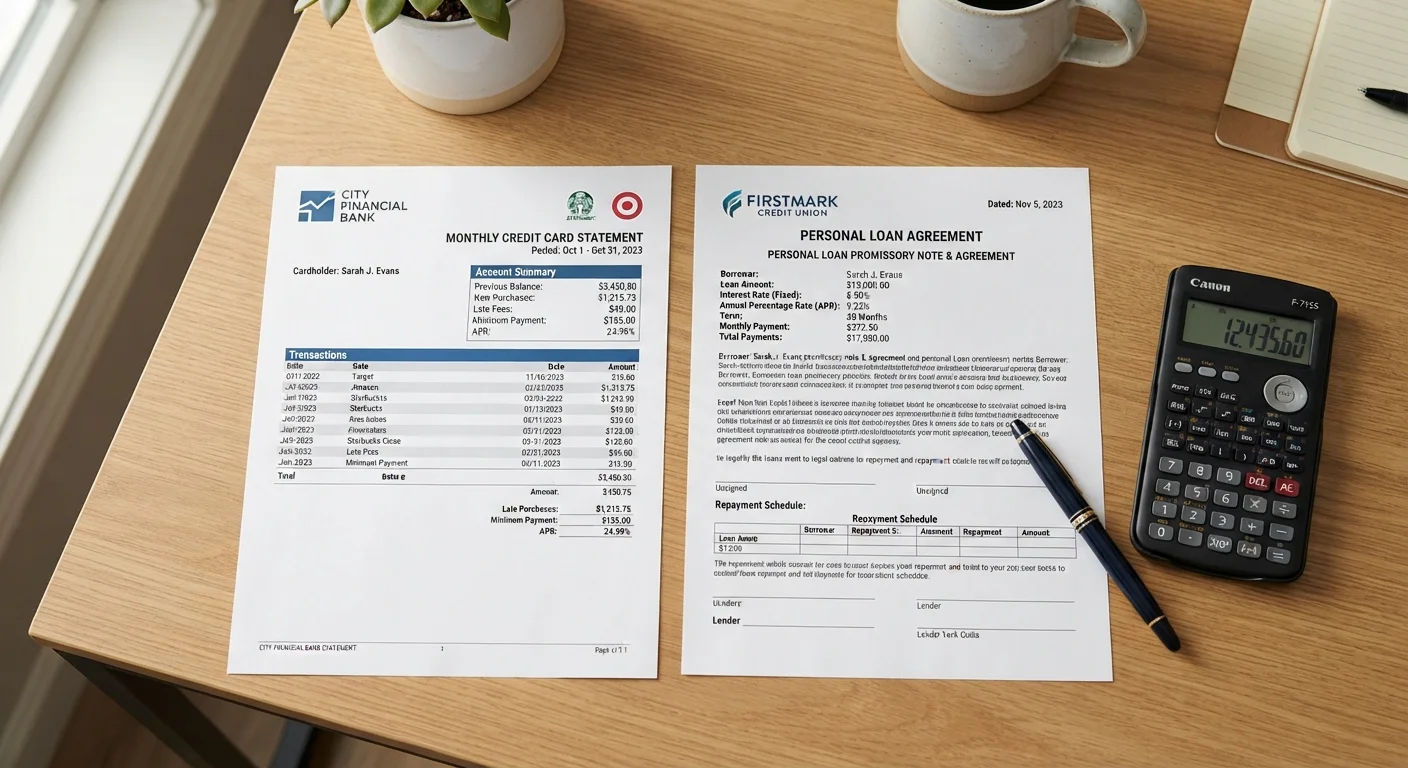
Credit card debt and personal loan debt serve different purposes and carry fundamentally different structures. Credit cards offer flexibility but often at a steep, variable interest cost; personal loans provide predictability with fixed rates and terms. Neither is inherently better — what matters is understanding how each works so you can manage or eliminate them strategically.
| Best for | Recommended |
|---|---|
| Those who want predictable monthly payments and a clear payoff timeline | Personal Loan |
| Those who need flexible, short-term purchasing access and pay balances in full monthly | Credit Card |
| Those carrying high-rate revolving debt and seeking to reduce interest costs | Personal Loan (used for consolidation) |
How Each Type of Debt Is Structured
Credit card debt is revolving debt — meaning you have a credit limit, you borrow up to it, repay some or all of it, and borrow again. There's no fixed end date. As long as you make at least the minimum payment each month, the account stays open and the remaining balance carries forward, accruing interest.
A personal loan is installment debt. You borrow a lump sum upfront and repay it in equal monthly installments over a set term — commonly 24 to 60 months. Once you've repaid the loan in full, the debt is closed. There's no revolving feature.
For a grounding in terms like APR, principal, and debt-to-income ratio, see our debt terminology reference before diving deeper.
Interest Rates: Variable vs. Fixed
This is where the two types diverge most significantly. Credit cards typically carry variable interest rates tied to the prime rate, which can change over time. Average credit card APRs have historically been well above 20%, making unpaid balances expensive to carry month to month.
Personal loans, by contrast, usually come with fixed interest rates — your rate is set at origination and doesn't change. Rates vary based on your credit profile and loan term, but they are generally lower than credit card APRs for borrowers with good credit. The fixed rate means your total interest cost is knowable from day one.
20%+
Typical average credit card APR
Federal Reserve data has consistently shown average credit card interest rates exceeding 20% in recent years for accounts assessed interest.
24–60 months
Common personal loan repayment terms
Most personal loans offered by banks and credit unions carry terms ranging from two to five years, providing a clear payoff horizon.
One important nuance: if you pay your full credit card balance every billing cycle, you pay zero interest. The high APR only matters when you carry a balance. Personal loan interest, however, accrues from the moment you receive the funds — even if you later pay ahead of schedule.
Repayment Terms and Monthly Budgeting
Credit cards have no fixed payoff date. If you make only minimum payments — typically 1–2% of the balance — you can remain in debt for years, paying far more in total interest than the original purchases cost. This open-ended structure makes budgeting harder and debt harder to visualize as finite.
Personal loans offer a clear amortization schedule: the same payment every month, with a definite end date. This predictability integrates more easily into a monthly budget. You know exactly when you'll be debt-free, which can also be motivating.
Make More Than the Minimum Payment
On credit cards, paying only the minimum can stretch a balance into years of repayment and multiply your total interest cost significantly. Even adding a modest fixed extra amount each month accelerates payoff. Treat your credit card like a short-term loan with a self-imposed due date to stay ahead of compounding interest.
If you're weighing how aggressively to tackle either type of debt, review our pre-repayment checklist to assess your readiness first.
Impact on Your Credit Score
Both debt types affect your credit profile, but in different ways. Credit cards influence your credit utilization ratio — the percentage of your available revolving credit that you're using. High utilization (generally above 30%) can lower your score. Paying down balances improves this ratio relatively quickly.
Personal loans don't factor into credit utilization the same way. They contribute to your credit mix and payment history. A consistent on-time payment record on either debt type strengthens your score over time, while missed payments damage it.
| Credit Card Debt | Personal Loan Debt | |
|---|---|---|
| Debt structure | Revolving — reusable credit line | Installment — fixed lump sum |
| Interest rate type | Variable, typically higher | Fixed, typically lower |
| Repayment timeline | Open-ended, no set payoff date | Fixed term, defined end date |
| Monthly payment | Variable; minimum payment option available | Fixed equal installments |
| Credit utilization impact | Yes — directly affects utilization ratio | No — does not affect revolving utilization |
| Best use case | Short-term purchases paid in full monthly | Planned borrowing with structured repayment |
If you're considering using a personal loan to pay off credit card balances — a common consolidation move — our article on how debt consolidation works explains the mechanics and trade-offs in detail.
Choosing a Payoff Strategy
Once you understand how each debt type works, you can apply a structured payoff approach. The two most widely used frameworks are the debt avalanche (targeting highest-interest debt first to minimize total interest paid) and the debt snowball (targeting smallest balances first for psychological momentum). Credit card debt, given its typically higher rates, often becomes the priority under an avalanche strategy.
For a side-by-side breakdown of both methods, see our guide to the debt avalanche and debt snowball.
If you hold both types of debt simultaneously, prioritize them by interest rate — not by type label. A personal loan at a high rate may cost more than a low-utilization credit card balance. Let the numbers guide your sequence, not assumptions about which debt is inherently worse.
This article is for general informational and educational purposes only and does not constitute personalized financial advice. Consult a qualified financial professional regarding decisions specific to your situation.
The content on this site is for informational purposes only and is not a substitute for professional advice. Always consult a qualified professional for guidance specific to your situation.