

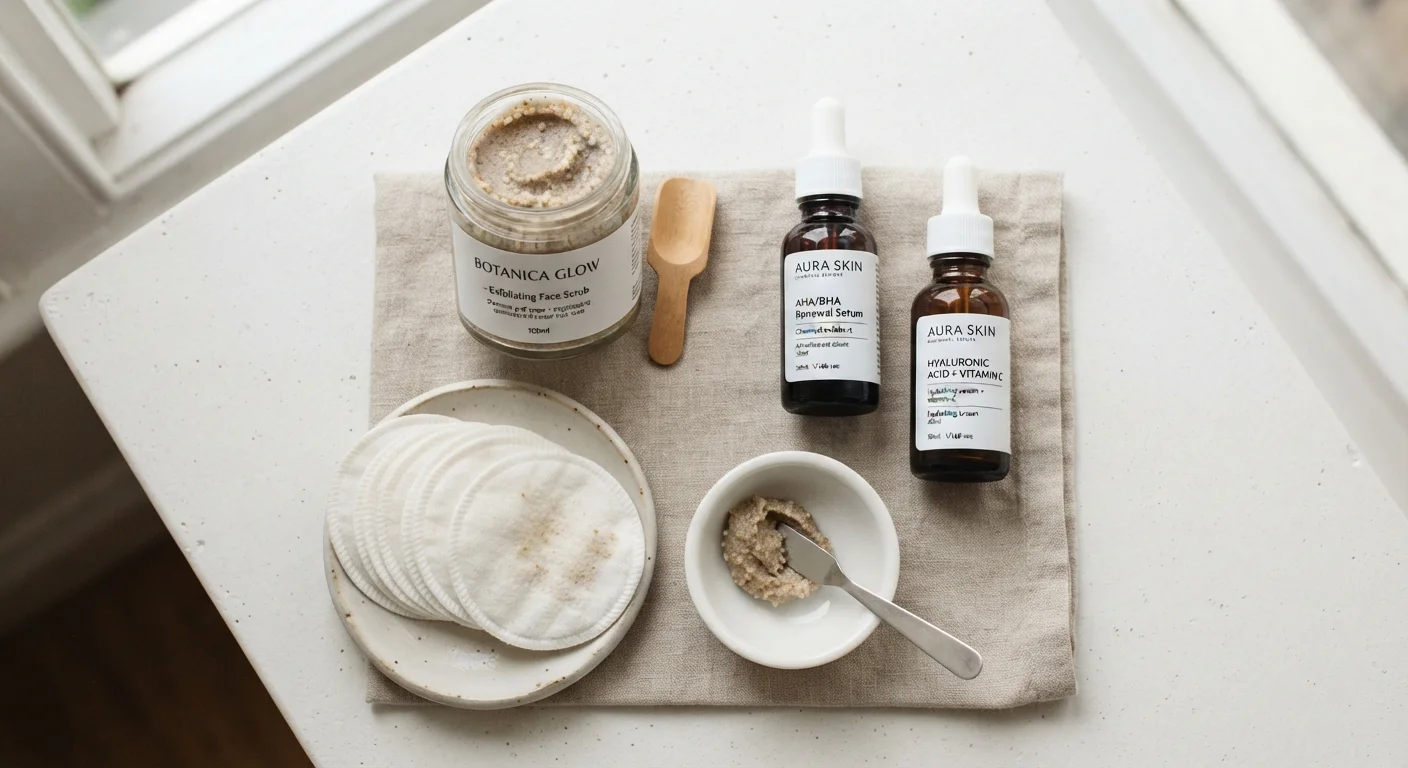
Option A
Chemical Exfoliation
The science-backed, skin-dissolving approach.
Best for: Best for most skin types seeking consistent, controlled cell turnover with less mechanical trauma.
Option B
Physical Scrubs
The tactile, immediate-results classic.
Best for: Best for normal, non-sensitized skin when used with fine-grain formulas and a very light hand.
How Each Method Actually Works
Exfoliation — the process of removing dead cells from the skin's outermost layer — sounds straightforward, but the biology underneath it matters. The skin naturally sheds cells through a process called desquamation, which slows with age and can be disrupted by dry or humid conditions, hormonal shifts, and certain skin types. Both exfoliation methods accelerate that turnover, just through completely different pathways.
Chemical exfoliants use acids or enzyme compounds to break apart the desmosomes — the protein bonds that keep dead skin cells attached to the surface. Alpha-hydroxy acids (AHAs), such as glycolic and lactic acid, are water-soluble and work mainly on the skin's surface layer, loosening cell bonds and improving texture and tone. Beta-hydroxy acids (BHAs), most commonly salicylic acid, are oil-soluble, meaning they can travel through sebum and into the pore lining — which is why dermatologists frequently recommend them for acne-prone and oily skin types. A newer category, polyhydroxy acids (PHAs), work similarly to AHAs but with larger molecular structures that penetrate more slowly, producing less potential irritation.
Physical scrubs work entirely through friction. The abrasive particles in the formula — which can range from finely milled sugar to coarser walnut shell powder or synthetic microbeads (now banned in rinse-off products in the U.S. under the Microbead-Free Waters Act of 2015) — physically dislodge dead cells when rubbed across the skin. The result is immediately visible smoothness, but the mechanism is far less precise than a chemical reaction. Pressure, grain size, and skin condition all determine whether you're getting gentle resurfacing or inadvertent micro-damage.
Understanding your own skin type is a prerequisite for choosing between these two approaches. Skin Types Decoded walks through how to identify yours and why it matters for building an effective routine.
Risk Profiles: Where Each Approach Can Go Wrong
| Criterion | Chemical Exfoliation | Physical Scrubs |
|---|---|---|
| Mechanism | Dissolves cell bonds via acids | Physically abrades surface cells |
| Precision | Controlled by concentration and pH | Depends on grain size and applied pressure |
| Pore penetration | BHAs reach inside pores | Surface-only action |
| Micro-tear risk | Low (no abrasion) | Moderate to high with coarse grains |
| UV sensitivity increase | Yes — especially AHAs | Minimal, indirect |
| Suited for sensitive skin | PHAs are the gentlest option | Generally not recommended |
| Evidence for pigmentation | Strong (glycolic, mandelic, lactic) | Limited |
| Frequency guidance | 1–3x/week depending on strength | 1–2x/week maximum |
Physical scrubs are frequently associated with micro-tears — tiny abrasions in the skin surface that compromise the barrier and can introduce bacteria into open pores. This risk is highest with coarse-grain formulas, harsh scrubbing motions, or use on already-compromised skin. The beauty industry has long marketed physical exfoliation as universally beneficial, but dermatology literature is more cautious, particularly for anyone dealing with acne, eczema, or rosacea.
Chemical exfoliants carry their own risks, primarily around over-exfoliation and photosensitivity. AHAs, in particular, have been shown in published research to increase UV sensitivity, which is why daily broad-spectrum SPF is considered non-negotiable after using them. Concentration matters significantly: a 5% glycolic acid toner used twice weekly differs substantially in intensity from a 20% in-office peel. Without attention to frequency and concentration, the skin barrier can become compromised — a state that shows up as persistent redness, stinging, flaking, and increased breakouts. For a deeper look at how to layer chemical actives without triggering that kind of reaction, see Active Ingredients: How to Layer Them Without Wrecking Your Skin Barrier.
8%+
AHA concentration triggering UV sensitivity
The U.S. FDA has noted that AHA concentrations of 8% or more at certain pH levels can measurably increase photosensitivity, warranting sunscreen guidance on product labeling.
~28 days
Natural skin cell turnover cycle (adult average)
Dermatology textbooks cite roughly a 28-day epidermal turnover cycle in young adults, a rate that slows with age — one reason exfoliation becomes more commonly discussed as part of adult skincare.
One often-overlooked consideration: both methods become more consequential if your skin barrier is already weakened. If you're experiencing unusual dryness, tightness, or sensitivity, pausing all exfoliation and focusing on barrier repair first is the more protective choice.
Choosing, Combining, and Knowing When to Stop
Neither method is universally superior — the right choice depends on skin type, concern, and how your skin responds over time. That said, chemical exfoliation is generally considered more controllable: you can start at a low concentration and adjust, and the mechanism is independent of how hard you press or how long you scrub.
If you choose a physical scrub, a few practical principles reduce risk: use the finest grain available, apply with minimal pressure, limit use to once or twice per week on non-irritated skin, and never use it on active breakouts or open skin. If you opt for chemical exfoliation, start with a lower-potency formulation, introduce it slowly, and always follow with sunscreen the next morning.
Combining both methods — using a chemical exfoliant on some days and a physical scrub on others — is something many people do, but it raises the cumulative exfoliation burden on the skin barrier. If you do both, frequency for each should decrease accordingly. Signs that you've overdone it include a shiny or "tight" feeling without adequate moisture, burning when applying otherwise-mild products, or a sudden uptick in breakouts.
For those using exfoliation to address dark spots or uneven tone, chemical exfoliants have a more established evidence base. Hyperpigmentation, Dark Spots, and Melasma explains the distinctions between those concerns and how different approaches apply to each.
Whichever path you choose, exfoliation is just one piece of a broader routine. The Everyday Skincare Routine, Built from Scratch provides a practical framework for integrating it without overcomplicating your regimen.
This article is for general informational purposes only and does not constitute medical or dermatological advice. If you have a skin condition or concerns about a reaction, consult a qualified dermatologist or healthcare professional.
The content on this site is for informational purposes only and is not a substitute for professional advice. Always consult a qualified professional for guidance specific to your situation.