

Why Small Habits Add Up to Big Hair Problems
Hair damage rarely announces itself all at once. More often, it's the accumulation of small, repeated choices — how you sleep, how you tie your ponytail, what's in your tap water — that quietly erode hair health over months and years. By the time the breakage, thinning, or dullness becomes obvious, the underlying habit has been running unchecked for a long time.
Understanding where the damage actually comes from is the first step toward stopping it. The habits below are common, often overlooked, and genuinely correctable without a salon appointment or expensive overhaul. For a deeper look at how different damage types behave and what recovery realistically involves, see our guide on hair damage types and recovery.
Wearing tight hairstyles too frequently
Ponytails, buns, and braids pulled tightly place sustained tension on the hair follicle. Over time, this repeated stress can lead to traction alopecia — a gradual, preventable form of hair loss most commonly seen along the hairline and temples. It develops slowly, which is exactly why it's so easy to miss until significant thinning has occurred.
Alternating hairstyle placement, using fabric-covered elastics instead of rubber bands, and building in regular low-manipulation days all meaningfully reduce cumulative follicle stress. For a balanced look at how different styling approaches affect the hair, see our overview of protective styles and styling trade-offs.
Traction alopecia develops slowly — often long before the thinning becomes visible to the eye.
Brushing hair when it's fully wet
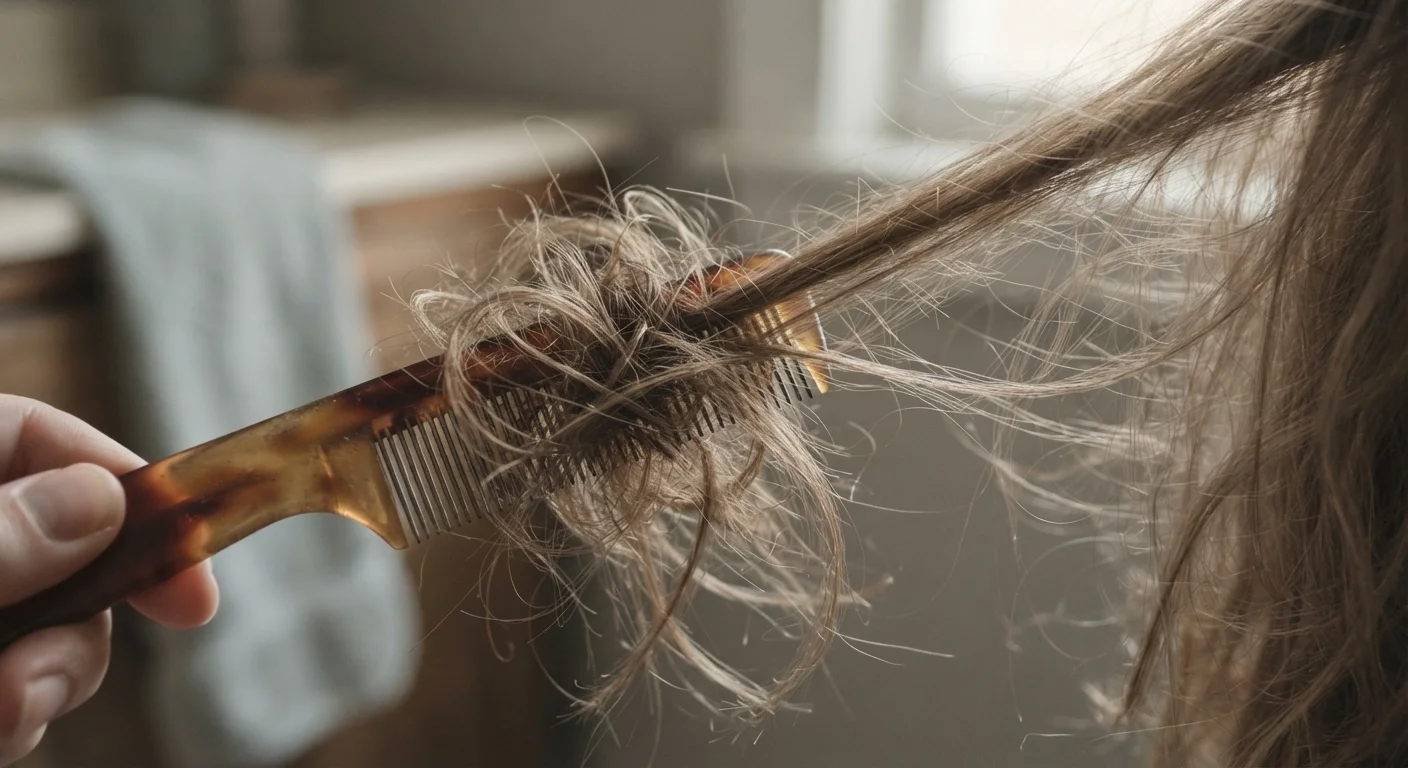
Wet hair is in its most vulnerable state. The hydrogen bonds that give hair its structural integrity are temporarily weakened by water, making strands significantly more elastic and prone to snapping under mechanical force. Running a standard brush through soaking-wet hair generates the kind of tension that causes breakage, not just tangles.
If you need to detangle after washing, a wide-tooth comb or a brush specifically designed for wet use — worked from ends to roots — dramatically reduces the mechanical stress. Applying a leave-in conditioner or detangler before combing adds slip and further lowers the risk. Understanding whether what you're seeing is breakage or shedding can also help you respond appropriately — our guide on hair shedding vs. breakage walks through the difference.
Wet hair is far more elastic and snap-prone — mechanical force at this stage causes disproportionate breakage.
Ignoring hard water buildup
Hard water — water with elevated concentrations of dissolved minerals like calcium and magnesium — is common across much of the United States. When hard water is used to wash hair regularly, mineral deposits accumulate on the hair shaft, leaving it feeling rough, appearing dull, and resisting moisture absorption. Over months, this buildup can weaken the cuticle layer and make hair increasingly difficult to manage.
A chelating or clarifying shampoo used periodically can dissolve mineral deposits that regular shampoo leaves behind. This is a simple, low-cost adjustment that many people skip simply because they don't connect their water supply to their hair's behavior.
Mineral deposits from hard water accumulate quietly on the hair shaft, dulling it and blocking moisture over time.
Sleeping on a rough pillowcase
Cotton pillowcases create friction as you move during sleep — and most people move considerably throughout the night. That repeated friction acts like fine sandpaper on the hair cuticle, roughing up the outer layer of each strand gradually. The result over time is increased frizz, dullness, and susceptibility to breakage, particularly for those with fragile, textured, or chemically treated hair.
Satin or silk pillowcases reduce surface friction significantly. A loose satin bonnet or scarf achieves the same effect at lower cost. Neither solution requires changing your entire routine — just the surface your hair contacts for seven or eight hours each night.
Eight hours of nightly friction against rough cotton is one of the most underestimated sources of cuticle damage.
Skipping regular trims to preserve length
The logic seems sound: avoid cutting hair to keep it longer. In practice, split ends don't stop at the tip. Once a strand splits, the damage travels upward along the shaft — and the longer it's left unaddressed, the further it progresses. Attempting to retain length by avoiding trims often results in more length loss later, when more of each strand must be removed to get back to healthy hair.
Trimming frequency depends on hair type, styling habits, and how much heat or chemical processing is involved — there's no universal schedule. But leaving splits to migrate unchecked is consistently counterproductive to length retention goals.
Split ends left uncut travel up the shaft — avoiding trims almost always costs more length in the long run.
Using heat tools without adjusting temperature
Many people default to the highest heat setting on flat irons and curling wands, reasoning that it works faster. Higher heat does style more quickly — but fine, color-treated, or already-compromised hair can sustain significant structural damage at temperatures that thicker, virgin hair handles more easily. The habit of using one setting for all hair states and textures quietly accumulates thermal damage over time.
Using the lowest effective temperature for your specific hair type, applying a heat protectant beforehand, and limiting the number of passes over each section all reduce thermal stress without necessarily sacrificing results. For a thorough comparison of heat versus no-heat approaches, our article on air drying vs. blow drying trade-offs examines what the research and technique actually suggest.
Defaulting to maximum heat regardless of hair type is one of the most common and correctable sources of thermal damage.
Neglecting the protein-moisture balance
Hair needs both structural protein and adequate moisture to remain resilient and elastic. Leaning too heavily on one without the other creates problems: excess protein makes hair stiff and prone to snapping, while insufficient protein leaves it limp and overly stretchy under tension. Many people don't realize their routine is chronically skewed in one direction until they start noticing these symptoms.
Reading how your hair responds — does it feel mushy and lack elasticity, or brittle and rough? — is a more reliable guide than following a fixed schedule. Our article on protein treatments and moisture balance explains how to interpret these signals and adjust accordingly.
An unchecked protein-moisture imbalance can make hair brittle or limp — and the fix depends on knowing which way you're skewed.
Building Better Habits Without Starting from Scratch
None of these habits require a complete lifestyle overhaul to fix. Most corrections are small adjustments — switching a hair tie, lowering heat settings, adding one clarifying wash per month — that compound positively over time, just as the damaging habits compounded negatively. If you're unsure where persistent dryness or fragility is coming from even after making changes, it may point to deeper imbalances. Our article on why hair feels persistently dry explores causes that products alone can't resolve.
Start With One Change at a Time
When multiple habits need adjusting, trying to overhaul everything simultaneously makes it harder to identify what's actually working. Pick the habit most relevant to your current hair concerns — whether that's friction from your pillowcase or heat tool temperature — and give it four to six weeks before adding another change. Hair grows and responds slowly, and patience with incremental adjustments tends to yield clearer results than wholesale routine changes.
If you want to put these corrections into a practical structure, a weekly hair care routine can help you organize washing, conditioning, and styling in a way that protects rather than stresses your hair over time.
This article is for general informational purposes only and does not constitute medical advice. If you are experiencing significant hair loss or scalp changes, consult a qualified healthcare professional or dermatologist.
The content on this site is for informational purposes only and is not a substitute for professional advice. Always consult a qualified professional for guidance specific to your situation.