

Option A
Tire Rotation
The preventive wear-management service every driver needs regularly.
Best for: Drivers who want to maximize tire lifespan and maintain even tread wear across all four tires.
Option B
Wheel Balancing
The precision fix for vibration and uneven rolling weight distribution.
Best for: Drivers experiencing steering wheel vibration, uneven tread wear patterns, or after mounting new tires.
What Each Service Actually Does
These two services are often lumped together or confused - sometimes shops offer them as a package, which adds to the blur. But tire rotation and wheel balancing solve fundamentally different problems.
Tire rotation means physically moving each tire to a different position on the vehicle - front-left to rear-left, for example, or crossing axles depending on the vehicle's drivetrain and tire type. The reason: tires wear at different rates depending on where they sit. Front tires on a front-wheel-drive vehicle, for instance, handle steering, braking, and engine power delivery simultaneously, which accelerates their wear compared to the rear tires. Rotating on a regular schedule levels out this disparity and helps all four tires wear down at roughly the same rate, stretching the life of the full set. See our complete guide to your car's maintenance schedule for context on how rotation fits within broader service intervals.
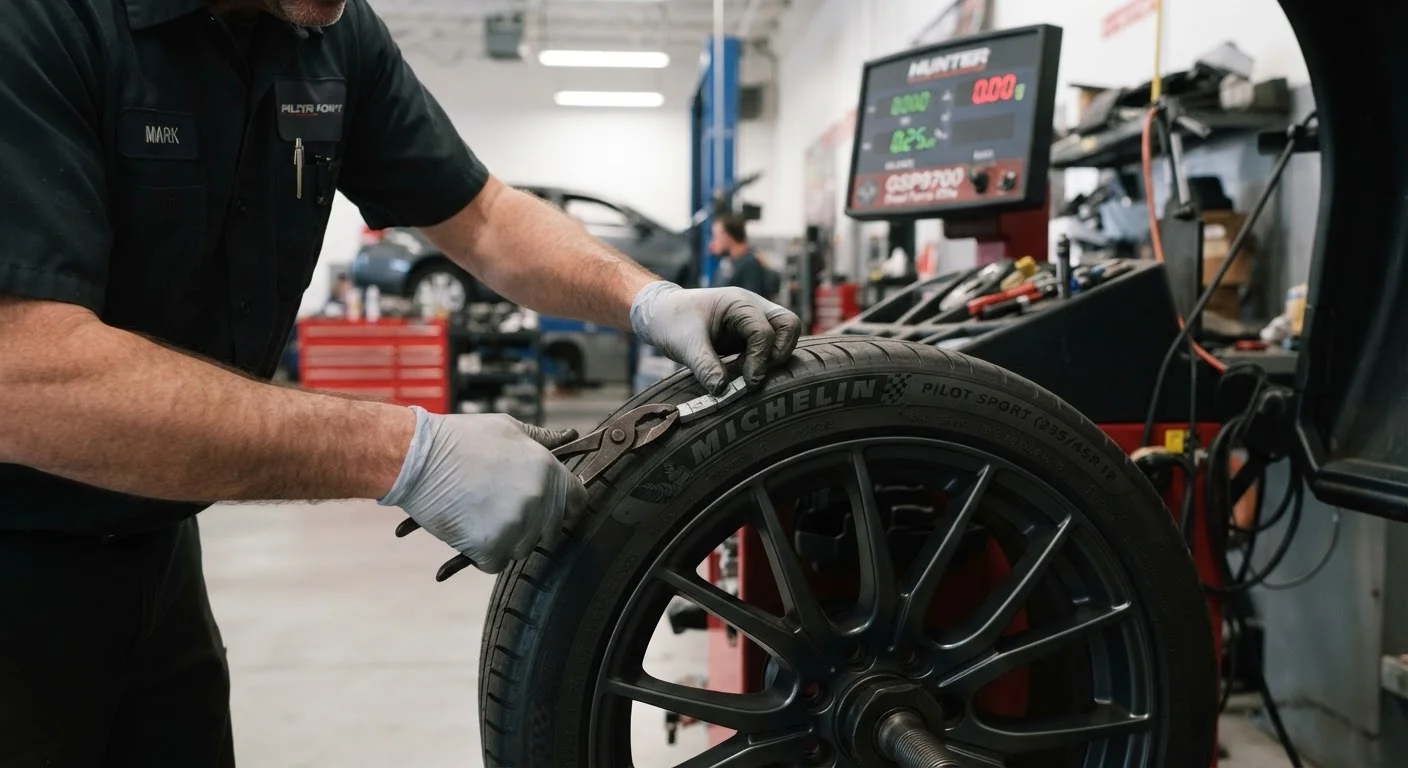
Wheel balancing, by contrast, doesn't move tires between positions. Instead, a technician mounts each wheel-and-tire assembly on a balancing machine that spins it and measures where the weight is unevenly distributed. Small counterweights are then attached to the rim to correct the imbalance. Even new tires fresh from the factory aren't perfectly uniform in weight - tiny variations in rubber thickness or rim manufacturing can cause an assembly to wobble at speed, producing vibration felt through the steering wheel or floorboard.
| Criterion | Tire Rotation | Wheel Balancing |
|---|---|---|
| What it fixes | Uneven tread wear across tire positions | Uneven weight distribution in a tire-wheel assembly |
| How it works | Tires moved to different positions on the vehicle | Counterweights added to the rim to balance spin |
| Typical interval | Every 5,000-7,500 miles | When symptoms arise or new tires are mounted |
| Key warning sign | Tires wearing unevenly across the full set | Vibration at highway speeds; scalloped tread |
| Equipment needed | Lift and basic tools | Specialized balancing machine |
| DIY feasibility | Possible with proper tools and knowledge | Requires shop equipment; not practical at home |
When You Need Each One - and the Warning Signs
Knowing the right interval for each service helps you stay ahead of problems rather than chasing symptoms.
Rotation intervals: Most vehicle manufacturers and tire makers suggest rotating tires every 5,000 to 7,500 miles, though your owner's manual is the authoritative source for your specific vehicle. Many drivers align rotations with oil changes for convenience. There often aren't dramatic warning signs that you're overdue - tread wear differences can be subtle at first. Visually inspecting tires for uneven wear patterns across the width of the tread (one edge wearing faster than the other, or front tires significantly more worn than rears) is a good habit to build. Our guide to checking your tire pressure correctly includes tips on what to look for when you're examining your tires.
Balancing triggers: Unlike rotation, balancing is typically reactive - you do it when you notice a problem or after a specific event. Key situations that call for balancing include:
- Vibration felt in the steering wheel, seat, or floor at highway speeds (typically above 50-60 mph)
- New tire installation or tire remounting
- After hitting a significant pothole or curb
- Unusual tread wear patterns - cupping or scalloping along the tire surface
Don't Confuse Balancing With Alignment
Wheel balancing and wheel alignment are two distinct services that address different issues. Balancing corrects weight distribution within the tire-wheel assembly. Alignment adjusts the angles of the wheels relative to the vehicle and road surface - a suspension-level adjustment. Both matter for tire longevity and handling, but they require different equipment and target different problems. If you're unsure which your vehicle needs, describing your symptoms to a qualified technician is the best starting point.
It's worth noting that wheel balancing and wheel alignment are also two different services. Alignment addresses the angle at which tires contact the road and is a separate adjustment performed on the suspension - not the tire-wheel assembly itself.
Cost, Frequency, and Practical Takeaways
Both services are relatively affordable compared to the cost of replacing tires prematurely. Rotation is typically a quick, low-cost procedure - often performed in under 30 minutes. Balancing adds a bit more time since each assembly must be individually measured and adjusted, but it's still a routine shop task rather than a major repair.
The clearest practical takeaway: these services are complements, not substitutes. A shop that rotates your tires is not simultaneously balancing them. If you've been getting regular rotations but have never had your wheels balanced, or vice versa, it's worth discussing both with your technician during your next visit. For a broader look at which maintenance tasks make sense to handle yourself versus leaving to a professional, our article on DIY car maintenance tradeoffs offers an honest breakdown.
5,000-7,500 mi
Recommended tire rotation interval
Most vehicle manufacturers and tire industry guidelines suggest rotating tires within this mileage range, though always defer to your owner's manual.
~$10-$20
Typical cost per tire for balancing
General industry pricing estimates suggest per-tire balancing costs in this range, though shop rates and location vary.
Keeping up with both services - on schedule and when symptoms arise - is one of the simplest ways to protect your tire investment, maintain fuel efficiency, and ensure a safe, comfortable ride on American roads.
The content on this site is for informational purposes only and is not a substitute for professional advice. Always consult a qualified professional for guidance specific to your situation.