

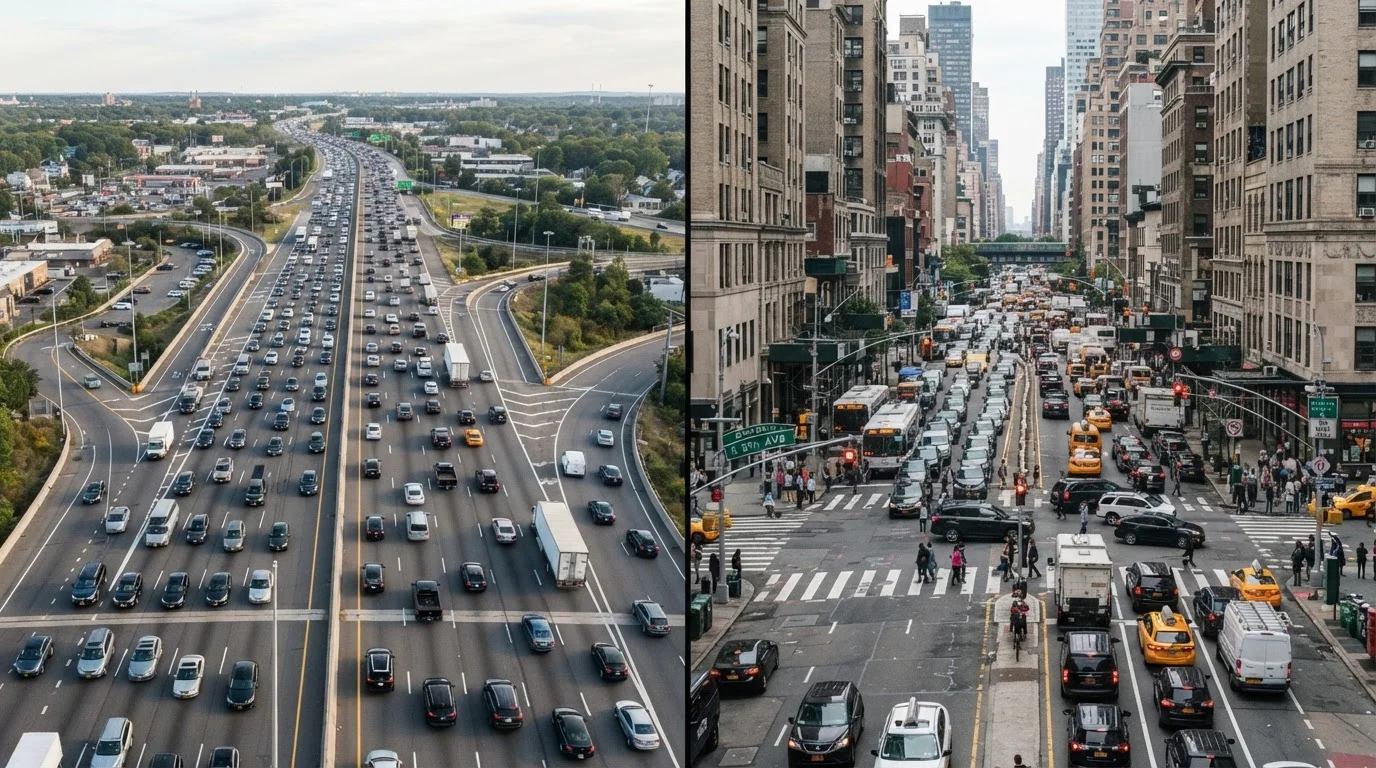
Option A
Highway Driving
High-speed, sustained-attention driving with fewer but more severe crash risks.
Best for: Covering long distances efficiently, but demands strong lane discipline, merging skills, and fatigue management.
Option B
City Driving
Lower-speed, high-complexity driving with constant decision-making demands.
Best for: Short urban trips requiring sharp situational awareness, pedestrian vigilance, and precise maneuvering at intersections.
Why the Two Environments Demand Different Mental Modes
Most drivers assume experience in one environment transfers seamlessly to the other. It largely does - but the gaps in that transfer are where crashes happen. Highway and city driving require fundamentally different types of attention, and recognizing which mode you need to be in before you enter a road type is the first step toward driving it safely.
Highway driving asks you to sustain long-horizon focus: scanning far ahead, managing speed relative to other vehicles, and making fewer but higher-stakes decisions - like merging at 65 mph. City driving demands rapid close-range scanning: pedestrians stepping off curbs, cyclists filtering between lanes, signal changes, and tight gaps that require constant split-second judgments.
Neither is strictly harder - they're differently demanding. Drivers who rarely leave the suburbs can be rattled by dense highway traffic; lifelong city drivers can underestimate how fast closure rates develop at freeway speeds. The solution is knowing what each environment asks of you before you're in it. For drivers still building that awareness, foundational road safety habits are worth revisiting regardless of experience level.
| Criterion | Highway Driving | City Driving |
|---|---|---|
| Typical speed range | 55-80 mph | 15-45 mph |
| Crash frequency per mile | Lower overall rate | Higher overall rate |
| Crash severity | Higher - more fatal outcomes | Lower - more fender-benders |
| Primary hazard type | Speed, merging, fatigue | Intersections, pedestrians, cyclists |
| Decision frequency | Low - fewer but bigger decisions | High - constant small decisions |
| Pedestrian/cyclist risk | Minimal to none | Significant and constant |
| Fatigue risk | High - monotony accelerates fatigue | Moderate - engagement keeps alertness up |
| Following distance needed | 3-4 seconds minimum | 2-3 seconds minimum |
Highway Hazards: Speed, Fatigue, and the Merge
The defining feature of highway danger is kinetic energy. At 70 mph, a vehicle traveling requires significantly more distance to stop than at 30 mph - and the consequences of a collision scale sharply with speed. Yet highway crash rates per mile are generally lower than city rates, because traffic flows in one direction, intersections are eliminated, and pedestrians are absent.
What raises the stakes: when things do go wrong on a highway, they go wrong fast and with little room for correction. The three most dangerous moments on a highway are merging onto the roadway, lane changes in dense traffic, and late-trip fatigue. On ramp merging requires matching speed to the flow of traffic while identifying a gap - a skill many drivers underestimate. Common merging errors include merging too slowly, failing to check blind spots, and stopping at the end of an acceleration lane.
Fatigue is a compounding factor unique to long highway trips. Monotonous conditions - steady speed, minimal steering input, unchanging scenery - accelerate cognitive fatigue faster than city driving. Drowsy driving impairs reaction time in ways that mirror alcohol impairment, yet many drivers press on rather than pull over.
~33%
Highway share of total crash fatalities
According to NHTSA data, interstates and freeways account for a disproportionate share of fatal crashes relative to total vehicle miles traveled on those roads.
40%
Urban intersection-related crash share
The Federal Highway Administration has noted that a significant proportion of all urban crashes occur at or near intersections, reflecting the complexity of those environments.
3-4 sec
Recommended following distance at highway speeds
Traffic safety organizations consistently recommend a minimum three-to-four-second following distance on highways, increasing in adverse conditions.
City Hazards: Intersections, Pedestrians, and Decision Density
City driving packs more potential conflict points into a single mile than any other environment. A typical urban mile can involve multiple signalized intersections, mid-block crosswalks, parallel parking zones, delivery vehicles, cyclists, and pedestrians - each requiring an active response. The sheer volume of decisions per minute is what makes city driving exhausting and, statistically, where more crashes occur in absolute numbers.
Intersections are the highest-risk location in urban environments. The combination of crossing traffic paths, turning vehicles, and pedestrians with the right of way creates overlapping hazard zones. A leading cause of city crashes is drivers entering an intersection on a stale green light - one that has been green long enough that it's likely to change - without accounting for cross-traffic that may jump the light.
Pedestrians and cyclists add another layer. Unlike highway environments, urban road users are frequently unprotected and unpredictable. Children, people with mobility devices, and individuals crossing mid-block are common in dense neighborhoods. Scanning door zones alongside parked cars and anticipating pedestrians who haven't yet stepped off the curb are habits that separate experienced city drivers from reactive ones. See how this connects to sharing the road with vulnerable users for a fuller picture.
Speed Adaptation After Highway Exits
When you exit a highway and enter city streets, your brain's sense of normal speed is temporarily recalibrated to freeway conditions. As a result, 35 mph can feel much slower than it actually is. Actively check your speedometer in the first few blocks after exiting a highway rather than relying on how speed feels. This simple habit can prevent you from inadvertently carrying dangerous speed into pedestrian-heavy zones.
The Transition Moments Most Drivers Ignore
One of the most overlooked risk points in driving is the transition between environments - specifically, the highway exit ramp leading into city streets, and the on-ramp acceleration from a stop. These transitions require a rapid shift in mental mode that many drivers don't consciously make.
After 45 minutes on a highway at 70 mph, exiting onto a 35 mph city street often feels slower than it actually is. Speed perception becomes calibrated to highway conditions, causing drivers to carry more speed into urban intersections than they realize. This effect - sometimes called speed adaptation - is responsible for a meaningful number of post-highway urban collisions.
Going the other direction, drivers entering a highway from a low-speed road must accelerate decisively and read traffic gaps accurately. Hesitation on an acceleration lane is one of the most dangerous things a driver can do, as it disrupts the speed-matching process that makes merging safe. Weather compounds both transitions: rain, fog, and snow affect stopping distances and visibility in ways that hit hardest at transition points. Be mindful of how your driving environment is also affected by night driving conditions, which amplify the hazards in both settings.
This article is for general informational purposes only and does not constitute professional driving instruction or legal advice. Always follow the traffic laws applicable in your state and consult a certified driving instructor for personalized guidance.
The content on this site is for informational purposes only and is not a substitute for professional advice. Always consult a qualified professional for guidance specific to your situation.