

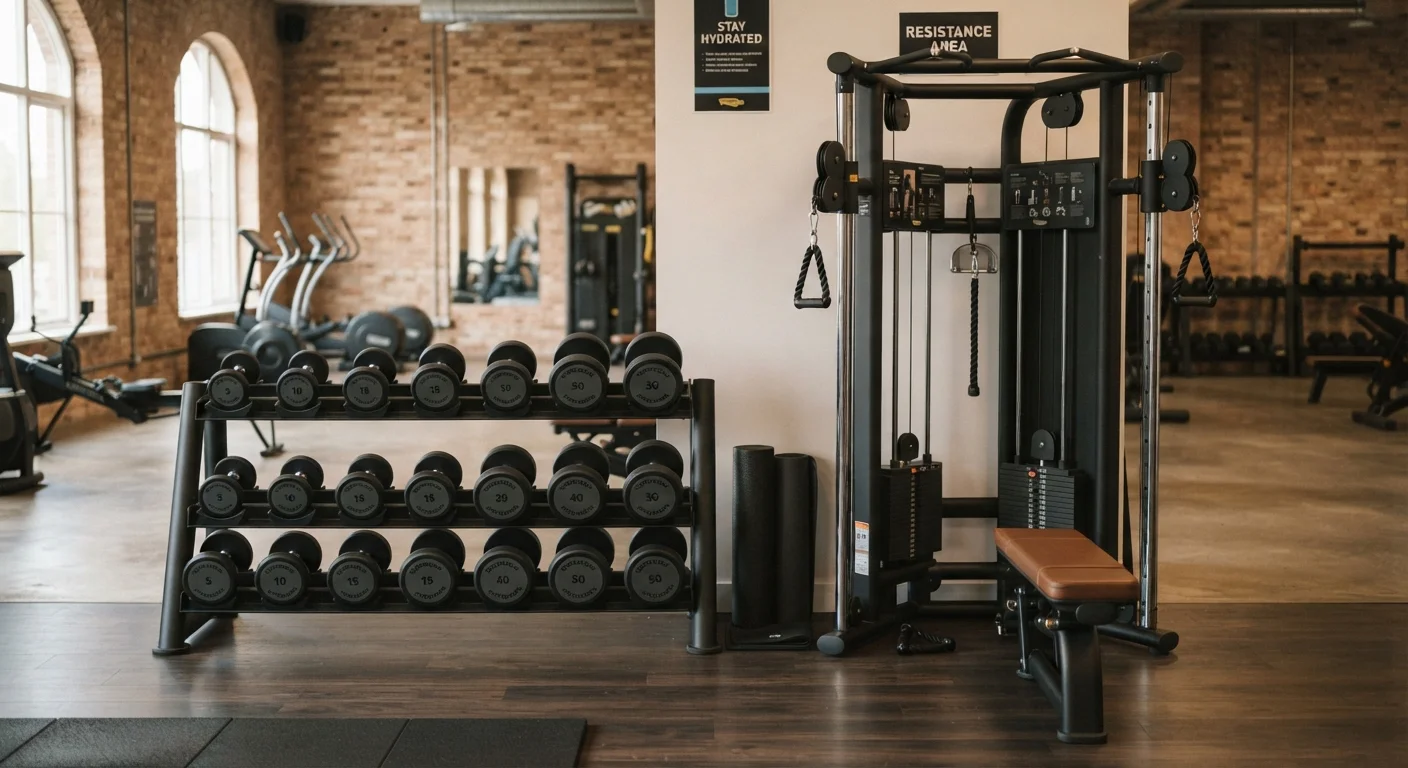
Option A
Free Weights
The versatile, functional strength-builder.
Best for: People who want to build real-world strength, improve coordination, and have some experience with basic lifting form.
Option B
Resistance Machines
The guided, accessible entry point to strength training.
Best for: Beginners, people returning from injury, or anyone who wants structured, lower-risk muscle training without a coach.
What Sets These Two Approaches Apart
Free weights — dumbbells, barbells, kettlebells — require you to control the weight through its full path. Nothing guides the movement except your muscles and coordination. Resistance machines, by contrast, move along a fixed track or cable system that constrains your range of motion and reduces the demand on stabilizing muscles.
This distinction is more meaningful than it might first appear. When you perform a dumbbell row, your rotator cuff, core, and smaller back muscles all work to keep the weight on course. On a seated row machine, much of that stabilization is handled by the equipment itself. Neither is wrong — they're simply training different things.
If you're just getting started, the beginner's guide to building fitness from scratch covers foundational concepts worth understanding before committing to either tool.
| Criterion | Free Weights | Resistance Machines |
|---|---|---|
| Stabilizer muscle activation | High — demands full-body coordination | Lower — fixed path reduces stabilizer demand |
| Injury risk for beginners | Higher without proper coaching | Lower due to guided movement |
| Learning curve | Steeper — form is critical | Gentler — self-explanatory setup |
| Exercise variety | Very high — hundreds of movements | Limited to machine's design |
| Home setup feasibility | Very practical — scalable cost | Impractical — large and expensive |
| Rehabilitation suitability | Possible but requires guidance | Often preferred — controlled range |
| Functional strength carryover | Strong — mimics real-world patterns | More limited to specific muscles |
Muscle Activation, Safety, and Learning Curve
Research consistently shows that free weight exercises tend to produce greater activation of stabilizer and synergist muscles compared to machine equivalents. A barbell squat, for example, demands coordinated effort from the glutes, hamstrings, core, and smaller postural muscles simultaneously. A leg press machine isolates the quadriceps more directly with far less demand on the rest of the chain.
That additional muscle recruitment is a strength of free weights — but it also raises the stakes for form. Poor technique under a loaded barbell creates injury risk that a machine, with its guided path, largely eliminates. For this reason, machines are a genuinely sensible starting point for beginners or anyone returning after time off.
~43%
Greater stabilizer activation with free weights
Studies published in sports science journals suggest free-weight exercises can recruit stabilizing muscles significantly more than machine equivalents for the same movement pattern.
2–3x
Sessions per week recommended for muscle strength
The American College of Sports Medicine recommends adults perform muscle-strengthening activities targeting all major muscle groups at least two to three days per week.
From a learning-curve perspective, machines win on accessibility. Most carry labels showing which muscles they target and how to adjust the seat. Free weights require either coaching, quality instruction, or careful self-education. Working with a certified personal trainer — even for a few sessions — is one of the more practical investments a new lifter can make.
It's also worth noting that even a well-designed routine has its limits. Our article on signs your exercise routine might be working against you outlines common warning signs that your approach needs adjusting, regardless of which equipment you use.
Practical Fit: Space, Cost, and Gym Access
Resistance machines are large, expensive, and largely limited to commercial gyms. A single cable station or Smith machine can cost several thousand dollars — realistic for a facility, impractical for most home setups. Free weights, in contrast, scale to almost any budget and space. A set of adjustable dumbbells and a bench can deliver a full-body workout in a spare room.
For those without gym access, this alone tips the scales. But within a gym environment, most people benefit from having both available. Many trainers recommend using compound free-weight movements — squats, deadlifts, overhead press — as the foundation of a session, then using machines for targeted isolation work at the end.
A Hybrid Approach Is Common in Practice
Many exercise physiologists and certified trainers recommend combining both tools rather than choosing one exclusively. A typical structure uses free-weight compound lifts (squats, deadlifts, presses) as the primary movements, then follows with machine-based isolation work. This allows you to build functional strength while still targeting specific muscle groups in a controlled way. There's no single correct formula — a qualified trainer can help you structure a routine that fits your goals and physical condition.
Free weights and resistance training more broadly are also only one dimension of a complete fitness picture. If you're comparing strength training to purely aerobic work, our overview of what walking can and cannot do for your health provides a useful contrast. And for those managing joint concerns or looking for gentler options, low-impact exercise options covers what suits different populations.
This article is for general informational and educational purposes only and is not a substitute for professional medical or fitness advice. Consult a qualified healthcare provider or certified fitness professional before beginning any new exercise program, particularly if you have existing health conditions or injuries.
The content on this site is for informational purposes only and is not a substitute for professional advice. Always consult a qualified professional for guidance specific to your situation.