

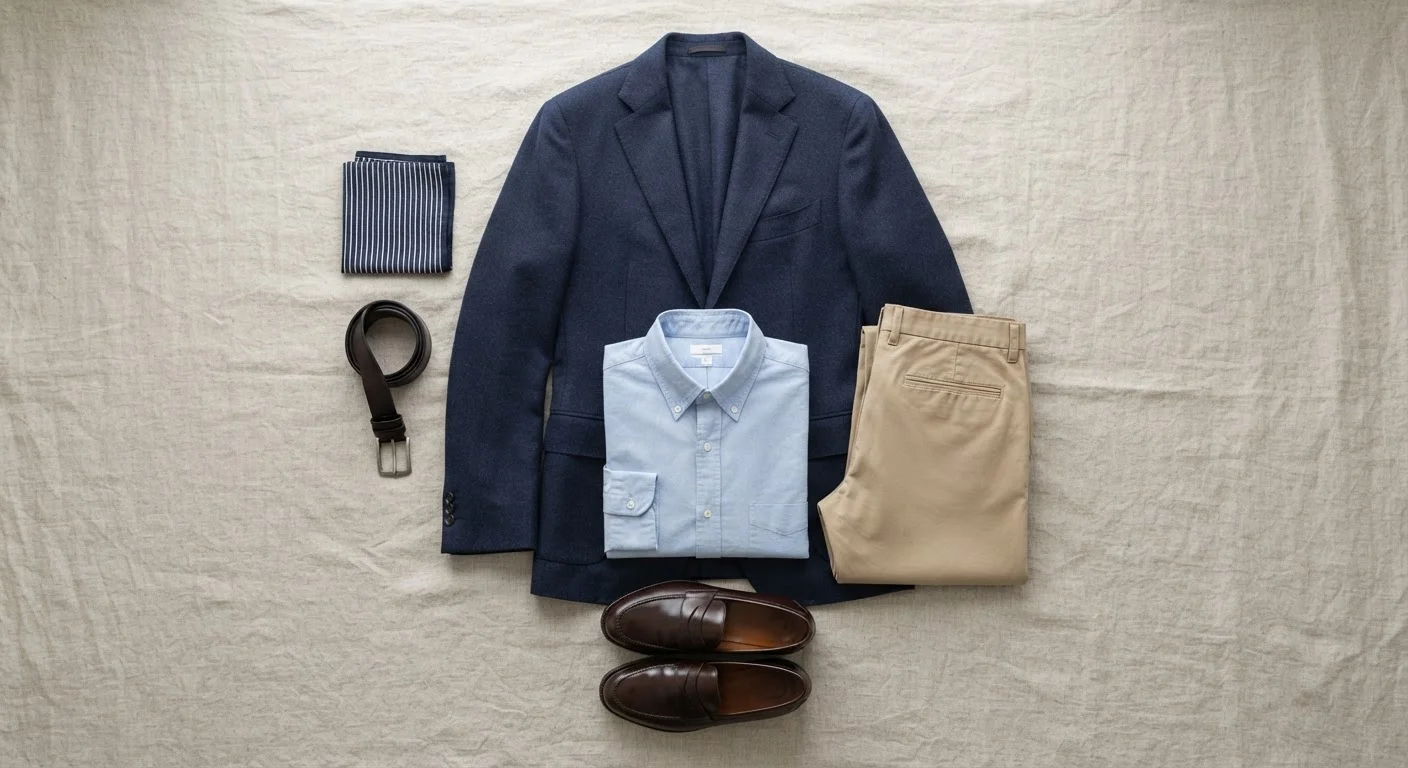
Why Dress Codes Feel So Confusing
Dress codes were once simpler — black tie meant tuxedos, casual meant jeans. Today, the middle ground has fractured into overlapping terms that even confident dressers misread. Showing up underdressed to a job interview or overdressed to a casual dinner both carry social costs. The good news: once you understand what each code is actually signaling, the guesswork disappears.
| Most formal common code | Business Formal |
| Most misunderstood code | Business Casual |
| Evening semi-formal standard | Cocktail Attire |
| Key factor across all codes | Fit and cleanliness |
| Default when code is unclear | Dress one level more formal |
Most dress code confusion comes from assuming these are rigid rules rather than contextual signals. A dress code communicates the formality level of an event or workplace — not a precise uniform. Your job is to match that level while expressing your own style within it.
The Four Most Common Dress Codes, Defined
Business Formal — The most structured office dress code. For men, this typically means a full suit in a neutral color (navy, charcoal, or black), a dress shirt, tie, and leather dress shoes. For women, a tailored suit, structured dress, or skirt suit in conservative cuts. Accessories should be minimal and polished.
Business Casual — The most widely misunderstood code. It does not mean casual with a blazer thrown on. Think dress trousers or chinos, collared shirts, blouses, or knit tops. Blazers are welcome but not required. Clean leather shoes or structured flats work well. Jeans are typically out unless explicitly permitted by the workplace culture.
Smart Casual — More relaxed than business casual but still intentional. Well-fitted dark jeans or trousers, a neat top, clean sneakers or loafers, and a light jacket or cardigan all fit here. The emphasis is on fit and cleanliness rather than formality. Smart casual is common for casual dinners, social gatherings, and non-client-facing office days.
Cocktail Attire — Evening-appropriate and semi-formal. Knee-length dresses or dressy separates for women; a dark suit or sport coat with dress trousers for men. This is the dress code for weddings, holiday parties, and formal celebrations that stop short of black tie.
Business Formal
The most structured workplace dress code, requiring full suits, dress shirts or blouses, and polished dress shoes. Best suited to client-facing roles, courtrooms, or formal presentations.
Business Casual
A mid-level professional dress code that favors tailored trousers, collared shirts, and structured shoes without requiring a full suit. Jeans are generally not appropriate unless the workplace explicitly allows them.
Smart Casual
A relaxed but intentional dress code emphasizing good fit and clean presentation over formality. Includes well-fitted jeans, neat tops, and polished casual shoes or sneakers.
Cocktail Attire
A semi-formal evening dress code typically calling for knee-length dresses or dressy separates for women, and a dark suit or blazer with dress trousers for men.
Formality Level
The degree of dressiness expected in a given context, ranging from casual to black tie. Dress codes are signals about the appropriate formality level, not strict uniform requirements.
Understanding where these four codes sit on the spectrum — and what separates them — removes most decision paralysis. See our guide to why outfits don't always come together if the mechanics of putting looks together still feel elusive.
How to Dress for Any Code on Any Budget
You don't need a vast wardrobe to navigate multiple dress codes. A handful of versatile pieces — a well-fitted blazer, dark trousers or chinos, two or three quality tops, clean leather or leather-look shoes — can be combined to cover business casual through cocktail attire with thoughtful styling.
Fit matters more than price. A moderately priced garment that fits precisely reads as more polished than an expensive one that doesn't. When building toward a dress code, prioritize alterations on the pieces you already own before adding new items.
Color also plays a significant role in whether an outfit reads as the intended formality level. Neutral foundations — navy, gray, black, white — translate most reliably across codes. For guidance on building outfits that feel cohesive, our piece on color coordination principles offers a practical framework. And if you're thinking seasonally, dressing through seasons without rebuilding your wardrobe explains how transitional pieces stretch your existing clothes further.
When a dress code is ambiguous, default to the slightly more formal interpretation. It is almost always easier to dress down a polished look than to elevate an underdressed one. Removing a blazer, rolling sleeves, or swapping structured shoes for clean sneakers are all easy adjustments — the reverse rarely works as smoothly.
Finally, pattern choices affect formality. Solid colors and subtle textures read as more formal; bold prints and mixed patterns read as more casual. If you want to experiment with mixing patterns within a smart casual or cocktail context, our article on when pattern mixing actually works covers the logic behind combinations that look intentional rather than accidental.
The content on this site is for informational purposes only and is not a substitute for professional advice. Always consult a qualified professional for guidance specific to your situation.